LESSON 1 OF 12 · 120 MINUTES
Variables, units and expressions
STEP 1 OF 6
Your objective
Evaluate a formula with signed numbers and explain each quantity and unit.
STEP 2 OF 6
The idea
Entry diagnostic (suggested 8/10, not exclusion): 1. Compute −7+12. 2. Compute 3/4+1/8. 3. Compute (2/3)×9. 4. Compute 18÷(−3). 5. Simplify the ratio12:18. 6. Convert90 minutes to hours. 7. Find20% of45. 8. A value rises from40 to50. Find percentage increase. 9. Compute 6−2×2. 10. At3litres/hour, how much in2hours? Keep the attempt, then check the answers. Revisit signed-number arithmetic for1/4, fractions for2/3, ratios/units for5/6/10, percent baselines for7/8 and precedence for9. Begin when you can explain corrections, not merely recognise the keys.
A variable names a quantity that may change. A formula specifies how quantities are related; it is not a claim that every numerical input is meaningful. Start a calculation with a small dictionary: symbol, meaning, unit and allowed values. In a fictional hire model C=12+5h, h is whole hours from 0 through 8, 12 is a fixed charge in dollars and 5 is dollars per hour. The term 5h is dollars, so adding 12 dollars makes sense.
An expression such as 3x+2 has a value once x is supplied. An equation such as 3x+2=17 adds a statement of equality. Evaluation substitutes a known input; solving an equation searches for unknown inputs. Keeping these tasks separate prevents an unexplained number from becoming an answer to the wrong question.
Use parentheses around a substituted negative number. Multiplication and division come before addition and subtraction; equal-precedence operations proceed left to right. Thus 4+3×2 is 10, while (4+3)×2 is 14. A fraction bar groups its entire numerator and denominator. Write (x+6)/3 rather than an ambiguous x+6/3 if the sum is to be divided.
Units provide an independent error check. Two hours is 120 minutes, not 2 minutes. A rate stated per hour needs hours as its multiplier, or an explicitly converted rate. A numerically correct computation with incompatible units answers no coherent physical question. All money and service cases in this course are invented, not actual offers.
STEP 3 OF 6
Two worked examples: reconstruct every step
Starting point
Evaluate C=12+5h for h=3 hours and h=0 hours.
A checkable approach
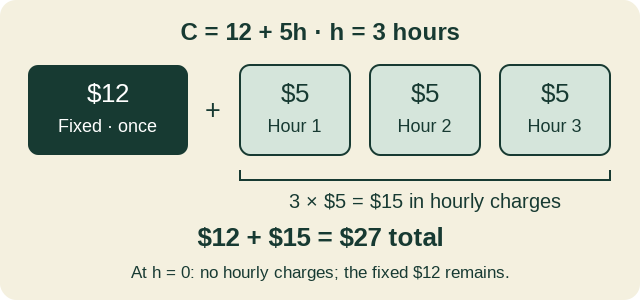
At h=3, C=12+5×3=27 dollars. At zero, C=12 dollars because selecting this fictional plan incurs its fixed charge even without use. The coefficient 5 is not the three-hour total.
Second worked example — Evaluate 2x²−3x when x=−2. Substitute as 2(−2)²−3(−2). The square is 4; the two terms are 8 and +6, so the result is 14. By contrast −2² means −(2²)=−4 under ordinary precedence; parentheses distinguish these expressions.
Read the picture, then change one input
Keep C = 12 + 5h and the allowed whole-hour inputs 0 through 8. At h = 3, the picture shows 12 + 5 + 5 + 5 = 27 dollars. At h = 2, remove one hourly box, not the fixed charge: C = 12 + 5 × 2 = 22 dollars. Check the change: 27 − 22 = 5 dollars for one extra hour. The fixed charge stays 12 dollars in both cases.
Sketch & check
Before opening the feedback: sketch the boxes for h = 4. What is the total, and which part stays unchanged? Explain why 68 dollars is not the answer.
Show diagram-practice feedback
The total is 32 dollars: 12 + 5 × 4 = 12 + 20. Draw one fixed-charge box and four hourly boxes. The fixed 12 dollars stays unchanged. A result of 68 uses (12 + 5) × 4 and charges the fixed fee four times. Check by comparing with h = 3: 32 − 27 = 5 dollars, exactly one hourly charge.
Optional video & watching prompt
Khan Academy — Evaluating an expression with one variable (video) ↗ (new tab)
Optional external video with a transcript link on Khan Academy. Watch for the substitution step, then return and explain why the fixed charge is added once. This lesson and its feedback are complete without the video. External site policies apply; nothing is embedded or loaded here.
Link checked 2026-10-30.
STEP 4 OF 6
Try it yourself
First solve on paper or in a local document; retain your reasoning before opening the worked answer. Problem 1: Evaluate 8+4t for t=5 and t=0. Problem 2: Evaluate (a+9)/3 at a=−3. Problem 3: A rate is 6 litres/hour. Find volume in 30 minutes. Problem 4: Explain the error in 2+3×4=20; then give parentheses that make 20 correct. Check 1: What is 12+5×3? A. 51 B. 27 C. 20 D. 17 Check 2: Which unit belongs to the 5 in C=12+5h? A. Hours B. Dollars C. Dollars per hour D. No unit Check 3: What is (−3)²? A. −9 B. 6 C. −6 D. 9 Practical portfolio: Create a fictional cost formula with one fixed charge and one usage rate. Define all units and a finite whole-number domain. Evaluate at zero and two positive inputs. Explain a unit mistake a reader could make. Self-review /10: dictionary 3, three evaluations 3, order-of-operations explanation 2, corrected unit mistake 2.
Fictional exercise · prewritten feedback, no live AI grading.
Write your answer on paper or in your own notes, then compare the options and worked answer.
Check 1: What is 12+5×3?
A. 51
Not correct. That evaluates (12+5)×3, a different expression.
B. 27
Correct. Multiplication gives 15, then addition gives 27.
C. 20
Not correct. Adding the three numbers ignores multiplication.
D. 17
Not correct. That omits the factor 3.
Check 2: Which unit belongs to the 5 in C=12+5h?
A. Hours
Not correct. That is the unit of h.
B. Dollars
Not correct. The product has dollars; the coefficient is a rate.
C. Dollars per hour
Correct. Multiplying this rate by hours gives dollars.
D. No unit
Not correct. Ignoring units hides conversion mistakes.
Check 3: What is (−3)²?
A. −9
Not correct. The negative sign is inside the squared parentheses.
B. 6
Not correct. Squaring multiplies the number by itself, not by two.
C. −6
Not correct. Neither doubling nor a retained negative sign represents the square.
D. 9
Correct. The product of two negative threes is positive nine.
STEP 5 OF 6
Worked answer & self-check
Entry diagnostic answers: 1. 5: starting at −7 and adding12 crosses zero by5. 2. 7/8: use denominator8, so6/8+1/8=7/8. 3. 6: divide9 by3 then multiply by2. 4. −6: a positive divided by a negative is negative. 5. 2:3: divide both parts by6. 6. 1.5hours:90/60=1.5. 7. 9:0.20×45=9. 8. 25%: change10 divided by original40 is0.25. 9. 2: multiplication precedes subtraction. 10. 6litres: rate×time=3×2. Practice 1: 8+4×5=28 and 8+4×0=8. The constant survives zero input. Practice 2: (−3+9)/3=6/3=2; dividing only 9 by 3 would be a different expression. Practice 3: 30 minutes is 0.5 hour, so 6×0.5=3 litres; 180 would mix hours and minutes. Practice 4: Multiplication first gives 2+12=14. The different expression (2+3)×4=20 is valid. Check 1: What is 12+5×3? A. 51 — Not correct. That evaluates (12+5)×3, a different expression. B. 27 — Correct. Multiplication gives 15, then addition gives 27. C. 20 — Not correct. Adding the three numbers ignores multiplication. D. 17 — Not correct. That omits the factor 3. Check 2: Which unit belongs to the 5 in C=12+5h? A. Hours — Not correct. That is the unit of h. B. Dollars — Not correct. The product has dollars; the coefficient is a rate. C. Dollars per hour — Correct. Multiplying this rate by hours gives dollars. D. No unit — Not correct. Ignoring units hides conversion mistakes. Check 3: What is (−3)²? A. −9 — Not correct. The negative sign is inside the squared parentheses. B. 6 — Not correct. Squaring multiplies the number by itself, not by two. C. −6 — Not correct. Neither doubling nor a retained negative sign represents the square. D. 9 — Correct. The product of two negative threes is positive nine. Portfolio self-review: Create a fictional cost formula with one fixed charge and one usage rate. Define all units and a finite whole-number domain. Evaluate at zero and two positive inputs. Explain a unit mistake a reader could make. Self-review /10: dictionary 3, three evaluations 3, order-of-operations explanation 2, corrected unit mistake 2. Keep an original attempt and a dated correction explaining the first step that changed. No teacher or AI is grading this work automatically.
Compare your answer
- Defines variables, units and permitted inputs before calculating.
- Shows reversible steps or explains why a restriction or special case is needed.
- Checks results in the original statement, including a boundary or counterexample.
- Explains decisions in words; preserves a correction rather than replacing the first attempt silently.
Give yourself one check for each point your work meets. Revise any missing piece. This is a self-check, not a score sent to a teacher.
STEP 6 OF 6
Recap & next step
- Name quantities before substituting.
- Group negative inputs and numerators explicitly.
- Check units as well as arithmetic.
Next: Distributivity and equivalent forms. Bring one explained correction from this lesson.