Algebra & Functions — full text

12 original lessons · about 1800 minutes · self-paced

Course details & full text

Twelve original foundation lessons: quantities, equations, functions and checkable models.

Everyday Numbers outcomes or equivalent signed-number, fraction, ratio, unit and percentage skills. Begin with the supplied 10-item diagnostic; suggested 8/10 with targeted revision, not exclusion. Paper and pencil suffice; a calculator or existing spreadsheet is optional. No account, paid tool or private data required.

Independent non-credit short foundation course. Twelve lessons with original examples, 48 solved practice problems, 36 explained checks and a modelling project. Proposed total learner workload: 30 hours, including practice and revision; not a measured completion time or academic credit. Self-review records do not certify competence.

  • Evaluate expressions with consistent units and explicit domains.
  • Simplify equivalent expressions and preserve restrictions.
  • Solve and check linear equations, inequalities and small systems.
  • Interpret functions, tables, slopes and model limits.
  • Use exponents and introductory logarithms to reason about growth.
  • Analyse simple quadratic roots and turning points.
  • Compare three fictional plans and document assumptions, checks and revisions.

LESSON 1 OF 12 · 120 MINUTES

Variables, units and expressions

STEP 1 OF 6

Your objective

Evaluate a formula with signed numbers and explain each quantity and unit.

STEP 2 OF 6

The idea

Entry diagnostic (suggested 8/10, not exclusion): 1. Compute −7+12. 2. Compute 3/4+1/8. 3. Compute (2/3)×9. 4. Compute 18÷(−3). 5. Simplify the ratio12:18. 6. Convert90 minutes to hours. 7. Find20% of45. 8. A value rises from40 to50. Find percentage increase. 9. Compute 6−2×2. 10. At3litres/hour, how much in2hours? Keep the attempt, then check the answers. Revisit signed-number arithmetic for1/4, fractions for2/3, ratios/units for5/6/10, percent baselines for7/8 and precedence for9. Begin when you can explain corrections, not merely recognise the keys.

A variable names a quantity that may change. A formula specifies how quantities are related; it is not a claim that every numerical input is meaningful. Start a calculation with a small dictionary: symbol, meaning, unit and allowed values. In a fictional hire model C=12+5h, h is whole hours from 0 through 8, 12 is a fixed charge in dollars and 5 is dollars per hour. The term 5h is dollars, so adding 12 dollars makes sense.

An expression such as 3x+2 has a value once x is supplied. An equation such as 3x+2=17 adds a statement of equality. Evaluation substitutes a known input; solving an equation searches for unknown inputs. Keeping these tasks separate prevents an unexplained number from becoming an answer to the wrong question.

Use parentheses around a substituted negative number. Multiplication and division come before addition and subtraction; equal-precedence operations proceed left to right. Thus 4+3×2 is 10, while (4+3)×2 is 14. A fraction bar groups its entire numerator and denominator. Write (x+6)/3 rather than an ambiguous x+6/3 if the sum is to be divided.

Units provide an independent error check. Two hours is 120 minutes, not 2 minutes. A rate stated per hour needs hours as its multiplier, or an explicitly converted rate. A numerically correct computation with incompatible units answers no coherent physical question. All money and service cases in this course are invented, not actual offers.

STEP 3 OF 6

Two worked examples: reconstruct every step

Starting point

Evaluate C=12+5h for h=3 hours and h=0 hours.

A checkable approach

At h=3, C=12+5×3=27 dollars. At zero, C=12 dollars because selecting this fictional plan incurs its fixed charge even without use. The coefficient 5 is not the three-hour total.

Second worked example — Evaluate 2x²−3x when x=−2. Substitute as 2(−2)²−3(−2). The square is 4; the two terms are 8 and +6, so the result is 14. By contrast −2² means −(2²)=−4 under ordinary precedence; parentheses distinguish these expressions.
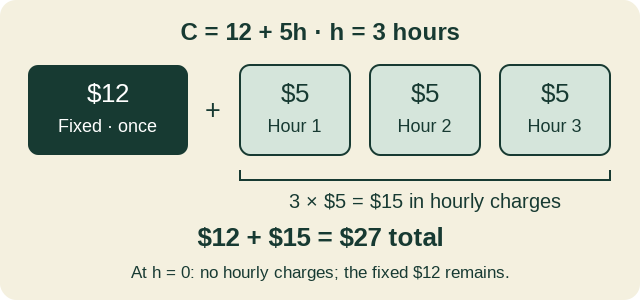
Cost at 3 hours: a fixed 12 dollars plus three 5-dollar hourly charges equals 27 dollars.
Read the parts, not the box widths: this diagram is not drawn to scale. The fixed charge appears once; each extra hour adds one 5-dollar charge.

Read the picture, then change one input

Keep C = 12 + 5h and the allowed whole-hour inputs 0 through 8. At h = 3, the picture shows 12 + 5 + 5 + 5 = 27 dollars. At h = 2, remove one hourly box, not the fixed charge: C = 12 + 5 × 2 = 22 dollars. Check the change: 27 − 22 = 5 dollars for one extra hour. The fixed charge stays 12 dollars in both cases.

Sketch & check

Before opening the feedback: sketch the boxes for h = 4. What is the total, and which part stays unchanged? Explain why 68 dollars is not the answer.

Show diagram-practice feedback

The total is 32 dollars: 12 + 5 × 4 = 12 + 20. Draw one fixed-charge box and four hourly boxes. The fixed 12 dollars stays unchanged. A result of 68 uses (12 + 5) × 4 and charges the fixed fee four times. Check by comparing with h = 3: 32 − 27 = 5 dollars, exactly one hourly charge.

Optional video & watching prompt

Khan Academy — Evaluating an expression with one variable (video) ↗ (new tab)

Optional external video with a transcript link on Khan Academy. Watch for the substitution step, then return and explain why the fixed charge is added once. This lesson and its feedback are complete without the video. External site policies apply; nothing is embedded or loaded here.

Link checked 2026-10-30.

STEP 4 OF 6

Try it yourself

First solve on paper or in a local document; retain your reasoning before opening the worked answer. Problem 1: Evaluate 8+4t for t=5 and t=0. Problem 2: Evaluate (a+9)/3 at a=−3. Problem 3: A rate is 6 litres/hour. Find volume in 30 minutes. Problem 4: Explain the error in 2+3×4=20; then give parentheses that make 20 correct. Check 1: What is 12+5×3? A. 51 B. 27 C. 20 D. 17 Check 2: Which unit belongs to the 5 in C=12+5h? A. Hours B. Dollars C. Dollars per hour D. No unit Check 3: What is (−3)²? A. −9 B. 6 C. −6 D. 9 Practical portfolio: Create a fictional cost formula with one fixed charge and one usage rate. Define all units and a finite whole-number domain. Evaluate at zero and two positive inputs. Explain a unit mistake a reader could make. Self-review /10: dictionary 3, three evaluations 3, order-of-operations explanation 2, corrected unit mistake 2.

Fictional exercise · prewritten feedback, no live AI grading.

Write your answer on paper or in your own notes, then compare the options and worked answer.

Check 1: What is 12+5×3?

A. 51

Not correct. That evaluates (12+5)×3, a different expression.

B. 27

Correct. Multiplication gives 15, then addition gives 27.

C. 20

Not correct. Adding the three numbers ignores multiplication.

D. 17

Not correct. That omits the factor 3.

Check 2: Which unit belongs to the 5 in C=12+5h?

A. Hours

Not correct. That is the unit of h.

B. Dollars

Not correct. The product has dollars; the coefficient is a rate.

C. Dollars per hour

Correct. Multiplying this rate by hours gives dollars.

D. No unit

Not correct. Ignoring units hides conversion mistakes.

Check 3: What is (−3)²?

A. −9

Not correct. The negative sign is inside the squared parentheses.

B. 6

Not correct. Squaring multiplies the number by itself, not by two.

C. −6

Not correct. Neither doubling nor a retained negative sign represents the square.

D. 9

Correct. The product of two negative threes is positive nine.

STEP 5 OF 6

Worked answer & self-check

Entry diagnostic answers: 1. 5: starting at −7 and adding12 crosses zero by5. 2. 7/8: use denominator8, so6/8+1/8=7/8. 3. 6: divide9 by3 then multiply by2. 4. −6: a positive divided by a negative is negative. 5. 2:3: divide both parts by6. 6. 1.5hours:90/60=1.5. 7. 9:0.20×45=9. 8. 25%: change10 divided by original40 is0.25. 9. 2: multiplication precedes subtraction. 10. 6litres: rate×time=3×2. Practice 1: 8+4×5=28 and 8+4×0=8. The constant survives zero input. Practice 2: (−3+9)/3=6/3=2; dividing only 9 by 3 would be a different expression. Practice 3: 30 minutes is 0.5 hour, so 6×0.5=3 litres; 180 would mix hours and minutes. Practice 4: Multiplication first gives 2+12=14. The different expression (2+3)×4=20 is valid. Check 1: What is 12+5×3? A. 51 — Not correct. That evaluates (12+5)×3, a different expression. B. 27 — Correct. Multiplication gives 15, then addition gives 27. C. 20 — Not correct. Adding the three numbers ignores multiplication. D. 17 — Not correct. That omits the factor 3. Check 2: Which unit belongs to the 5 in C=12+5h? A. Hours — Not correct. That is the unit of h. B. Dollars — Not correct. The product has dollars; the coefficient is a rate. C. Dollars per hour — Correct. Multiplying this rate by hours gives dollars. D. No unit — Not correct. Ignoring units hides conversion mistakes. Check 3: What is (−3)²? A. −9 — Not correct. The negative sign is inside the squared parentheses. B. 6 — Not correct. Squaring multiplies the number by itself, not by two. C. −6 — Not correct. Neither doubling nor a retained negative sign represents the square. D. 9 — Correct. The product of two negative threes is positive nine. Portfolio self-review: Create a fictional cost formula with one fixed charge and one usage rate. Define all units and a finite whole-number domain. Evaluate at zero and two positive inputs. Explain a unit mistake a reader could make. Self-review /10: dictionary 3, three evaluations 3, order-of-operations explanation 2, corrected unit mistake 2. Keep an original attempt and a dated correction explaining the first step that changed. No teacher or AI is grading this work automatically.

Compare your answer

  • Defines variables, units and permitted inputs before calculating.
  • Shows reversible steps or explains why a restriction or special case is needed.
  • Checks results in the original statement, including a boundary or counterexample.
  • Explains decisions in words; preserves a correction rather than replacing the first attempt silently.

Give yourself one check for each point your work meets. Revise any missing piece. This is a self-check, not a score sent to a teacher.

STEP 6 OF 6

Recap & next step

  • Name quantities before substituting.
  • Group negative inputs and numerators explicitly.
  • Check units as well as arithmetic.

Next: Distributivity and equivalent forms. Bring one explained correction from this lesson.
Next lesson: Distributivity and equivalent forms →

LESSON 2 OF 12 · 120 MINUTES

Distributivity and equivalent forms

STEP 1 OF 6

Your objective

Expand, collect and factor expressions while preserving their value.

STEP 2 OF 6

The idea

Two expressions are equivalent on a stated domain when they give the same result for every permitted input. Checking a few inputs may reveal a false claim but cannot by itself prove equivalence for all real numbers. Algebraic properties provide the justification: a(b+c)=ab+ac applies multiplication to both terms, not just the first.

A term includes its sign. In 5x−2+3x+7 the x terms combine to 8x and the constant terms to 5, giving 8x+5. You cannot combine 3x+2 into 5x because 2 is not two copies of x. Nor is x²+x equal to 2x²; these powers behave differently as x changes.

Subtraction of a grouped expression means addition of its negative. Thus 7−(2x−3)=7−2x+3=10−2x. Write the negative multiplier as −1 when in doubt. Factoring reverses expansion: 6x+9=3(2x+3). Equivalent forms serve different purposes; an expanded form helps combine terms, while a factored form can expose repeated quantities.

Division needs restrictions. (x²−x)/x=x−1 only when x≠0; the original expression is undefined at zero. Cancelling a factor is not deleting a term from a sum. In (x+6)/x, the x is not a factor of the entire numerator, so the result is not 6. Always preserve restrictions introduced by the original expression.

STEP 3 OF 6

Two worked examples: reconstruct every step

Starting point

Simplify 3(2x−4)+5x+1.

A checkable approach

Distribute to obtain 6x−12+5x+1. Combine like terms: 11x−11. At x=2 the original is 3(0)+10+1=11 and the simplified form is 22−11=11. The property proves equivalence; the substitution checks arithmetic.

Second worked example — Critique 4−2(x−3)=4−2x−6. Multiplication gives −2(x−3)=−2x+6, not −2x−6. The corrected form is 10−2x. At x=0, the original gives 10 while the incorrect form gives −2, a counterexample.

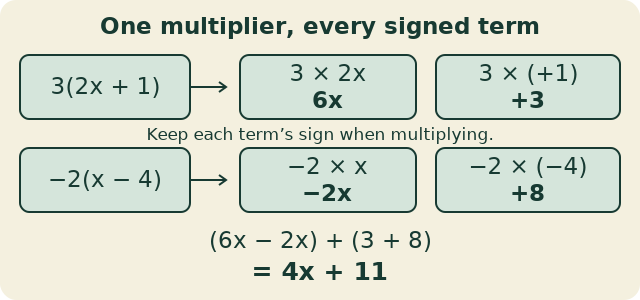
Distribute 3 to 2x and +1, giving 6x and +3. Distribute −2 to x and −4, giving −2x and +8. Then combine like terms to get 4x + 11.
Each product applies the multiplier to one signed term. The second multiplier is −2, not 2; its product with −4 is +8. Read the labels, not the box sizes.

Track the sign in both products

Simplify 3(2x + 1) − 2(x − 4). Treat the subtraction as the multiplier −2. The first pair of products gives 3 × 2x + 3 × 1 = 6x + 3. The second gives (−2) × x + (−2) × (−4) = −2x + 8. Now combine like terms: 6x + 3 − 2x + 8 = 4x + 11. At x = −1, the original is 3(−1) − 2(−5) = −3 + 10 = 7; the simplified form is 4(−1) + 11 = 7. Distribution proves equivalence for every real x; this substitution checks the arithmetic, not the whole identity.

Sketch & check

Sketch two branches for each multiplier in 2(3y − 2) − (y + 5). Write an equivalent simplified form, then check it at y = 3. A learner gets 5y + 1: which sign went wrong?

Show diagram-practice feedback

The second multiplier is −1. Expanding gives 6y − 4 − y − 5, so the equivalent form is 5y − 9. At y = 3, the original is 2(9 − 2) − (3 + 5) = 14 − 8 = 6, matching 15 − 9 = 6. The incorrect 5y + 1 comes from changing −(y + 5) into −y + 5; the +5 must also be multiplied by −1. It gives 16 at y = 3, so that input disproves it.

Optional video & watching prompt

Khan Academy — Distributive property with variables (video) ↗ (new tab)

Optional external video. Watch for the multiplier reaching every term, then return and explain the two products from −2 in our diagram. The publisher page lists a transcript; playback and captions were not checked. This lesson is complete without the video. External site policies apply; nothing is embedded or loaded here.

Link checked 2026-10-30.

STEP 4 OF 6

Try it yourself

First solve on paper or in a local document; retain your reasoning before opening the worked answer. Problem 1: Expand 5(y+2)−3y. Problem 2: Factor 8a+12 using the greatest positive integer common factor. Problem 3: Simplify 9−(3z+4). Problem 4: Give a counterexample to 2x+3=5x; explain why x=1 is not enough to test it. Check 1: Which equals 2(x+5)? A. 2x+5 B. 2x+10 C. 7x D. 10x Check 2: Which equals 7−(x−2)? A. 5−x B. 9+x C. 9−x D. 5+x Check 3: When does (x²−x)/x equal x−1? A. For every real x including zero B. Only at x=1 C. Never D. For x≠0 Practical portfolio: Write an incorrect expansion and a corrected one. Explain exactly which property was misused. Provide two checks including zero and factor the corrected expression if possible. /10: valid original identity 3, error diagnosis 3, checks 2, restriction/limits 2.

Fictional exercise · prewritten feedback, no live AI grading.

Write your answer on paper or in your own notes, then compare the options and worked answer.

Check 1: Which equals 2(x+5)?

A. 2x+5

Not correct. The 5 also needs multiplication by 2.

B. 2x+10

Correct. Distribute to both terms.

C. 7x

Not correct. A constant cannot be folded into the x coefficient.

D. 10x

Not correct. Multiplication does not replace the addition inside.

Check 2: Which equals 7−(x−2)?

A. 5−x

Not correct. The minus before parentheses changes −2 to +2.

B. 9+x

Not correct. The x term remains negative.

C. 9−x

Correct. Subtract x and add 2.

D. 5+x

Not correct. Both signs were handled incorrectly.

Check 3: When does (x²−x)/x equal x−1?

A. For every real x including zero

Not correct. The original denominator is zero at zero.

B. Only at x=1

Not correct. Factoring works for all nonzero x.

C. Never

Not correct. Factor x from the numerator and cancel for nonzero x.

D. For x≠0

Correct. The identity retains the original denominator restriction.

STEP 5 OF 6

Worked answer & self-check

Practice 1: 5y+10−3y=2y+10; both y terms have the same power. Practice 2: 8a+12=4(2a+3). Expanding the factors recovers both terms. Practice 3: 9−3z−4=5−3z; the negative applies to 4 as well. Practice 4: At x=0 the sides are 3 and 0. At x=1 they happen to agree, so that single successful check cannot prove a general identity. Check 1: Which equals 2(x+5)? A. 2x+5 — Not correct. The 5 also needs multiplication by 2. B. 2x+10 — Correct. Distribute to both terms. C. 7x — Not correct. A constant cannot be folded into the x coefficient. D. 10x — Not correct. Multiplication does not replace the addition inside. Check 2: Which equals 7−(x−2)? A. 5−x — Not correct. The minus before parentheses changes −2 to +2. B. 9+x — Not correct. The x term remains negative. C. 9−x — Correct. Subtract x and add 2. D. 5+x — Not correct. Both signs were handled incorrectly. Check 3: When does (x²−x)/x equal x−1? A. For every real x including zero — Not correct. The original denominator is zero at zero. B. Only at x=1 — Not correct. Factoring works for all nonzero x. C. Never — Not correct. Factor x from the numerator and cancel for nonzero x. D. For x≠0 — Correct. The identity retains the original denominator restriction. Portfolio self-review: Write an incorrect expansion and a corrected one. Explain exactly which property was misused. Provide two checks including zero and factor the corrected expression if possible. /10: valid original identity 3, error diagnosis 3, checks 2, restriction/limits 2. Keep an original attempt and a dated correction explaining the first step that changed. No teacher or AI is grading this work automatically.

Compare your answer

  • Defines variables, units and permitted inputs before calculating.
  • Shows reversible steps or explains why a restriction or special case is needed.
  • Checks results in the original statement, including a boundary or counterexample.
  • Explains decisions in words; preserves a correction rather than replacing the first attempt silently.

Give yourself one check for each point your work meets. Revise any missing piece. This is a self-check, not a score sent to a teacher.

STEP 6 OF 6

Recap & next step

  • Distribute to every term.
  • A counterexample disproves a general claim.
  • Equivalent simplification must retain domain restrictions.

Next: Solve linear equations and check. Bring one explained correction from this lesson.
Next lesson: Solve linear equations and check →

LESSON 3 OF 12 · 120 MINUTES

Solve linear equations and check

STEP 1 OF 6

Your objective

Solve linear equations, distinguish identities from contradictions, and verify in the original equation.

STEP 2 OF 6

The idea

An equation states that two expressions are equal. A valid solving step preserves exactly the same solutions. Adding or subtracting the same quantity on both sides, or multiplying or dividing both sides by the same nonzero constant, preserves equality. “Move and change the sign” is shorthand, not the reason: describe the operation on both sides.

Collect the variable terms and constants until the equation has the form ax=b. If a is nonzero, divide by a. If a=0, stop and interpret: 0=0 is true for every allowed input, whereas 0=5 is false for every input. Neither case justifies division by zero. An equation can have one solution, no solution or infinitely many solutions.

Clear a numeric denominator by multiplying the whole equation by a common multiple. Parentheses matter: 3×((x+2)/3)=x+2. Check your answer in the original equation, not just the last simplified line. A subtraction error may have produced a different equation whose answer is internally consistent but wrong for the original.

In an application the algebraic solution must also satisfy the domain. A fictional package size cannot be −4 or 2.5 if only whole nonnegative packages are allowed. Rejecting an out-of-domain result does not mean the algebra failed; it may mean no feasible purchase meets the exact condition.

STEP 3 OF 6

Two worked examples: reconstruct every step

Starting point

Solve 4x+7=2x+19.

A checkable approach

Subtract 2x from both sides: 2x+7=19. Subtract 7: 2x=12. Divide by 2: x=6. Check original: 4×6+7=31 and 2×6+19=31.

Second worked example — Compare 3(x+2)=3x+6 with 3(x+2)=3x+8. Expanding the first yields 3x+6=3x+6; subtracting gives 0=0, so every real x works. The second gives 6=8 after subtracting 3x, so no real x works. Do not report x=0 in either case.

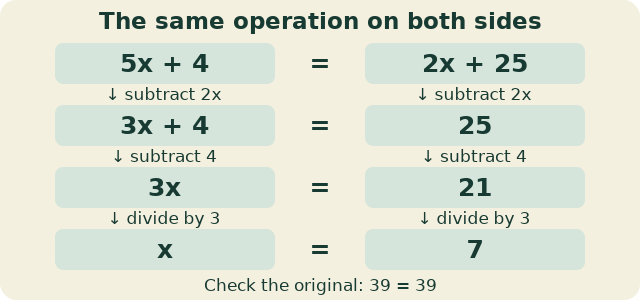
Solve 5x + 4 = 2x + 25. Subtract 2x from both sides to get 3x + 4 = 25; subtract 4 from both sides to get 3x = 21; divide both sides by 3 to get x = 7.
Follow both columns together: the same operation is applied to the entire left side and the entire right side. Every row has the same solution.

Keep equality while removing the extra terms

Solve 5x + 4 = 2x + 25 over the real numbers. Subtract 2x from both sides: 5x + 4 − 2x = 2x + 25 − 2x, so 3x + 4 = 25. Subtract 4 from both sides to get 3x = 21. Divide both sides by the nonzero number 3 to get x = 7. Check in the original equation: 5 × 7 + 4 = 39 and 2 × 7 + 25 = 39. Both sides agree. The diagram is an equality-preserving chain, not permission to erase a term from only one side.

Sketch & check

Make a two-column chain for 7x − 5 = 3x + 19. Label the operation on both sides at every step, then check your solution in the original equation. Why must you add 5 rather than subtract 5 after collecting the x terms?

Show diagram-practice feedback

Subtract 3x from both sides: 4x − 5 = 19. Add 5 to both sides: 4x = 24. Divide both sides by 4: x = 6. Original-equation check: 7 × 6 − 5 = 37 and 3 × 6 + 19 = 37. Adding 5 cancels the −5; subtracting 5 would leave 4x − 10 = 14 and would not isolate 4x. Subtracting 5 is still a valid operation if done to both sides, but it does not undo the −5.

Optional video & watching prompt

Khan Academy — Intro to equations with variables on both sides (video) ↗ (new tab)

Optional external video. Pause after each operation and name what was done to both sides; then return to check x = 7 in our original equation. The publisher page lists a transcript; playback and captions were not checked. This lesson is complete without the video. External site policies apply; nothing is embedded or loaded here.

Link checked 2026-10-30.

STEP 4 OF 6

Try it yourself

First solve on paper or in a local document; retain your reasoning before opening the worked answer. Problem 1: Solve 5x−9=16. Problem 2: Solve (x+4)/3=6. Problem 3: Solve 2(x−1)=2x+1. Problem 4: A fictional fee is 7+4n dollars for whole n≥0. Can the fee equal 17 dollars? Check 1: Solve 3x+4=19. A. 5 B. 23/3 C. 15 D. 7 Check 2: What does 0=0 after valid simplification mean? A. Only x=0 B. No solution C. Every input in the original domain D. Divide by zero next Check 3: Why substitute into the original equation? A. To change the problem B. To expose an earlier transformation error C. Because a simplified equation can never be correct D. To avoid considering the domain Practical portfolio: Create one one-solution equation, one identity and one contradiction using a variable on both sides. Solve each and explain its solution set in words. Include original-equation substitution checks where meaningful. /10: equations 3, valid steps 3, solution-set language 2, checks 2.

Fictional exercise · prewritten feedback, no live AI grading.

Write your answer on paper or in your own notes, then compare the options and worked answer.

Check 1: Solve 3x+4=19.

A. 5

Correct. Subtract 4 then divide 15 by 3; substitution gives 19.

B. 23/3

Not correct. You added rather than subtracted the constant.

C. 15

Not correct. This is 3x, not x.

D. 7

Not correct. Substitution gives 25, not 19.

Check 2: What does 0=0 after valid simplification mean?

A. Only x=0

Not correct. The statement does not restrict x to zero.

B. No solution

Not correct. The statement is true, not contradictory.

C. Every input in the original domain

Correct. Valid operations preserved the original solution set.

D. Divide by zero next

Not correct. Division by zero is undefined.

Check 3: Why substitute into the original equation?

A. To change the problem

Not correct. The original is the statement to preserve.

B. To expose an earlier transformation error

Correct. The original sides must agree for a valid solution.

C. Because a simplified equation can never be correct

Not correct. Valid simplifications are useful; a check is independent evidence.

D. To avoid considering the domain

Not correct. The domain still matters after substitution.

STEP 5 OF 6

Worked answer & self-check

Practice 1: Add 9 to obtain 5x=25, divide by 5: x=5. Check 25−9=16. Practice 2: Multiply both sides by 3: x+4=18, so x=14. Check (14+4)/3=6. Practice 3: Expansion gives 2x−2=2x+1, hence −2=1. No solution. Practice 4: 7+4n=17 gives n=2.5. This is not a whole-number input, so there is no allowed booking with exactly that fee. Check 1: Solve 3x+4=19. A. 5 — Correct. Subtract 4 then divide 15 by 3; substitution gives 19. B. 23/3 — Not correct. You added rather than subtracted the constant. C. 15 — Not correct. This is 3x, not x. D. 7 — Not correct. Substitution gives 25, not 19. Check 2: What does 0=0 after valid simplification mean? A. Only x=0 — Not correct. The statement does not restrict x to zero. B. No solution — Not correct. The statement is true, not contradictory. C. Every input in the original domain — Correct. Valid operations preserved the original solution set. D. Divide by zero next — Not correct. Division by zero is undefined. Check 3: Why substitute into the original equation? A. To change the problem — Not correct. The original is the statement to preserve. B. To expose an earlier transformation error — Correct. The original sides must agree for a valid solution. C. Because a simplified equation can never be correct — Not correct. Valid simplifications are useful; a check is independent evidence. D. To avoid considering the domain — Not correct. The domain still matters after substitution. Portfolio self-review: Create one one-solution equation, one identity and one contradiction using a variable on both sides. Solve each and explain its solution set in words. Include original-equation substitution checks where meaningful. /10: equations 3, valid steps 3, solution-set language 2, checks 2. Keep an original attempt and a dated correction explaining the first step that changed. No teacher or AI is grading this work automatically.

Compare your answer

  • Defines variables, units and permitted inputs before calculating.
  • Shows reversible steps or explains why a restriction or special case is needed.
  • Checks results in the original statement, including a boundary or counterexample.
  • Explains decisions in words; preserves a correction rather than replacing the first attempt silently.

Give yourself one check for each point your work meets. Revise any missing piece. This is a self-check, not a score sent to a teacher.

STEP 6 OF 6

Recap & next step

  • Preserve equality on both sides.
  • Never divide by zero.
  • Check both the original equation and its domain.

Next: Inequalities and feasible values. Bring one explained correction from this lesson.
Next lesson: Inequalities and feasible values →

LESSON 4 OF 12 · 120 MINUTES

Inequalities and feasible values

STEP 1 OF 6

Your objective

Solve inequalities including negative scaling, then intersect the result with a practical domain.

STEP 2 OF 6

The idea

An inequality compares order rather than equality. The symbols < and > are strict: equality is excluded. The symbols ≤ and ≥ include the boundary. Solving usually produces a range of inputs, not one number. State whether inputs are real numbers, whole numbers or a finite list before interpreting that range.

Adding the same quantity to both sides preserves order. Multiplying or dividing both sides by a positive number also preserves order. Multiplying or dividing by a negative number reverses order: from 2<5, multiplication by −1 gives −2>−5. Negatives reverse positions on the number line; the sign flip is not an arbitrary rule.

A budget constraint means at most, not exactly. If a fictional cost is 9+4n and the budget is 30, use 9+4n≤30. Solving gives n≤5.25, then whole nonnegative inputs give 0,1,2,3,4,5. Rounding to the nearest integer is unsafe: sometimes it produces a value above the permitted budget.

Check a value inside, a boundary and a value outside the proposed solution set. Multiple constraints all have to hold. For 2≤x<6 and whole x, the possible values are 2,3,4,5. A number line with an open or closed endpoint can help, but an explicit list or inequality is an equally useful accessible representation.

STEP 3 OF 6

Two worked examples: reconstruct every step

Starting point

Solve −3x+6≥15.

A checkable approach

Subtract 6 to get −3x≥9. Divide by −3 and reverse the relation: x≤−3. Check x=−3 gives 15; x=−4 gives 18; x=−2 gives 12 and is excluded.

Second worked example — Find whole n≥0 satisfying 9+4n≤30. Subtract 9: 4n≤21. Divide by 4: n≤5.25. Intersect with whole n≥0: 0 through 5. At n=5 cost is 29; at n=6 it is 33, so six exceeds the budget.

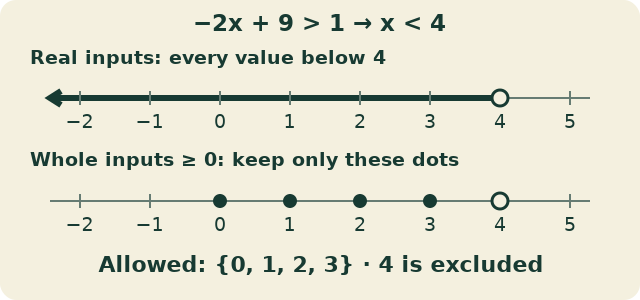
For −2x + 9 > 1, the real-number solution is x < 4: an open circle at 4 and a ray to the left. Requiring whole x at least zero leaves only 0, 1, 2 and 3, shown as separate filled dots.
An open circle excludes 4. The upper ray includes negative and fractional real numbers; the lower row keeps only whole nonnegative inputs. Separate dots do not include the values between them.

Solve the inequality, then apply the domain

Solve −2x + 9 > 1. Subtract 9 from both sides: −2x > −8. Divide by −2 and reverse the inequality: x < 4. Over the real numbers this includes every value below 4, not just integers. If a fictional model permits only whole x ≥ 0, intersect the range with that domain: {0, 1, 2, 3}. Check x = 3: −2 × 3 + 9 = 3, and 3 > 1. At the excluded boundary x = 4, the left side is 1, which is not greater than 1. At x = 5 it is −1, also excluded. The open circle records the strict inequality; the domain removes negative and fractional inputs.

Sketch & check

Solve −3n + 14 ≥ 2 for whole n ≥ 1. Sketch the real-number solution with the correct open or closed endpoint, then list the allowed whole values. Check the endpoint and the next whole value. Would a ray pointing right be correct?

Show diagram-practice feedback

Subtract 14: −3n ≥ −12. Divide by −3 and reverse the relation: n ≤ 4. The real-number graph has a closed circle at 4 and a ray to the left. Intersect with whole n ≥ 1 to get {1, 2, 3, 4}. At n = 4, −12 + 14 = 2, so the boundary is included. At n = 5, −15 + 14 = −1, which fails −1 ≥ 2. A right-pointing ray would include 5 and is therefore wrong. Unlike the worked example’s strict > sign, ≥ allows equality at the boundary.

Optional video & watching prompt

Khan Academy — One-step inequalities examples (video) ↗ (new tab)

Optional external video. Watch for the inequality reversing when both sides are divided by a negative number. Then return and explain why our boundary is open before applying the whole-number domain. Playback and captions were not checked. This lesson is complete without the video. External site policies apply; nothing is embedded or loaded here.

Link checked 2026-10-30.

STEP 4 OF 6

Try it yourself

First solve on paper or in a local document; retain your reasoning before opening the worked answer. Problem 1: Solve 2x−7<5. Problem 2: Solve −4x≤12. Problem 3: Find whole n≥0 for 6+5n≤28. Problem 4: List whole x satisfying x>2 and x≤6; distinguish the two endpoints. Check 1: Solve −2x<8. A. x<−4 B. x>−4 C. x=−4 D. x>4 Check 2: A whole count satisfies n≤4.4 and n≥0. Maximum? A. 4 B. 4.4 C. 5 D. 0 Check 3: Which input is included in x<6? A. 6 B. 7 C. 5.9 D. Only integers below six Practical portfolio: Design a fictional resource budget with a fixed use and a per-item use. Find its maximum whole output, test the next item and explain any unused resource. Then add a minimum-output constraint and identify whether both can hold. /10: model/domain 3, inequality work 3, boundary checks 2, feasibility interpretation 2.

Fictional exercise · prewritten feedback, no live AI grading.

Write your answer on paper or in your own notes, then compare the options and worked answer.

Check 1: Solve −2x<8.

A. x<−4

Not correct. Dividing by a negative requires reversal.

B. x>−4

Correct. Reverse < when dividing by −2.

C. x=−4

Not correct. Equality is excluded by the original strict inequality.

D. x>4

Not correct. The division gives −4, not +4.

Check 2: A whole count satisfies n≤4.4 and n≥0. Maximum?

A. 4

Correct. Four is feasible; five is not.

B. 4.4

Not correct. Counts were restricted to whole numbers.

C. 5

Not correct. Rounding up violates the constraint.

D. 0

Not correct. Zero is feasible but not the maximum.

Check 3: Which input is included in x<6?

A. 6

Not correct. Strict inequality excludes equality.

B. 7

Not correct. Seven is greater than six.

C. 5.9

Correct. It is less than six for a real-valued domain.

D. Only integers below six

Not correct. No integer restriction was stated.

STEP 5 OF 6

Worked answer & self-check

Practice 1: 2x<12, so x<6. Six is excluded because it makes equality, not a strict inequality. Practice 2: Divide by −4 and reverse: x≥−3. At −3 the sides equal 12. Practice 3: 5n≤22, so n≤4.4; whole feasible n are 0 through 4. Five costs 31 and fails. Practice 4: 3,4,5,6. The lower endpoint 2 is excluded by >, while 6 is included by ≤. Check 1: Solve −2x<8. A. x<−4 — Not correct. Dividing by a negative requires reversal. B. x>−4 — Correct. Reverse < when dividing by −2. C. x=−4 — Not correct. Equality is excluded by the original strict inequality. D. x>4 — Not correct. The division gives −4, not +4. Check 2: A whole count satisfies n≤4.4 and n≥0. Maximum? A. 4 — Correct. Four is feasible; five is not. B. 4.4 — Not correct. Counts were restricted to whole numbers. C. 5 — Not correct. Rounding up violates the constraint. D. 0 — Not correct. Zero is feasible but not the maximum. Check 3: Which input is included in x<6? A. 6 — Not correct. Strict inequality excludes equality. B. 7 — Not correct. Seven is greater than six. C. 5.9 — Correct. It is less than six for a real-valued domain. D. Only integers below six — Not correct. No integer restriction was stated. Portfolio self-review: Design a fictional resource budget with a fixed use and a per-item use. Find its maximum whole output, test the next item and explain any unused resource. Then add a minimum-output constraint and identify whether both can hold. /10: model/domain 3, inequality work 3, boundary checks 2, feasibility interpretation 2. Keep an original attempt and a dated correction explaining the first step that changed. No teacher or AI is grading this work automatically.

Compare your answer

  • Defines variables, units and permitted inputs before calculating.
  • Shows reversible steps or explains why a restriction or special case is needed.
  • Checks results in the original statement, including a boundary or counterexample.
  • Explains decisions in words; preserves a correction rather than replacing the first attempt silently.

Give yourself one check for each point your work meets. Revise any missing piece. This is a self-check, not a score sent to a teacher.

STEP 6 OF 6

Recap & next step

  • Reverse order under negative scaling.
  • Intersect algebraic ranges with allowed inputs.
  • Test the excluded next whole value.

Next: Functions, tables and domain. Bring one explained correction from this lesson.

Next lesson: Functions, tables and domain →

LESSON 5 OF 12 · 120 MINUTES

Functions, tables and domain

STEP 1 OF 6

Your objective

Determine whether a mapping is a function and preserve restrictions when evaluating or inverting it.

STEP 2 OF 6

The idea

A function assigns exactly one output to each input in its domain. Several inputs may share an output. In f(x)=2x+3, f is the function name and f(4) means the output for input 4, not f multiplied by 4. The domain is the set of allowed inputs; the range is the set of outputs actually produced.

A table can define a function without a formula. Inputs 1,2,3 with outputs 7,7,9 define one, even though 7 occurs twice. Rows (1,7) and (1,9) together do not define a single-output function unless another variable distinguishes the cases. A scattered collection of measurements needs a declared rule if you want to predict unmeasured inputs.

The formula may impose mathematical restrictions, while context imposes further ones. For g(x)=12/(x−2), x=2 is excluded because the denominator is zero. A room-booking model may additionally allow only whole nonnegative inputs. A square-root output uses the nonnegative square root; over real numbers its input must be nonnegative.

Finding an input from an output is a different task from evaluating a function. Solve f(x)=target and check all candidates against the domain. Some functions have multiple inputs for one output, so reversing them does not automatically define a function. For x² on all real numbers, output 9 corresponds to both −3 and 3.

STEP 3 OF 6

Two worked examples: reconstruct every step

Starting point

For f(x)=2x+3 with whole x from 0 to 3, list outputs and find the input for output 7.

A checkable approach

The input-output pairs are (0,3),(1,5),(2,7),(3,9). Range={3,5,7,9}. Solving 2x+3=7 gives x=2, which is allowed. Output 8 is not in this discrete range.

Second worked example — For g(x)=12/(x−2), evaluate at 5 and explain the problem at 2. g(5)=12/3=4. At x=2 the denominator is zero, so g(2) is undefined, not zero or infinity as an ordinary real output. Writing a table must mark this unknown/undefined value explicitly, not silently fill 0.

STEP 4 OF 6

Try it yourself

First solve on paper or in a local document; retain your reasoning before opening the worked answer. Problem 1: List f(x)=x² for x in {−2,−1,0,1,2}. Problem 2: Does {(1,4),(2,4),(3,5)} define a function? Problem 3: Does {(1,4),(1,6)} define a function of its first coordinate? Problem 4: Find all real x with x²=16 and then restrict to x≥0. Check 1: Does a repeated output violate the function rule? A. Always B. No, if every input still has one output C. Only for negative outputs D. Only when the formula is missing Check 2: What is g(2) for 12/(x−2)? A. 0 B. 6 C. Undefined D. 12 Check 3: For x²=9 on all real numbers, which inputs work? A. 3 only B. −3 only C. 9 and −9 D. −3 and 3 Practical portfolio: Create a six-row input-output table with one repeated output but no conflicting input. State its domain/range. Then construct a separate conflicting table and explain the one row you would remove or relabel. /10: valid mapping 3, domain/range 3, conflict explanation 2, inverse caution 2.

Fictional exercise · prewritten feedback, no live AI grading.

Write your answer on paper or in your own notes, then compare the options and worked answer.

Check 1: Does a repeated output violate the function rule?

A. Always

Not correct. The rule limits outputs per input, not inputs per output.

B. No, if every input still has one output

Correct. Many-to-one functions are permitted.

C. Only for negative outputs

Not correct. The sign has no bearing on uniqueness.

D. Only when the formula is missing

Not correct. A table can itself define a function.

Check 2: What is g(2) for 12/(x−2)?

A. 0

Not correct. Zero denominator does not produce zero.

B. 6

Not correct. That would divide by x, not x−2.

C. Undefined

Correct. The denominator is zero.

D. 12

Not correct. The denominator is not one.

Check 3: For x²=9 on all real numbers, which inputs work?

A. 3 only

Not correct. −3 also squares to 9.

B. −3 only

Not correct. 3 also works.

C. 9 and −9

Not correct. Those square to 81.

D. −3 and 3

Correct. Both yield 9; a nonnegative restriction would retain only 3.

STEP 5 OF 6

Worked answer & self-check

Practice 1: Outputs in input order are 4,1,0,1,4; the range is {0,1,4}, with duplicates removed. Practice 2: Yes. Every input has one output; distinct inputs may share 4. Practice 3: No. Input 1 is assigned two different outputs, 4 and 6. Practice 4: Real solutions are −4 and 4. Restricting to nonnegative inputs leaves 4. Squaring verifies both original real solutions. Check 1: Does a repeated output violate the function rule? A. Always — Not correct. The rule limits outputs per input, not inputs per output. B. No, if every input still has one output — Correct. Many-to-one functions are permitted. C. Only for negative outputs — Not correct. The sign has no bearing on uniqueness. D. Only when the formula is missing — Not correct. A table can itself define a function. Check 2: What is g(2) for 12/(x−2)? A. 0 — Not correct. Zero denominator does not produce zero. B. 6 — Not correct. That would divide by x, not x−2. C. Undefined — Correct. The denominator is zero. D. 12 — Not correct. The denominator is not one. Check 3: For x²=9 on all real numbers, which inputs work? A. 3 only — Not correct. −3 also squares to 9. B. −3 only — Not correct. 3 also works. C. 9 and −9 — Not correct. Those square to 81. D. −3 and 3 — Correct. Both yield 9; a nonnegative restriction would retain only 3. Portfolio self-review: Create a six-row input-output table with one repeated output but no conflicting input. State its domain/range. Then construct a separate conflicting table and explain the one row you would remove or relabel. /10: valid mapping 3, domain/range 3, conflict explanation 2, inverse caution 2. Keep an original attempt and a dated correction explaining the first step that changed. No teacher or AI is grading this work automatically.

Compare your answer

  • Defines variables, units and permitted inputs before calculating.
  • Shows reversible steps or explains why a restriction or special case is needed.
  • Checks results in the original statement, including a boundary or counterexample.
  • Explains decisions in words; preserves a correction rather than replacing the first attempt silently.

Give yourself one check for each point your work meets. Revise any missing piece. This is a self-check, not a score sent to a teacher.

STEP 6 OF 6

Recap & next step

  • One output per permitted input.
  • Undefined is not zero.
  • Reversing a function may require restricting its domain.

Next: Slope, intercept and linear models. Bring one explained correction from this lesson.

Next lesson: Slope, intercept and linear models →

LESSON 6 OF 12 · 120 MINUTES

Slope, intercept and linear models

STEP 1 OF 6

Your objective

Build a linear model from two points and interpret its rate, intercept and limits.

STEP 2 OF 6

The idea

A linear model y=mx+b has a constant change m in y for each one-unit change in x. The intercept b is the output at x=0. The slope is a ratio of changes, Δy/Δx, so its units are output units per input unit. Dividing y by x gives a rate from the origin and is not generally the slope when b is nonzero.

Two points with different x coordinates determine one line. Compute their changes in the same order: (y₂−y₁)/(x₂−x₁). Substitute one point into y=mx+b to find b, then check the other. Two points with the same x but different y cannot describe a single-output function of x.

An intercept is mathematical; its real-world interpretation depends on the model. A line fitted to observations from ages 20–40 should not automatically be interpreted at age zero. Interpolation estimates between known inputs; extrapolation goes outside them and needs stronger justification. Even exact agreement at two points does not prove the system is linear.

A table with equally spaced inputs and equal output differences supports a linear pattern over those observed values. It does not prove future behaviour. Negative slopes model decline, not necessarily error. A tank losing water can decline linearly only until empty; negative predicted water is a sign to restrict or replace the model.

STEP 3 OF 6

Two worked examples: reconstruct every step

Starting point

A fictional tank has 52 litres at minute 2 and 40 litres at minute 5. Find a linear model.

A checkable approach

Slope=(40−52)/(5−2)=−12/3=−4 litres/minute. Use 52=−4×2+b, giving b=60. Model V(t)=60−4t. Check V(5)=40. If the tank starts at 60 litres and drains steadily, restrict to 0≤t≤15.

Second worked example — A fictional delivery fee is 14 dollars at 2 km and 26 dollars at 5 km. Slope=(26−14)/(5−2)=4 dollars/km. Since 14=4×2+b, b=6 dollars. Thus C(d)=6+4d. The quotient 14/2=7 is not the marginal rate because the fixed six-dollar fee is included.

STEP 4 OF 6

Try it yourself

First solve on paper or in a local document; retain your reasoning before opening the worked answer. Problem 1: Find the line through (1,7) and (4,16). Problem 2: For y=30−2x, interpret intercept and slope if y is litres and x minutes. Problem 3: At x=0,1,2,3 outputs are 2,5,8,12. Is one exact line consistent with all four? Problem 4: For V=60−4t, find when V=0 and explain V(18). Check 1: What is the slope through (1,7),(4,16)? A. 9 B. 3 C. 7 D. 4 Check 2: What does a negative slope mean? A. The model is always invalid B. Output decreases as input increases C. All outputs are negative D. The input must be negative Check 3: What is extrapolation? A. Estimating outside the observed input range B. Writing the equation correctly C. Using a table instead of a graph D. Checking a measured point Practical portfolio: Choose two fictional tank measurements with decreasing volume. Derive a line, make a five-row table and identify the physically allowable interval. Describe one condition that would break constant drainage. /10: slope/intercept 4, table 2, domain 2, limitation 2.

Fictional exercise · prewritten feedback, no live AI grading.

Write your answer on paper or in your own notes, then compare the options and worked answer.

Check 1: What is the slope through (1,7),(4,16)?

A. 9

Not correct. Nine is the output change, not divided by input change.

B. 3

Correct. Output change 9 divided by input change 3.

C. 7

Not correct. The quotient at one point ignores the intercept.

D. 4

Not correct. Four is the intercept for this line.

Check 2: What does a negative slope mean?

A. The model is always invalid

Not correct. Declining quantities may have negative slope.

B. Output decreases as input increases

Correct. Each positive input increment produces a negative output change.

C. All outputs are negative

Not correct. The intercept and domain determine output signs.

D. The input must be negative

Not correct. Slope sign does not constrain input sign.

Check 3: What is extrapolation?

A. Estimating outside the observed input range

Correct. That extends the model beyond its observed support.

B. Writing the equation correctly

Not correct. Equation writing alone says nothing about the range.

C. Using a table instead of a graph

Not correct. Either representation can show extrapolation.

D. Checking a measured point

Not correct. That is a check within the evidence, not extension.

STEP 5 OF 6

Worked answer & self-check

Practice 1: Slope=(16−7)/(4−1)=3; b=7−3=4, so y=3x+4. Check 3×4+4=16. Practice 2: Initial model output is 30 litres; it decreases by 2 litres per minute, while the model applies. Practice 3: No. Differences are 3,3,4 rather than a constant 3. A fitted approximation could be considered but must be labelled approximate. Practice 4: 60−4t=0 gives t=15 minutes. V(18)=−12 algebraically, but negative water is outside the physical model; stop at empty or introduce a new rule. Check 1: What is the slope through (1,7),(4,16)? A. 9 — Not correct. Nine is the output change, not divided by input change. B. 3 — Correct. Output change 9 divided by input change 3. C. 7 — Not correct. The quotient at one point ignores the intercept. D. 4 — Not correct. Four is the intercept for this line. Check 2: What does a negative slope mean? A. The model is always invalid — Not correct. Declining quantities may have negative slope. B. Output decreases as input increases — Correct. Each positive input increment produces a negative output change. C. All outputs are negative — Not correct. The intercept and domain determine output signs. D. The input must be negative — Not correct. Slope sign does not constrain input sign. Check 3: What is extrapolation? A. Estimating outside the observed input range — Correct. That extends the model beyond its observed support. B. Writing the equation correctly — Not correct. Equation writing alone says nothing about the range. C. Using a table instead of a graph — Not correct. Either representation can show extrapolation. D. Checking a measured point — Not correct. That is a check within the evidence, not extension. Portfolio self-review: Choose two fictional tank measurements with decreasing volume. Derive a line, make a five-row table and identify the physically allowable interval. Describe one condition that would break constant drainage. /10: slope/intercept 4, table 2, domain 2, limitation 2. Keep an original attempt and a dated correction explaining the first step that changed. No teacher or AI is grading this work automatically.

Compare your answer

  • Defines variables, units and permitted inputs before calculating.
  • Shows reversible steps or explains why a restriction or special case is needed.
  • Checks results in the original statement, including a boundary or counterexample.
  • Explains decisions in words; preserves a correction rather than replacing the first attempt silently.

Give yourself one check for each point your work meets. Revise any missing piece. This is a self-check, not a score sent to a teacher.

STEP 6 OF 6

Recap & next step

  • Slope is change divided by change.
  • Interpret intercepts only where context permits.
  • A line fitting two points need not predict indefinitely.

Next: When does the better option change?. Bring one explained correction from this lesson.

Next lesson: When does the better option change? →

LESSON 7 OF 12 · 90 MINUTES

When does the better option change?

STEP 1 OF 6

Your objective

Find and check intersections, compare either side and distinguish fractional thresholds from feasible decisions.

STEP 2 OF 6

The idea

A fictional rehearsal group compares A(n)=18+7n dollars and B(n)=42+4n dollars. The domain is whole sessions from 0 through 20; each fixed charge applies even at zero use. The lower per-session rate does not alone identify the cheapest plan. Fixed charges matter especially for small bookings.

Equality locates a possible switch. Subtracting the cost functions reveals the direction: A(n)−B(n)=3n−24. A negative difference means A costs less; a positive difference means B costs less; zero means a tie. Negative differences do not imply negative total prices or negative session counts.

For the original plans, A is cheaper at whole inputs 0–7, both tie at 8, and B is cheaper at 9–20. A readable table is an alternative to a plotted graph: at n=0 costs are 18 and 42; at 4 they are 46 and 58; at 8 both 74; at 12 they are 102 and 90; at 20 they are 158 and 122. If you draw a graph, label sessions horizontally and dollars vertically, and retain the table.

A model comparison answers the price question only under its assumptions. Unequal session length, accessibility, cancellation charges or reliability might change a real decision. All figures here are fictional. Sensitivity analysis changes one stated assumption and recomputes; it must not quietly replace the original scenario. A fractional intersection can still produce a useful whole-number decision.

STEP 3 OF 6

Two worked examples: reconstruct every step

Starting point

Find equality for A(n)=18+7n and B(n)=42+4n.

A checkable approach

18+7n=42+4n. Subtract 4n: 18+3n=42. Subtract 18: 3n=24. Divide by 3: n=8 sessions. Original-formula checks give A(8)=74 and B(8)=74 dollars.

Second worked example — Change only the fixed charge of B to 40 dollars. 18+7n=40+4n gives 3n=22, so n=22/3=7⅓. No whole booking ties. At n=7, A=67 and revised B=68; at n=8, A=74 and revised B=72. Revised B first becomes strictly cheaper at 8, not a rounded tie at 7 or 8.

STEP 4 OF 6

Try it yourself

First solve on paper or in a local document; retain your reasoning before opening the worked answer. Problem 1: Compare original plans at 6 and 10 sessions and give savings. Problem 2: Compare C(h)=12+3h and D(h)=27+2h for whole h from 0–24. Problem 3: Compare E(n)=10+5n and F(n)=30+5n; find any tie. Problem 4: For revised B=40+4n, distinguish the real intersection from the first whole input with B strictly cheaper. Check 1: Where do the original plans tie? A. 3 sessions B. 8 sessions C. 24 sessions D. 74 sessions Check 2: What does A(n)−B(n)<0 mean? A. A costs less than B B. B costs less than A C. A has a negative total price D. n must be negative Check 3: Revised B intersects at 7⅓. Which whole-input statement holds? A. Tie at 7 B. Tie at 8 C. B first strictly cheaper at 8 D. No useful comparison is possible Practical portfolio: Invent two fictional plans on whole uses 0–20. Define units, find and check the intersection (even if outside the domain), provide five table rows and choose at three inputs. Include two limitations. /10: domain/units 2, models/algebra 3, original and neighbour checks 2, decisions 1, limits 1, revision 1.

Fictional exercise · prewritten feedback, no live AI grading.

Write your answer on paper or in your own notes, then compare the options and worked answer.

Check 1: Where do the original plans tie?

A. 3 sessions

Not correct. Three is the rate difference, not the solved input.

B. 8 sessions

Correct. Both original costs are 74 dollars.

C. 24 sessions

Not correct. Twenty-four is the fixed-fee difference and is outside the domain.

D. 74 sessions

Not correct. Seventy-four is the cost, not the number of sessions.

Check 2: What does A(n)−B(n)<0 mean?

A. A costs less than B

Correct. A smaller number minus a larger number is negative.

B. B costs less than A

Not correct. That would make the difference positive.

C. A has a negative total price

Not correct. A difference may be negative while both totals are positive.

D. n must be negative

Not correct. The sign of a difference does not determine the input sign.

Check 3: Revised B intersects at 7⅓. Which whole-input statement holds?

A. Tie at 7

Not correct. Costs are 67 and 68.

B. Tie at 8

Not correct. Costs are 74 and 72.

C. B first strictly cheaper at 8

Correct. Check 7 and 8 to locate the feasible switch.

D. No useful comparison is possible

Not correct. Whole inputs on either side can still be compared.

STEP 5 OF 6

Worked answer & self-check

Practice 1: At 6, A=60 and B=66: A saves 6 dollars. At 10, A=88 and B=82: B saves 6 dollars. Practice 2: Equality gives h=15 and both costs 57. C is cheaper at 0–14, equal at 15, D cheaper at 16–24. Neighbours: h=14 gives 54 versus 55; h=16 gives 60 versus 59. Practice 3: Subtract 5n on both sides: equality would require 10=30. No tie; E is 20 dollars cheaper everywhere in the shared domain. Do not divide by the zero rate difference. Practice 4: The real intersection is 22/3. The first feasible whole input with revised B strictly cheaper is 8. Evaluating neighbours, rather than rounding the intersection into a false equality, proves this. Check 1: Where do the original plans tie? A. 3 sessions — Not correct. Three is the rate difference, not the solved input. B. 8 sessions — Correct. Both original costs are 74 dollars. C. 24 sessions — Not correct. Twenty-four is the fixed-fee difference and is outside the domain. D. 74 sessions — Not correct. Seventy-four is the cost, not the number of sessions. Check 2: What does A(n)−B(n)<0 mean? A. A costs less than B — Correct. A smaller number minus a larger number is negative. B. B costs less than A — Not correct. That would make the difference positive. C. A has a negative total price — Not correct. A difference may be negative while both totals are positive. D. n must be negative — Not correct. The sign of a difference does not determine the input sign. Check 3: Revised B intersects at 7⅓. Which whole-input statement holds? A. Tie at 7 — Not correct. Costs are 67 and 68. B. Tie at 8 — Not correct. Costs are 74 and 72. C. B first strictly cheaper at 8 — Correct. Check 7 and 8 to locate the feasible switch. D. No useful comparison is possible — Not correct. Whole inputs on either side can still be compared. Portfolio self-review: Invent two fictional plans on whole uses 0–20. Define units, find and check the intersection (even if outside the domain), provide five table rows and choose at three inputs. Include two limitations. /10: domain/units 2, models/algebra 3, original and neighbour checks 2, decisions 1, limits 1, revision 1. Keep an original attempt and a dated correction explaining the first step that changed. No teacher or AI is grading this work automatically.

Compare your answer

  • Defines variables, units and permitted inputs before calculating.
  • Shows reversible steps or explains why a restriction or special case is needed.
  • Checks results in the original statement, including a boundary or counterexample.
  • Explains decisions in words; preserves a correction rather than replacing the first attempt silently.

Give yourself one check for each point your work meets. Revise any missing piece. This is a self-check, not a score sent to a teacher.

STEP 6 OF 6

Recap & next step

  • Compare fixed fees and rates together.
  • Check intersections in both original rules.
  • A fractional threshold is not a whole-number tie.

Next: Systems: two unknowns, two conditions. Bring one explained correction from this lesson.

Next lesson: Systems: two unknowns, two conditions →

LESSON 8 OF 12 · 120 MINUTES

Systems: two unknowns, two conditions

STEP 1 OF 6

Your objective

Solve a two-equation system by substitution and classify inconsistent or dependent conditions.

STEP 2 OF 6

The idea

A system requires all its equations to hold at the same time. A solution is an ordered pair, not two independent answers from unrelated scenarios. Write the meaning and unit of each variable. If x counts adult tickets and y counts youth tickets, an equation about the total count and one about total revenue constrain the same pair.

Substitution uses one condition to express a variable in terms of the other, then inserts that expression into the second condition. Preserve parentheses around the replacement. Solve the resulting one-variable equation and return to find the other unknown. Check both original equations: checking only the total count cannot establish the revenue condition.

Two equations do not necessarily supply two independent facts. If one is a multiple of the other, they describe the same line and may permit infinitely many real pairs. If they have the same left-hand relation but conflicting totals, they have no common solution. With count restrictions, an infinite real solution set may become a finite list of allowed pairs.

Elimination is another valid route: add multiples of equations to cancel a variable. It should agree with substitution. In either route, mathematical consistency is not evidence that fictional inputs describe an actual event. Measurements may be rounded or incomplete; a poor fit may require an approximate model rather than forcing exact integer answers.

STEP 3 OF 6

Two worked examples: reconstruct every step

Starting point

Fictional tickets: x+y=14 and 8x+5y=91. Find x,y.

A checkable approach

From the count, y=14−x. Substitute: 8x+5(14−x)=91, so 3x+70=91, x=7, y=7. Check 7+7=14 and 56+35=91. Both are nonnegative whole counts.

Second worked example — Compare x+y=6 with 2x+2y=12, then with 2x+2y=15. The first second-equation is twice the first: it adds no independent restriction. All real pairs (x,6−x) work. Nonnegative whole counts give seven pairs. The alternative requires the same sum to be both 6 and 7.5, so it has no solution.

STEP 4 OF 6

Try it yourself

First solve on paper or in a local document; retain your reasoning before opening the worked answer. Problem 1: Solve x+y=11 and 2x+y=17. Problem 2: Solve y=3x−1 and y=x+7. Problem 3: Classify x+y=4 and 3x+3y=15. Problem 4: For x+y=4 and 2x+2y=8, list all nonnegative whole pairs. Check 1: A system solution must satisfy: A. Either one of its equations B. Every equation simultaneously C. Only the simpler equation D. Only the derived equation Check 2: What does y=14−x come from in the example? A. Dividing both sides by y B. Subtracting x from x+y=14 C. Assuming x=y D. Ignoring ticket revenue permanently Check 3: x+y=4 and 2x+2y=8 have how many real solutions? A. None B. Exactly one C. Exactly five D. Infinitely many Practical portfolio: Create a fictional two-price ticket case with known whole counts, compute total count/revenue, then hide and recover the counts using substitution. Add a redundant second equation to a separate example and explain why uniqueness is lost. /10: coherent case 3, solution 3, both checks 2, dependence explanation 2.

Fictional exercise · prewritten feedback, no live AI grading.

Write your answer on paper or in your own notes, then compare the options and worked answer.

Check 1: A system solution must satisfy:

A. Either one of its equations

Not correct. Both describe the same situation and must hold.

B. Every equation simultaneously

Correct. That is the definition of a common solution.

C. Only the simpler equation

Not correct. Simplicity does not remove a condition.

D. Only the derived equation

Not correct. A transformation mistake is caught by original checks.

Check 2: What does y=14−x come from in the example?

A. Dividing both sides by y

Not correct. No division by y occurs.

B. Subtracting x from x+y=14

Correct. That isolates y while preserving equality.

C. Assuming x=y

Not correct. Equality of the counts is a conclusion here, not an assumption.

D. Ignoring ticket revenue permanently

Not correct. Revenue is used in the next substitution.

Check 3: x+y=4 and 2x+2y=8 have how many real solutions?

A. None

Not correct. The equations are consistent.

B. Exactly one

Not correct. The second supplies no new independent condition.

C. Exactly five

Not correct. Five applies only to nonnegative whole pairs.

D. Infinitely many

Correct. All real pairs (x,4−x) satisfy both.

STEP 5 OF 6

Worked answer & self-check

Practice 1: Subtract the first equation from the second: x=6, then y=5. Checks: 6+5=11 and 12+5=17. Practice 2: Set 3x−1=x+7, giving 2x=8, x=4 and y=11. Both expressions for y give 11. Practice 3: No solution: three times the first requires 3x+3y=12, not 15. Practice 4: The second is redundant. Allowed pairs are (0,4),(1,3),(2,2),(3,1),(4,0); unrestricted real pairs would be infinite. Check 1: A system solution must satisfy: A. Either one of its equations — Not correct. Both describe the same situation and must hold. B. Every equation simultaneously — Correct. That is the definition of a common solution. C. Only the simpler equation — Not correct. Simplicity does not remove a condition. D. Only the derived equation — Not correct. A transformation mistake is caught by original checks. Check 2: What does y=14−x come from in the example? A. Dividing both sides by y — Not correct. No division by y occurs. B. Subtracting x from x+y=14 — Correct. That isolates y while preserving equality. C. Assuming x=y — Not correct. Equality of the counts is a conclusion here, not an assumption. D. Ignoring ticket revenue permanently — Not correct. Revenue is used in the next substitution. Check 3: x+y=4 and 2x+2y=8 have how many real solutions? A. None — Not correct. The equations are consistent. B. Exactly one — Not correct. The second supplies no new independent condition. C. Exactly five — Not correct. Five applies only to nonnegative whole pairs. D. Infinitely many — Correct. All real pairs (x,4−x) satisfy both. Portfolio self-review: Create a fictional two-price ticket case with known whole counts, compute total count/revenue, then hide and recover the counts using substitution. Add a redundant second equation to a separate example and explain why uniqueness is lost. /10: coherent case 3, solution 3, both checks 2, dependence explanation 2. Keep an original attempt and a dated correction explaining the first step that changed. No teacher or AI is grading this work automatically.

Compare your answer

  • Defines variables, units and permitted inputs before calculating.
  • Shows reversible steps or explains why a restriction or special case is needed.
  • Checks results in the original statement, including a boundary or counterexample.
  • Explains decisions in words; preserves a correction rather than replacing the first attempt silently.

Give yourself one check for each point your work meets. Revise any missing piece. This is a self-check, not a score sent to a teacher.

STEP 6 OF 6

Recap & next step

  • A solution satisfies all conditions.
  • Substitute the entire expression with parentheses.
  • Check dependence and domain before claiming uniqueness.

Next: Exponents and repeated growth. Bring one explained correction from this lesson.

Next lesson: Exponents and repeated growth →

LESSON 9 OF 12 · 120 MINUTES

Exponents and repeated growth

STEP 1 OF 6

Your objective

Distinguish additive and multiplicative change, use exponent rules and interpret growth/decay factors.

STEP 2 OF 6

The idea

For a positive integer n, a^n means multiplying n copies of a. It is not a×n. The rules a^m×a^n=a^(m+n) and (a^m)^n=a^(mn) follow by counting factors. For a≠0, a^0=1 and a^(−n)=1/a^n. The zero base needs separate care: division by zero is not defined, and this course leaves 0^0 undefined.

A repeated percentage change multiplies the current value. Growth of 10% per period has factor 1.10, while decline of 10% has factor 0.90. Starting at P, a discrete model after n periods is P×factor^n. A 10% increase followed by a 10% decrease does not restore P: 1.10×0.90=0.99, leaving 99% of the start.

Additive growth P+kn adds the same amount each period; exponential growth P×b^n multiplies by the same factor. For equally spaced inputs, compare differences for a linear pattern and ratios for an exponential one, where denominators are nonzero. Both models can agree at a few points; more context is required to justify one.

Counts such as cells or objects may not take fractional values even when an exponential formula does. Treat continuous outputs as a simplified model or expected amount, not an exact headcount. State the permitted periods, retain precision during calculation and round only the reported result with an explicit rule. No financial return or biological prediction is promised by these fictional patterns.

STEP 3 OF 6

Two worked examples: reconstruct every step

Starting point

A fictional quantity begins at 200 units and grows 10% each period for three periods.

A checkable approach

Values are 200,220,242,266.2. The formula is 200×1.1^3=266.2. Adding 20 three times would give 260, a different constant-increment model. Total relative increase is (266.2−200)/200=33.1%.

Second worked example — A fictional mass of 80 g retains 75% each hour. Find it after two hours and compare a zero exponent. M(2)=80×0.75²=45 g. M(0)=80×1=80 g. The factor 0.75 represents 25% loss, not 75% loss. A 75% loss would retain factor 0.25.

STEP 4 OF 6

Try it yourself

First solve on paper or in a local document; retain your reasoning before opening the worked answer. Problem 1: Evaluate 2³×2² and 2^(−3). Problem 2: Start at 50 and grow 20% for two periods. Problem 3: Start at 100 and decrease 20% then increase 20%. Problem 4: Classify sequences 5,8,11,14 and 5,10,20,40 using differences/ratios. Check 1: Which factor represents 15% decline? A. 1.15 B. 0.15 C. 0.85 D. −0.15 Check 2: What is 3²×3³? A. 3^6 B. 3^5 C. 6^5 D. 3^1 Check 3: Why does +20% then −20% not cancel? A. Percentages cannot be multiplied B. The second change uses a different baseline C. It always increases the start D. Rounding is the only cause Practical portfolio: Build tables for an additive and a multiplicative fictional model that start at the same value. Use five periods, label increments/ratios, compare outputs and state where extrapolation becomes questionable. /10: rules 3, calculations 3, distinction 2, limits/rounding 2.

Fictional exercise · prewritten feedback, no live AI grading.

Write your answer on paper or in your own notes, then compare the options and worked answer.

Check 1: Which factor represents 15% decline?

A. 1.15

Not correct. That represents growth.

B. 0.15

Not correct. That retains only 15%, a loss of 85%.

C. 0.85

Correct. Retain 100%−15%=85%.

D. −0.15

Not correct. A negative factor is not ordinary percentage retention.

Check 2: What is 3²×3³?

A. 3^6

Not correct. Exponent multiplication applies to a power of a power.

B. 3^5

Correct. There are five factors of 3 in the product.

C. 6^5

Not correct. The common base does not add.

D. 3^1

Not correct. Subtract exponents for division, not this product.

Check 3: Why does +20% then −20% not cancel?

A. Percentages cannot be multiplied

Not correct. Their factors can be multiplied.

B. The second change uses a different baseline

Correct. 1.2×0.8=0.96, not 1.

C. It always increases the start

Not correct. This pair decreases it by 4%.

D. Rounding is the only cause

Not correct. The mismatch exists exactly before rounding.

STEP 5 OF 6

Worked answer & self-check

Practice 1: 2^(3+2)=2^5=32; 2^(−3)=1/8. Multiplying exponents would incorrectly give 64. Practice 2: 50×1.2²=72. Period values are 50,60,72; the second increment is 12, not 10. Practice 3: 100×0.8×1.2=96. The decrease and increase use different baselines, so they do not cancel. Practice 4: First has constant difference 3 and is additive. Second has constant ratio 2 and is multiplicative; its differences 5,10,20 are not constant. Check 1: Which factor represents 15% decline? A. 1.15 — Not correct. That represents growth. B. 0.15 — Not correct. That retains only 15%, a loss of 85%. C. 0.85 — Correct. Retain 100%−15%=85%. D. −0.15 — Not correct. A negative factor is not ordinary percentage retention. Check 2: What is 3²×3³? A. 3^6 — Not correct. Exponent multiplication applies to a power of a power. B. 3^5 — Correct. There are five factors of 3 in the product. C. 6^5 — Not correct. The common base does not add. D. 3^1 — Not correct. Subtract exponents for division, not this product. Check 3: Why does +20% then −20% not cancel? A. Percentages cannot be multiplied — Not correct. Their factors can be multiplied. B. The second change uses a different baseline — Correct. 1.2×0.8=0.96, not 1. C. It always increases the start — Not correct. This pair decreases it by 4%. D. Rounding is the only cause — Not correct. The mismatch exists exactly before rounding. Portfolio self-review: Build tables for an additive and a multiplicative fictional model that start at the same value. Use five periods, label increments/ratios, compare outputs and state where extrapolation becomes questionable. /10: rules 3, calculations 3, distinction 2, limits/rounding 2. Keep an original attempt and a dated correction explaining the first step that changed. No teacher or AI is grading this work automatically.

Compare your answer

  • Defines variables, units and permitted inputs before calculating.
  • Shows reversible steps or explains why a restriction or special case is needed.
  • Checks results in the original statement, including a boundary or counterexample.
  • Explains decisions in words; preserves a correction rather than replacing the first attempt silently.

Give yourself one check for each point your work meets. Revise any missing piece. This is a self-check, not a score sent to a teacher.

STEP 6 OF 6

Recap & next step

  • A percentage change multiplies the current baseline.
  • Exponent rules count factors.
  • Keep model output distinct from actual observed counts.

Next: Logarithms: finding the missing exponent. Bring one explained correction from this lesson.

Next lesson: Logarithms: finding the missing exponent →

LESSON 10 OF 12 · 120 MINUTES

Logarithms: finding the missing exponent

STEP 1 OF 6

Your objective

Interpret logarithms as inverse exponent questions and translate real thresholds into whole-period decisions.

STEP 2 OF 6

The idea

A logarithm asks for an exponent. log_b(a)=c means b^c=a. In real-number work the base b must be positive and not 1, and the argument a must be positive. These restrictions follow from the behaviour of positive-base exponential functions; the calculator refusing log(0) is not a missing zero-valued answer.

Common logarithm log means base 10 in many calculators, while ln means base e. For ratios log(a)/log(b), any one consistent logarithm base works. Mixing ln in the numerator with base-10 log in the denominator does not. Use parentheses carefully and identify whether you need a real-valued crossing time or a first whole observation period.

To solve P×b^t=T for positive P,T and positive b≠1, divide by P to get b^t=T/P, then t=ln(T/P)/ln(b). This is a model-based time, not a guarantee. With b<1, ln(b) is negative; positive elapsed time can still result because the target/start ratio is also below one.

Useful identities have domain assumptions: log_b(uv)=log_b(u)+log_b(v) for positive u,v. There is no corresponding rule log(u+v)=log(u)+log(v). Exact powers are excellent checks. If a rounded time is close to an integer, evaluate the original model at neighbouring integers rather than trust a rounded display.

STEP 3 OF 6

Two worked examples: reconstruct every step

Starting point

Interpret log₂(32) and solve 100×2^n=800.

A checkable approach

Because 2^5=32, log₂(32)=5. In the model, divide by 100: 2^n=8, hence n=3. Substitute to get 100×8=800. The logarithm gives an exponent, not a quantity in the original output units.

Second worked example — When does 80×0.75^t fall to 30? Find the first whole hour at or below 30. t=ln(30/80)/ln(0.75)≈3.40942 hours. At hour 3 the model is 33.75; at hour 4 it is 25.3125. Thus the first whole hour at or below 30 is 4, while the real crossing is about 3.40942.

STEP 4 OF 6

Try it yourself

First solve on paper or in a local document; retain your reasoning before opening the worked answer. Problem 1: Evaluate log₁₀(1000), log₂(1) and log₃(9). Problem 2: Solve 50×2^n=400. Problem 3: For 100×1.1^n≥150 at whole n≥0, find the first qualifying period using logarithms and neighbour checks. Problem 4: Explain why log(0) and base-1 logarithms are not real inverse-function answers. Check 1: What is log₂(8)? A. 4 B. 3 C. 16 D. 1/3 Check 2: Which is a valid real logarithm argument? A. 0 B. −4 C. 0.5 D. Any number Check 3: Real threshold is 4.254 periods for an increasing model. First whole period reaching it? A. 4 B. 4.254 C. 5 D. 0 Practical portfolio: Choose an original increasing positive model and target above its start. Estimate the crossing using repeated multiplication or logs, then check adjacent whole periods. Explain the different units of the model output and its exponent. /10: valid domain 2, method 3, original neighbour checks 3, interpretation 2.

Fictional exercise · prewritten feedback, no live AI grading.

Write your answer on paper or in your own notes, then compare the options and worked answer.

Check 1: What is log₂(8)?

A. 4

Not correct. 2^4=16.

B. 3

Correct. 2³=8.

C. 16

Not correct. That is 2×8, not an exponent.

D. 1/3

Not correct. 2^(1/3) is not 8.

Check 2: Which is a valid real logarithm argument?

A. 0

Not correct. No finite exponent of a positive base yields zero.

B. −4

Not correct. Positive-base real powers are positive.

C. 0.5

Correct. A positive fraction is permitted and may yield a negative logarithm.

D. Any number

Not correct. The real argument must be positive.

Check 3: Real threshold is 4.254 periods for an increasing model. First whole period reaching it?

A. 4

Not correct. Four is before the threshold; check the model.

B. 4.254

Not correct. The question restricts observations to whole periods.

C. 5

Correct. Five is the next whole period; verify both neighbours.

D. 0

Not correct. The threshold has not been reached initially in this scenario.

STEP 5 OF 6

Worked answer & self-check

Practice 1: They are 3,0,2 because 10³=1000, 2⁰=1 and 3²=9. Practice 2: 2^n=8, so n=3. Original model gives 50×8=400. Practice 3: Real threshold ln(1.5)/ln(1.1)≈4.25416. At 4, output 146.41; at 5, 161.051. First whole period is 5. Practice 4: Positive-base exponentials never equal zero at a finite real exponent. Base 1 always outputs 1, so it cannot recover a unique exponent from an output. Check 1: What is log₂(8)? A. 4 — Not correct. 2^4=16. B. 3 — Correct. 2³=8. C. 16 — Not correct. That is 2×8, not an exponent. D. 1/3 — Not correct. 2^(1/3) is not 8. Check 2: Which is a valid real logarithm argument? A. 0 — Not correct. No finite exponent of a positive base yields zero. B. −4 — Not correct. Positive-base real powers are positive. C. 0.5 — Correct. A positive fraction is permitted and may yield a negative logarithm. D. Any number — Not correct. The real argument must be positive. Check 3: Real threshold is 4.254 periods for an increasing model. First whole period reaching it? A. 4 — Not correct. Four is before the threshold; check the model. B. 4.254 — Not correct. The question restricts observations to whole periods. C. 5 — Correct. Five is the next whole period; verify both neighbours. D. 0 — Not correct. The threshold has not been reached initially in this scenario. Portfolio self-review: Choose an original increasing positive model and target above its start. Estimate the crossing using repeated multiplication or logs, then check adjacent whole periods. Explain the different units of the model output and its exponent. /10: valid domain 2, method 3, original neighbour checks 3, interpretation 2. Keep an original attempt and a dated correction explaining the first step that changed. No teacher or AI is grading this work automatically.

Compare your answer

  • Defines variables, units and permitted inputs before calculating.
  • Shows reversible steps or explains why a restriction or special case is needed.
  • Checks results in the original statement, including a boundary or counterexample.
  • Explains decisions in words; preserves a correction rather than replacing the first attempt silently.

Give yourself one check for each point your work meets. Revise any missing piece. This is a self-check, not a score sent to a teacher.

STEP 6 OF 6

Recap & next step

  • A logarithm asks for an exponent.
  • Positive argument; positive base other than one.
  • Use original-model neighbours for whole-period decisions.

Next: Quadratic patterns and model limits. Bring one explained correction from this lesson.

Next lesson: Quadratic patterns and model limits →

LESSON 11 OF 12 · 150 MINUTES

Quadratic patterns and model limits

STEP 1 OF 6

Your objective

Find simple quadratic roots and turning points, while separating algebraic and contextual domains.

STEP 2 OF 6

The idea

A quadratic has a nonzero squared term, y=ax²+bx+c with a≠0. Its change per input unit is not constant, so a straight-line model generally misses its curvature. For equally spaced inputs, a quadratic has constant second differences: compute differences of successive first differences. This pattern check supports a model but does not prove every unobserved point follows it.

Factoring can reveal roots. If (x−2)(x−5)=0, at least one factor must be zero, giving x=2 or x=5. This zero-product property applies when the product equals zero; from (x−2)(x−5)=6 you cannot simply set each factor equal to 6. Expand factors to check that they describe the original quadratic.

A vertex form y=a(x−h)²+k exposes turning behaviour. Since a square is nonnegative, a positive a gives a minimum k at x=h; a negative a gives a maximum k. In y=−(x−4)²+16, maximum output is 16 at x=4. The sign inside the parentheses is easy to misread: x−4 becomes zero at positive 4.

A quadratic is a simplified relationship, not a promise about physical reality. A rectangle with perimeter 20 has area A(x)=x(10−x), but only 0<x<10 describes positive side lengths. Endpoints can represent degenerate zero-area limiting cases if explicitly allowed. Roots outside a contextual domain must not be offered as feasible dimensions. This lesson uses simple factorable or vertex-form quadratics, not the full quadratic formula.

STEP 3 OF 6

Two worked examples: reconstruct every step

Starting point

Solve x²−7x+10=0 and verify both roots.

A checkable approach

Factor as (x−2)(x−5)=0. Roots are 2 and 5. Checks: 4−14+10=0 and 25−35+10=0. The expansion x²−5x−2x+10 confirms the factorisation.

Second worked example — Find the largest area for positive rectangle sides x and 10−x. A=x(10−x)=10x−x²=25−(x−5)². Since the square is at least zero, A≤25, reached at x=5. Both sides are 5. Inputs x=0 or 10 give zero area but not positive-sided rectangles; negative x is not physically permitted.

STEP 4 OF 6

Try it yourself

First solve on paper or in a local document; retain your reasoning before opening the worked answer. Problem 1: Solve x²−9=0 over real numbers. Problem 2: Find the minimum of y=(x−3)²+2 and the input where it occurs. Problem 3: For x=0,1,2,3,4, list x² and its first/second differences. Problem 4: Evaluate A=x(10−x) at x=3,5,7,12; state which inputs fit positive rectangle sides. Check 1: Roots of (x−2)(x−5)=0 are: A. −2 and −5 B. 2 and 5 C. 7 only D. 10 only Check 2: Maximum of 16−(x−4)² occurs at: A. x=−4 B. x=16 C. x=4 D. Every x Check 3: Why reject x=12 for sides x and 10−x? A. The arithmetic cannot be performed B. One side becomes −2 C. All quadratics reject numbers above ten D. The result must be rounded Practical portfolio: Create a table for a fixed-perimeter rectangle with five allowable widths. Derive its area function, express it in vertex form, identify maximum and explain invalid widths. Retain a text table even if you draw a curve. /10: model/domain 3, table 2, vertex reasoning 3, limitation 2.

Fictional exercise · prewritten feedback, no live AI grading.

Write your answer on paper or in your own notes, then compare the options and worked answer.

Check 1: Roots of (x−2)(x−5)=0 are:

A. −2 and −5

Not correct. Setting x−2=0 gives positive 2, likewise 5.

B. 2 and 5

Correct. Either factor can equal zero.

C. 7 only

Not correct. Adding the roots does not produce a root.

D. 10 only

Not correct. The constant product is not an input solution.

Check 2: Maximum of 16−(x−4)² occurs at:

A. x=−4

Not correct. The squared expression is zero at positive 4.

B. x=16

Not correct. Sixteen is the maximum output, not its input.

C. x=4

Correct. The subtracted square is minimized at zero.

D. Every x

Not correct. The square varies with x.

Check 3: Why reject x=12 for sides x and 10−x?

A. The arithmetic cannot be performed

Not correct. It can, but the result is outside the context.

B. One side becomes −2

Correct. Positive side lengths were required.

C. All quadratics reject numbers above ten

Not correct. This restriction belongs to this context only.

D. The result must be rounded

Not correct. Rounding does not fix an invalid side.

STEP 5 OF 6

Worked answer & self-check

Practice 1: (x−3)(x+3)=0 gives x=3 or −3. Both square to 9; √9 names the principal nonnegative root, not the entire equation solution set. Practice 2: The square is minimized at x=3, giving y=2. The minimum is not at x=−3. Practice 3: Outputs 0,1,4,9,16. First differences 1,3,5,7; second differences 2,2,2. Constant second differences differ from constant first differences. Practice 4: Areas are 21,25,21,−24. Inputs 3,5,7 are feasible; 12 gives a negative second side and is outside the model domain, not a negative physical area. Check 1: Roots of (x−2)(x−5)=0 are: A. −2 and −5 — Not correct. Setting x−2=0 gives positive 2, likewise 5. B. 2 and 5 — Correct. Either factor can equal zero. C. 7 only — Not correct. Adding the roots does not produce a root. D. 10 only — Not correct. The constant product is not an input solution. Check 2: Maximum of 16−(x−4)² occurs at: A. x=−4 — Not correct. The squared expression is zero at positive 4. B. x=16 — Not correct. Sixteen is the maximum output, not its input. C. x=4 — Correct. The subtracted square is minimized at zero. D. Every x — Not correct. The square varies with x. Check 3: Why reject x=12 for sides x and 10−x? A. The arithmetic cannot be performed — Not correct. It can, but the result is outside the context. B. One side becomes −2 — Correct. Positive side lengths were required. C. All quadratics reject numbers above ten — Not correct. This restriction belongs to this context only. D. The result must be rounded — Not correct. Rounding does not fix an invalid side. Portfolio self-review: Create a table for a fixed-perimeter rectangle with five allowable widths. Derive its area function, express it in vertex form, identify maximum and explain invalid widths. Retain a text table even if you draw a curve. /10: model/domain 3, table 2, vertex reasoning 3, limitation 2. Keep an original attempt and a dated correction explaining the first step that changed. No teacher or AI is grading this work automatically.

Compare your answer

  • Defines variables, units and permitted inputs before calculating.
  • Shows reversible steps or explains why a restriction or special case is needed.
  • Checks results in the original statement, including a boundary or counterexample.
  • Explains decisions in words; preserves a correction rather than replacing the first attempt silently.

Give yourself one check for each point your work meets. Revise any missing piece. This is a self-check, not a score sent to a teacher.

STEP 6 OF 6

Recap & next step

  • A squared term changes the rate.
  • Zero products reveal roots.
  • A vertex and a domain together determine a meaningful optimum.

Next: Final project: compare, challenge and revise. Bring one explained correction from this lesson.

Next lesson: Final project: compare, challenge and revise →

LESSON 12 OF 12 · 480 MINUTES

Final project: compare, challenge and revise

STEP 1 OF 6

Your objective

Produce an auditable model comparison, defend decisions and revise a limitation without overstating certainty.

STEP 2 OF 6

The idea

The final project brings the course together, rather than introducing an unrelated formula. Three fictional equipment-hire plans cover the same basic sessions: A(n)=12+8n, B(n)=36+5n and C(n)=72+3n dollars. Each fixed fee is charged even at zero use. Domain: whole n from 0 through 30. These are invented teaching figures, not provider offers. Use a local document, paper or an existing spreadsheet; no upload, account or paid software is required.

Find all pairwise intersections, but do not assume every intersection is a switch in the overall cheapest plan. At an A/C tie, B might undercut both. The lower envelope is the minimum of all three costs at each allowed input. A spreadsheet MIN can help check arithmetic, but explain the algebra and compare all candidates rather than treating a cell as authority.

Your deliverable should include a symbol/unit/domain dictionary, formulas, a full 0–30 table and either a labelled graph with the table retained or a well-labelled table alone. Show pairwise equations and checks in the original formulas. Explain decisions at 4,12 and24 sessions; at tied minima report both choices. Identify at least three omitted real-world conditions and one assumption whose change you test explicitly.

Keep a revision record: original claim, counterexample or error, corrected result and consequence for the decision. Do not erase inconvenient evidence. The work is self-reviewed unless an actual reviewer examines it. Lesson review buttons record your progress, not a certification. A perfect MCQ result alone does not demonstrate that you can build and critique a model.

Proposed 30-hour course budget, not measured completion time: explanation/optional reading 6 hours, reconstructing worked examples 5, independent practice 10, project 6 and checks/revision 3. The eight-hour final lesson includes six project hours plus two hours of portfolio review/checking; the other lessons distribute the remaining work. Take breaks and record actual time to inform a later workload revision. The course is not academic credit.

STEP 3 OF 6

Two worked examples: reconstruct every step

Starting point

Find the first two pairwise crossings, A/B and B/C.

A checkable approach

12+8n=36+5n gives 3n=24, n=8; both cost 76. At 8, C=96, so A/B are jointly cheapest. 36+5n=72+3n gives 2n=36, n=18; both cost 126. At 18, A=156, so B/C are jointly cheapest.

Second worked example — Does the A/C intersection at n=12 switch the cheapest plan? 12+8n=72+3n gives 5n=60, n=12. A=C=108, but B=36+60=96. Therefore B is cheaper at that intersection. Pairwise equality alone does not establish a global minimum. The cheapest sets are A at 0–7; A/B tie at 8; B at 9–17; B/C tie at 18; C at 19–30.

STEP 4 OF 6

Try it yourself

First solve on paper or in a local document; retain your reasoning before opening the worked answer. Problem 1: Calculate all three costs at n=4,12,24 and identify cheapest. Problem 2: Check neighbours 7,9,17,19 around the two genuine switches. Problem 3: Change only C fixed fee from72 to82. Find the new B/C crossing and the cheapest plan at20. Problem 4: Explain why total price alone may not settle a real equipment choice; give three missing conditions. Check 1: At A=C=108 for n=12, which is cheapest? A. A only B. A and C C. B at96 D. All three Check 2: What best supports the first whole switch? A. Rounding any intersection B. Checking original costs at the boundary and neighbouring inputs C. Using the lowest per-use rate only D. Deleting zero-use rows Check 3: What does marking the project reviewed demonstrate? A. Independent certified competence B. Only a personal review record unless actual assessment occurs C. A recognised semester credit D. That no limitation remains Practical portfolio: Final portfolio /20: variables, units and domain 4; algebra and original checks 6; complete accessible representation 4; decisions and limitations 4; visible revision 2. Explain any domain violation and correct it before marking reviewed. Proposed self-review completion standard: 70% overall, with at least 60% separately on practical portfolio and final project; weight the 36 explained lesson checks 20% (the entry diagnostic is ungraded), lesson practical portfolio 40%, final project 40%. Convert each self-scored section to a percentage first. These are internal suggested thresholds, not automatic grading or a credential. Include an original sensitivity scenario beyond the worked 82-dollar example. Keep your own files; the player does not save draft answers.

Fictional exercise · prewritten feedback, no live AI grading.

Write your answer on paper or in your own notes, then compare the options and worked answer.

Check 1: At A=C=108 for n=12, which is cheapest?

A. A only

Not correct. C ties A but B undercuts both.

B. A and C

Not correct. Their tie is not the global minimum.

C. B at96

Correct. All three candidates must be compared.

D. All three

Not correct. B is12 dollars lower.

Check 2: What best supports the first whole switch?

A. Rounding any intersection

Not correct. A fractional intersection must be tested at feasible neighbours.

B. Checking original costs at the boundary and neighbouring inputs

Correct. This verifies both equality and which side is cheaper.

C. Using the lowest per-use rate only

Not correct. Fixed fees also affect total costs.

D. Deleting zero-use rows

Not correct. Zero is an explicitly permitted input and tests intercepts.

Check 3: What does marking the project reviewed demonstrate?

A. Independent certified competence

Not correct. No independent assessment has occurred.

B. Only a personal review record unless actual assessment occurs

Correct. The interface does not judge a portfolio or award credit.

C. A recognised semester credit

Not correct. This is an independent non-credit course.

D. That no limitation remains

Not correct. A useful model can still have important limitations.

STEP 5 OF 6

Worked answer & self-check

Practice 1: At4: A=44,B=56,C=84, choose A. At12: A=108,B=96,C=108, choose B. At24: A=204,B=156,C=144, choose C. Practice 2: At7: 68,71,93, choose A. At9:84,81,99, choose B. At17:148,121,123, choose B. At19:164,131,129, choose C. Practice 3: Revised C=82+3n. Equality with B:36+5n=82+3n gives n=23, both151. At20 A=172,B=136,revised C=142; B wins. The new C crossing is checked against A(23)=196, so B/C really are cheapest at23. Practice 4: Possible omissions: whether session length is identical, cancellation charges, equipment condition, accessibility, availability or a refundable deposit. Name how an omitted condition could change cost or usefulness, without inventing actual provider facts. Check 1: At A=C=108 for n=12, which is cheapest? A. A only — Not correct. C ties A but B undercuts both. B. A and C — Not correct. Their tie is not the global minimum. C. B at96 — Correct. All three candidates must be compared. D. All three — Not correct. B is12 dollars lower. Check 2: What best supports the first whole switch? A. Rounding any intersection — Not correct. A fractional intersection must be tested at feasible neighbours. B. Checking original costs at the boundary and neighbouring inputs — Correct. This verifies both equality and which side is cheaper. C. Using the lowest per-use rate only — Not correct. Fixed fees also affect total costs. D. Deleting zero-use rows — Not correct. Zero is an explicitly permitted input and tests intercepts. Check 3: What does marking the project reviewed demonstrate? A. Independent certified competence — Not correct. No independent assessment has occurred. B. Only a personal review record unless actual assessment occurs — Correct. The interface does not judge a portfolio or award credit. C. A recognised semester credit — Not correct. This is an independent non-credit course. D. That no limitation remains — Not correct. A useful model can still have important limitations. Portfolio self-review: Final portfolio /20: variables, units and domain 4; algebra and original checks 6; complete accessible representation 4; decisions and limitations 4; visible revision 2. Explain any domain violation and correct it before marking reviewed. Proposed self-review completion standard: 70% overall, with at least 60% separately on practical portfolio and final project; weight the 36 explained lesson checks 20% (the entry diagnostic is ungraded), lesson practical portfolio 40%, final project 40%. Convert each self-scored section to a percentage first. These are internal suggested thresholds, not automatic grading or a credential. Include an original sensitivity scenario beyond the worked 82-dollar example. Keep your own files; the player does not save draft answers. Keep an original attempt and a dated correction explaining the first step that changed. No teacher or AI is grading this work automatically. Complete original-project table (session: A dollars, B dollars, C dollars; lowest): 0: 12, 36, 72; A 1: 20, 41, 75; A 2: 28, 46, 78; A 3: 36, 51, 81; A 4: 44, 56, 84; A 5: 52, 61, 87; A 6: 60, 66, 90; A 7: 68, 71, 93; A 8: 76, 76, 96; A/B 9: 84, 81, 99; B 10: 92, 86, 102; B 11: 100, 91, 105; B 12: 108, 96, 108; B 13: 116, 101, 111; B 14: 124, 106, 114; B 15: 132, 111, 117; B 16: 140, 116, 120; B 17: 148, 121, 123; B 18: 156, 126, 126; B/C 19: 164, 131, 129; C 20: 172, 136, 132; C 21: 180, 141, 135; C 22: 188, 146, 138; C 23: 196, 151, 141; C 24: 204, 156, 144; C 25: 212, 161, 147; C 26: 220, 166, 150; C 27: 228, 171, 153; C 28: 236, 176, 156; C 29: 244, 181, 159; C 30: 252, 186, 162; C

Compare your answer

  • Defines variables, units and permitted inputs before calculating.
  • Shows reversible steps or explains why a restriction or special case is needed.
  • Checks results in the original statement, including a boundary or counterexample.
  • Explains decisions in words; preserves a correction rather than replacing the first attempt silently.

Give yourself one check for each point your work meets. Revise any missing piece. This is a self-check, not a score sent to a teacher.

STEP 6 OF 6

Recap & next step

  • A pairwise tie need not be the cheapest option.
  • A model is auditable when units, domain and assumptions are visible.
  • Keep a correction record and distinguish self-review from assessment.

Retain your model, checks and revision log. Revisit any prerequisite weakness before further mathematics.

Revisit the course → · Choose another course →

Sources & learning limits

Examples, exercises and worked answers are original fictional teaching material. Source checks inform the factual explanations; these organisations do not endorse this course.

This independent course is general education, not accreditation, a degree, professional advice or a promise of competence. No institutional affiliation or endorsement is implied. The illustrated setting is fictional.