LESSON 1 OF 8 · PLANNED 20 MINUTES
Problem framing: a decision worth making
STEP 1 OF 6
Your objective
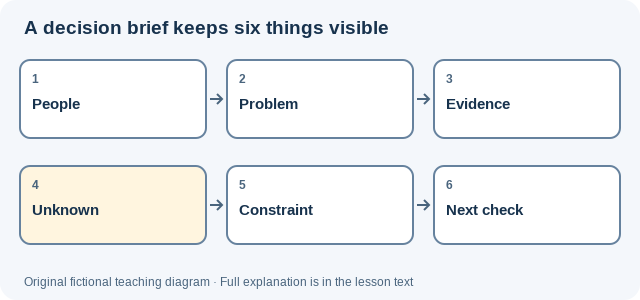
Produce and revise a six-line decision brief: People, Problem, Evidence, Unknown, Constraint and Next check. Point to evidence in your own brief for each of the five essential rubric criteria; a selected option alone is not enough.
STEP 2 OF 6
The idea
A problem describes a difficulty someone experiences while trying to do something. A solution proposes a change. “Buy more equipment” is a solution; it does not yet explain whose difficulty the purchase would address. Define the difficulty before choosing the remedy. Well, we found a shopping list. Now let’s find the problem.
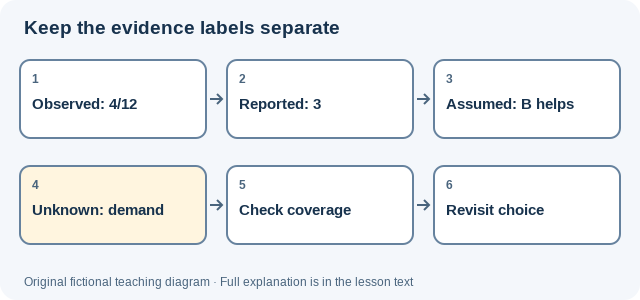
Evidence is something you can inspect, such as a dated return record or a person’s account of their experience. An assumption is an explanation you have not checked. A record can show a late return without explaining its cause. A person’s account matters, but one account does not represent everyone. Keep both the observation and its limits visible.
Look beyond the person requesting the change. Consider users, people who could use the service but currently cannot, and those who run it. Their needs may differ. A useful brief names a practical boundary, then identifies the smallest check that could change the decision. Checking a problem can lead to changing, postponing or abandoning the original idea.
STEP 3 OF 6
The Maple Shelf tool-lending pilot — entirely fictional
Starting point
The coordinator says: “Buy eight more drills so borrowers stop returning tools late.” In this invented case, the log shows 12 loans during a two-week pilot; four came back after the agreed time. Three of those four borrowers said the only return window conflicted with their schedules. No one recorded requests that could not be filled. These are teaching details, not real research findings.
A checkable approach
Reframe it: “Some pilot borrowers could not meet the agreed return time. What is making returns difficult, and what change could help within the existing volunteer hours?” This keeps the decision open: a different return window, clearer instructions or another explanation may matter. The log does not establish that too few drills caused late returns.
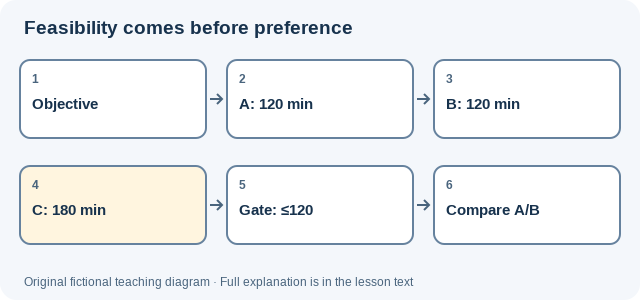
Separate the claims. Observation: four of 12 loans were late in this pilot. Reported experience: three borrowers described a scheduling conflict. Assumption: buying more drills will solve lateness. Unknown: whether the same difficulty affects other borrowers or people who never joined. Constraint: the fictional coordinator can rearrange two volunteer hours per week, but cannot add hours or approve purchases during the next trial.
Another worked interpretation
A different fictional example is a shared reading table that becomes noisy. “Install a screen” is a proposed remedy, while “readers cannot hear a discussion at the agreed table” is a problem description. A six-line brief would separate an observed interruption from an assumed cause, name other room users and state what a check could change. The shape of the brief transfers; the tool-lending facts do not.
Sketch & check
Sketch the six boxes and place “Buy more drills” beside the box where it would be an unsupported leap.
Show diagram-practice feedback
It is a proposed option, not an observed problem or established evidence. Put the underlying difficulty in Problem, keep the remedy provisional, and use Next check to identify information that could support or reject it.
Optional video & watching prompt
University of Basel — Phase 1: problem framing ↗ (new tab)
Optional 5:30 video in a collaborative-research context. The public publisher page and linked English transcript were inspected; playback and caption synchronization were not tested. Rewrite the question from two affected people’s perspectives, then name the shared outcome. Nothing is embedded or played here; no account or response submission is required for this lesson.
Link checked 2026-10-30.
STEP 4 OF 6
Try it yourself
Choose the best next step for Maple Shelf and explain why. Then draft six short lines headed People, Problem, Evidence, Unknown, Constraint and Next check. Use only the fictional facts above; do not invent another survey. Include one affected group beyond current borrowers. Finally, classify “More drills will prevent late returns” as an observation or an assumption, and say what the existing log cannot tell you. Keep a first draft before reading the worked answer. For each of the five rubric criteria, quote a short phrase from your own brief and label it Supported or Not yet supported. Revise a missing or weak part and add a two-sentence revision note: what changed, and why that change better meets a named criterion. If every criterion was already supported, clarify one sentence without adding facts. Use the optional in-tab notes or paper; copy any notes you want to keep before leaving or reloading. Do not collect real people’s information for this exercise.
Fictional exercise · prewritten feedback, no live AI grading.
Write your answer on paper or in your own notes, then compare the options and worked answer.
Practice options
A. Order eight drills: four late returns prove that the service needs more stock.
This jumps from an observed delay to an untested cause. Late returns do not measure unmet demand, and no unfilled requests were recorded. A purchase also exceeds the stated authority. First find out what is making returns difficult.
B. Review the return records and ask about return barriers before choosing a small trial within the existing volunteer hours.
This is the strongest next step. It uses the available evidence while checking its limits. Include volunteers and people who could not join, and ask what happened rather than asking everyone to endorse a preferred answer. The check may support a different return window or reveal a different problem.
C. Move every return to Saturday: three comments prove Saturday will work for everyone.
The comments identify a possible scheduling problem, but they do not specify Saturday or represent all users. A new window could exclude different people or exceed volunteer availability. Check the proposed time before treating it as the solution.
STEP 5 OF 6
Worked answer & self-check
Sufficient evidence example for this introductory task — a worked brief: People: current borrowers, volunteers handling returns and potential borrowers who could not use the pilot; include people with different access needs rather than assuming one group speaks for everyone. Problem: some pilot borrowers are struggling to return tools at the agreed time; we need to understand the barrier before choosing a change. Evidence: the fictional two-week log contains four late returns among 12 loans. Three of those borrowers reported that the return window conflicted with their schedules. Requests that could not be filled were not recorded, so the log cannot establish unmet demand. This is a small local observation, not a prediction of all future borrowing. Unknown: which barriers affect other borrowers and nonparticipants, whether instructions were clear, and whether there is unmet demand for equipment. “More drills will prevent late returns” is an assumption: the log records timing, not the cause of lateness or how a purchase would affect it. Constraint: rearrange, but do not increase, the two volunteer hours per week. No purchasing authority is available for the next trial. Next check: review the existing notes and ask borrowers, volunteers and potential borrowers about the steps and times that caused difficulty. If those checks support it, the coordinator could approve a short trial that reallocates part of the existing return window. Record late and total returns, volunteer time and barriers people report. For example, if potential borrowers report that the proposed alternative window would exclude them, revise that window before a trial; if volunteers cannot cover it within the existing two hours, abandon that option and investigate another barrier. Agree beforehand what would justify continuing, changing or stopping. A small improvement would be a reason to investigate further, not proof of the cause. Other briefs can work. The test is whether the evidence supports the wording and the next check could change your mind. This is a self-check with a worked example, not live grading. Insufficient evidence example: “People want more drills. Four late returns prove a shortage. Buy eight drills, then ask whether people like them.” This does not identify another affected group, assumes a cause, exceeds purchasing authority and tests approval of a purchase rather than an unknown barrier. Merely selecting the strongest option would not repair this brief. Revision example (criterion 3, evidence accuracy): Before: “Four late returns prove a shortage.” After: “Four of 12 loans were late; three of those borrowers reported a scheduling conflict. The log does not record unmet requests or establish the cause.” Revision note: “I replaced a causal claim with the recorded counts and a reported experience. I stated the missing evidence so the next check can investigate rather than assume a cause.” This fixes criterion 3 only; the other four still need evidence. How to judge your work: use the five criteria below as essential checks, not an average score. For each, identify a sentence in your brief that meets its Supported descriptor. Mark a missing requirement Not yet supported, revise it and check again. The worked brief illustrates one defensible answer, not wording you must copy. Your revision note should identify the changed passage and the criterion it now supports. What the player checks: choosing an option displays prewritten reasoning; it does not assess your written brief or revision. Review marks and progress are your own reports, not an independently verified result. No teacher or automated grader evaluates your notes here.
Compare your answer
- 1 · Affected people. Supported: names current borrowers and at least one other affected group (such as volunteers or nonparticipants), without claiming identical needs. Not yet supported: says only “everyone” or treats one group’s account as universal.
- 2 · Open problem. Supported: describes difficulty meeting return times while leaving the remedy undecided. Not yet supported: defines the problem as a need to buy drills or move all returns to a particular day.
- 3 · Evidence accuracy. Supported: uses four late returns among 12 loans and three reports from those late borrowers accurately; distinguishes reports from a proven cause and notes that unmet requests were not recorded. Not yet supported: invents findings or claims the counts prove a shortage or a universal scheduling barrier.
- 4 · Feasible boundary. Supported: keeps any proposed trial within two volunteer hours per week, rearranged rather than increased, with no purchases. Not yet supported: omits the boundary or requires extra hours or purchasing authority.
- 5 · Decision-changing check. Supported: links a next check to a named unknown, includes another affected group, and states how a possible finding could change the proposed action. For example, if an alternative window excludes nonparticipants or cannot fit volunteer hours, revise or abandon that option. Not yet supported: says only “do more research,” invents results, or asks people to approve a solution already chosen.
Give yourself one check for each point your work meets. Revise any missing piece. This is a self-check, not a score sent to a teacher.
STEP 6 OF 6
Recap & next step
- Describe the difficulty before naming a solution.
- An observation, a person’s explanation and a proven cause are different things.
- A useful next check can change the decision; it should not merely confirm your favourite idea.
Return to your first draft and compare it with all five essential criteria. Keep your revised six-line brief, criterion-to-evidence notes and revision explanation in your own notes if useful. Your evidence is ready for your own review when every criterion has a supporting passage and your revision explains what improved; this is not certification or independent verification. Mark reviewed only as your personal progress signal. Continue to Goals, constraints and real options in this expanded course. Content version 1.1 was reviewed on 29 October 2026; source links and assessment wording should be rechecked when this module is revised. This historical version 1.1 review note applies only to the original frame module, not to the expansion. Show all reveals text; it does not complete the task.