LESSON 1 OF 8 · PLANNED 90 MINUTES
Knowledge is more than a stored file
STEP 1 OF 6
Your objective
Distinguish explicit records, tacit judgement and the context needed for useful reuse.
STEP 2 OF 6
The idea
Knowledge management helps a group retain and use what it needs to do its work. A file collection is one possible support, not the goal. Begin with a person, a task and a moment of need: a new display editor needs to decide whether a replacement caption is ready before a fictional preview. The useful question is not “How many documents do we have?” but “Can this editor find, interpret and apply the relevant know-how, or obtain help when it does not cover the case?”
Explicit knowledge can be articulated in a form such as a rule, diagram, example or explanation. Tacit knowledge includes judgement or skill that people may use without fully explaining it. These are working distinctions, not two airtight boxes. A designer might write “leave enough white space” while still relying on experience to recognise a crowded card. Writing that sentence makes part of the idea explicit; it does not automatically transfer the judgement needed to apply it.
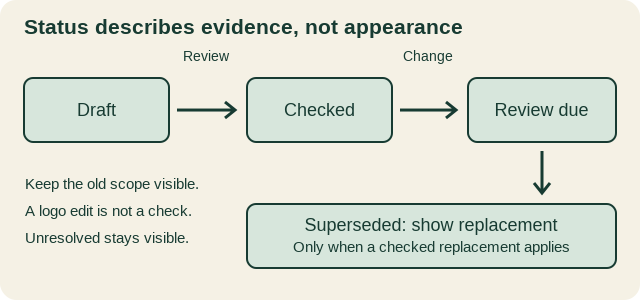
A record becomes more reusable when its context travels with it. State the task, audience, conditions, date, source of authority, known exceptions and where to ask when uncertain. In the fictional Paperbridge display team, “60 words maximum” is incomplete unless the reader knows which card format it concerns and whether it is current. A beautiful old example may illustrate layout without establishing the current rule. An experienced colleague may also remember an obsolete rule sincerely.
Choose a capture method to fit what is missing. A stable limit may need a checked reference card. Judging a borderline layout may need contrasting examples, an explanation of cues and a practice attempt with feedback. A specialist contact may still be necessary when the circumstances change. Do not promise that every kind of expertise can be extracted into text or that collecting everything is worth the maintenance burden.
This course concentrates on knowledge moving between people, tasks and maintained resources. Clear Writing supports readable explanations; Technical Instructions develops executable procedures; Learning & Memory concerns individual study practice. Those are useful neighbours, not substitutes for an organisational knowledge system. Work only with fictional inputs here. No employee interview, personal record, account or disclosure is needed, and the models do not establish real-world competence.
STEP 3 OF 6
Original worked example
Starting point
The team has a folder labelled “Useful stuff”, a checked card stating a 60-word caption limit, and an experienced editor who can spot cramped layouts. A newcomer cannot tell which example applies. What should be preserved?
A checkable approach
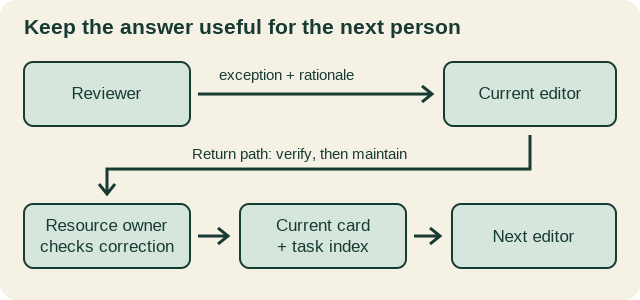
Preserve the checked 60-word rule with its format, owner and review date as explicit knowledge. Capture the editor’s layout cues through two contrasting fictional examples and a commentary on the differences, then let a newcomer explain a new case. Keep a route to the editor role for unresolved judgement. Rename or index the folder by actual tasks. File count alone would not show that the newcomer can use any of this.
All people, roles, records and results in this case are fictional. First try an answer privately; then compare the reasoning, not just the wording.
STEP 4 OF 6
Try it yourself
Use only these fictional inputs. Practice 1: Classify a saved caption template, an editor’s unspoken sense of visual crowding, and a dated note explaining when the template must not be used. Propose a useful next step for each. Practice 2: A manager says that scanning 300 pages has transferred all the team’s expertise. Rewrite the claim and name one test. Complete the three explained checks. Keep your first attempt on paper or in an existing local file before revealing the model.
Fictional exercise · prewritten feedback, no live AI grading.
Navigation within this player keeps your notes. Use the optional notebook Save or Export controls to keep a snapshot before leaving. Nothing typed here is uploaded.
Check 1: Which item most directly represents tacit judgement?
Choose an option to see its reasoning. You can try again. No score is recorded.
Check 2: What is missing from “use the blue template”?
Choose an option to see its reasoning. You can try again. No score is recorded.
Check 3: What is the best evidence of useful transfer in this limited case?
Choose an option to see its reasoning. You can try again. No score is recorded.
STEP 5 OF 6
Worked answer & self-check
Practice 1: The template is an explicit artefact: identify its current version and purpose. The sense of crowding is largely tacit judgement: use contrasting examples and ask what cues matter. The dated exception note is explicit context: connect it to the template and verify whether the exception still applies. Classification alone is not enough; each item needs a reuse path. Partial-credit self-review: 4 points: 1 for the template and verification; 1 for tacit judgement and examples; 1 for explicit exception context; 1 for linking the exception to the template. Award 0 for an unsupported “all files are current” claim. Practice 2: Scanning has created digital copies of 300 pages; coverage, currency and usable expertise are not established. Ask a fictional successor to locate the current caption rule and explain what to do with a borderline layout using the copies. Record the answer, missing context and any help required. A successful test supports that task only. Partial-credit self-review: 4 points: 1 distinguishes copies from transfer; 1 checks currency or context; 1 specifies an observable task; 1 limits the conclusion to the task. Which item most directly represents tacit judgement? A. A dated list of approved card sizes — Not correct. This list states information explicitly; it may still require context and verification. B. Recognising a cramped layout without yet explaining its cues — Correct. The judgement is being used before its relevant cues have been fully articulated. C. A folder containing the same template twice — Not correct. Duplicate files are explicit artefacts, not evidence of an unspoken judgement skill. D. A written 60-word limit — Not correct. A written limit is explicit, although its scope and authority still matter. What is missing from “use the blue template”? A. A larger number of duplicate copies — Not correct. Extra copies do not resolve which task, version or conditions the instruction concerns. B. A guarantee that every editor agrees — Not correct. Universal agreement is not a practical substitute for a checked scope and owner. C. Its task, applicable version and conditions for use — Correct. This context helps a new reader determine whether the template fits the present task. D. A promise of permanent correctness — Not correct. A template can become outdated, so permanent correctness should not be promised. What is the best evidence of useful transfer in this limited case? A. A successor locates the current rule and applies it to a new caption — Correct. The observed task checks both access and application, while supporting only a limited conclusion. B. The folder contains 300 files — Not correct. Document volume does not show that a successor can find or use relevant knowledge. C. The expert says the folder is complete — Not correct. An expert opinion is useful input but does not replace a successor’s application test. D. Every page has the same font — Not correct. Consistent appearance can aid reading but cannot establish currency or practical understanding. Keep your first attempt, explain one correction and try the changed case again. These are prewritten models, not automated or instructor grading. A defensible alternative may earn the stated criteria without matching this wording.
Compare your answer
- 4 points: 1 for the template and verification; 1 for tacit judgement and examples; 1 for explicit exception context; 1 for linking the exception to the template. Award 0 for an unsupported “all files are current” claim.
- 4 points: 1 distinguishes copies from transfer; 1 checks currency or context; 1 specifies an observable task; 1 limits the conclusion to the task.
- Distinguishes supplied facts from assumptions, missing knowledge and proposed tests.
- Makes a specific revision; does not treat a model or a review mark as observed performance.
Give yourself one check for each point your work meets. Revise any missing piece. This is a self-check, not a score sent to a teacher.
STEP 6 OF 6
Recap & next step
- Start with a person and task, not a repository.
- Preserve context along with explicit records.
- Use examples and practice for judgement that text alone may not transfer.
Save useful notes privately if wanted. Review marks record review only; Show all reveals text, not completed exercises or a tested handoff. Use the project pack to carry this lesson into your knowledge-handoff kit.
A personal record of review; no grade or certificate.