Build a realistic study routine with original tasks, delayed checks and cautious interpretation
Basic reading and evidence literacy. Paper or an existing local document is sufficient. No accounts, paid software, personal records or recruitment required.
Eight original lessons, eight worked examples, 16 solved practices and 24 individually explained checks. Proposed workload: 20 active hours across two to three weeks, including a two-week project; an unpiloted estimate. Show all reveals text only and cannot complete delayed practice. Educational strategies, not diagnosis, treatment, a psychology degree, accreditation or guaranteed grades. Local self-review only; no personal uploads required.
Distinguish recognition, recall and transfer through observable tasks.
Use a limited encoding, storage and retrieval model without diagnostic claims.
Construct retrieval prompts, feedback and a realistic spaced plan.
Compare confidence and delayed performance with explicit uncertainty.
Complete a two-week record and revise a plan without claiming causal proof.
Distinguish recognition, unaided recall and transfer using observable tasks.
STEP 2 OF 6
The idea
Learning is a change that can support later performance. A page looking familiar is an experience, not proof that you can explain its meaning tomorrow. Recognition asks whether something matches information encountered before. Recall asks you to produce information without seeing the answer. Transfer asks you to use an idea in a changed situation. Each task supplies different evidence; none is a complete measurement of a person.
Consider a fictional parcel rule: a blue label goes to shelf B, unless its corner is torn, in which case it goes to inspection. Recognising the sentence is easier than producing both the main rule and its exception. Applying it to an unfamiliar torn blue label tests whether you can use the exception rather than merely repeat the shelf letter. A mistake can identify a missing condition instead of proving that you cannot learn.
Begin with a practical outcome and an observable check. “Understand the rule” is vague. “Sort four new examples and explain the exception without the sheet” is testable. Keep the initial attempt, compare with a complete answer and explain the correction. Repeating an answer immediately after reading it is useful rehearsal but weak evidence of later independent access.
This course uses original fictional topics so no personal records or external account are needed. You may use paper or a local document. Its questions are learning exercises, not diagnostic tests, IQ measures or a promise of grades. A lesson review mark means that you reviewed the lesson; it does not certify mastery. The project requires real delayed attempts, recorded honestly rather than filled in from the model.
STEP 3 OF 6
Original worked example
Starting point
A learner recognises “torn corner” on the sheet but sends a torn blue parcel to B. What evidence is missing?
A checkable approach
Recognition is present, but correct application of the exception is not. Ask the learner to explain the condition, then sort a new torn blue example without looking. Record the first error and later correction separately.
Try the two independent tasks before comparing the worked answers. A successful attempt here is evidence for this task, not a universal measure of ability.
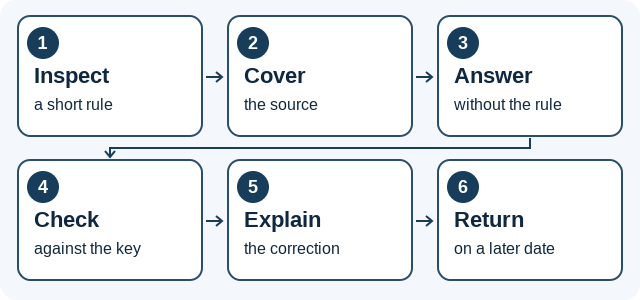
Inspect a short rule → cover it → give an unaided answer → check the key → explain the correction → return on a later date. This is a study workflow, not a model of the brain. Keep the first answer and record actual dates.
Keep the first answer and the correction
In the fictional parcel task, a learner first sends a torn blue parcel to shelf B. After checking, they record: “Inspection: the torn-corner exception applies.” The original answer remains in the log. Copying the correction shows that feedback was used; it does not establish unaided recall. A later closed-source example can supply additional evidence.
Sketch & check
Sketch the six stages. A learner reads the parcel rule, leaves it visible while answering, then copies the model and marks tomorrow’s check complete today. Identify two unsupported claims and write a better record. Keep your attempt before opening the feedback.
Show diagram-practice feedback
The visible rule means unaided recall was not tested, and tomorrow’s check has not occurred. Record “answered with reference support; correction copied; delayed check planned.” Keep the initial answer, cover the rule for the next attempt, and record the later date only when it happens. Self-check: one point for identifying reference support; one point for identifying the unobserved delay; one point for preserving the first answer and correction; one point for a later check plan. Equivalent wording is acceptable. This is self-review, not automatic grading.
Optional: choose Retrieval Practice under Strategy Videos for the Classroom. Publisher page checked October 30, 2026; underlying playback and captions not tested. Ask which stage requires producing an answer without the rule visible. This lesson provides all required explanation and practice without the video. External policies and tracking may apply after following the link; nothing is embedded here. No copying or reuse permission is inferred.
Link checked 2026-10-30.
STEP 4 OF 6
Try it yourself
Keep an unaided attempt before opening the model. Practice 1: Write one recall question and one transfer question for the parcel rule. Practice 2: A learner answers correctly with the sheet open. Write a cautious result statement. Complete the three independent checks below. Use only original fictional topics; record actual attempts privately on paper or in an existing local file.
Fictional exercise · prewritten feedback, no live AI grading.
Write your answer on paper or in your own notes, then compare the options and worked answer.
Check 1: A familiar page most directly establishes what?
A. Permanent mastery
Not correct. Familiarity alone does not establish durable performance.
B. A feeling of recognition
Correct. Recognition can occur without producing or applying an answer.
C. Correct transfer
Not correct. Transfer requires an application task in a changed context.
D. A diagnosis
Not correct. This classroom observation cannot establish a clinical diagnosis.
Check 2: Which task most directly checks recall?
A. Copy the rule
Not correct. Copying supplies the answer during the task.
B. Look at the heading
Not correct. A heading does not require producing the rule.
C. Explain the rule with the sheet closed
Correct. Producing the rule without its text checks unaided access.
D. Highlight every sentence
Not correct. Highlighting does not demonstrate unaided production of meaning.
Check 3: What does a review mark mean here?
A. The lesson was reviewed
Correct. It records review, not demonstrated competence or elapsed time.
B. A qualification was earned
Not correct. The course does not award an accredited qualification.
C. All future problems will be solved
Not correct. One review cannot guarantee performance on future tasks.
D. Two weeks have elapsed
Not correct. A button cannot establish that a delay actually occurred.
STEP 5 OF 6
Worked answer & self-check
Practice 1: Recall: What happens to a blue label with a torn corner? Transfer: A blue label has a torn corner but the shelf B space is empty; where should it go and why? Both answers are inspection, because the exception applies regardless of space.
Practice 2: The learner applied the rule with reference support. Unaided recall and delayed performance were not tested. Do not relabel this as independent mastery.
A familiar page most directly establishes what?
A. Permanent mastery — Not correct. Familiarity alone does not establish durable performance.
B. A feeling of recognition — Correct. Recognition can occur without producing or applying an answer.
C. Correct transfer — Not correct. Transfer requires an application task in a changed context.
D. A diagnosis — Not correct. This classroom observation cannot establish a clinical diagnosis.
Which task most directly checks recall?
A. Copy the rule — Not correct. Copying supplies the answer during the task.
B. Look at the heading — Not correct. A heading does not require producing the rule.
C. Explain the rule with the sheet closed — Correct. Producing the rule without its text checks unaided access.
D. Highlight every sentence — Not correct. Highlighting does not demonstrate unaided production of meaning.
What does a review mark mean here?
A. The lesson was reviewed — Correct. It records review, not demonstrated competence or elapsed time.
B. A qualification was earned — Not correct. The course does not award an accredited qualification.
C. All future problems will be solved — Not correct. One review cannot guarantee performance on future tasks.
D. Two weeks have elapsed — Not correct. A button cannot establish that a delay actually occurred.
Revision: Explain an error and try a changed problem without the model. These are prewritten answers, not automated or instructor grading.
Compare your answer
Keeps an initial attempt separate from the model answer.
Explains the reasoning and the limits of the evidence.
Records actual dates and outcomes without filling missing results.
Makes a specific revision and plans a later check.
Give yourself one check for each point your work meets. Revise any missing piece. This is a self-check, not a score sent to a teacher.
STEP 6 OF 6
Recap & next step
Match the check to the claimed outcome.
Familiarity is not the same as recall.
Preserve mistakes as evidence for revision.
Save your work locally if wanted. Review marks record reading only. Show all reveals text; it does not complete practice, elapsed delays or the two-week project.
Use a limited memory model without treating it as a complete account of the brain.
STEP 2 OF 6
The idea
Encoding describes processing information when encountering it. Storage describes its retention over time. Retrieval describes accessing it later. These are useful functional descriptions, not three literal boxes inside the brain. Failure to answer a question can have several explanations: the material was not understood initially, a detail was forgotten, the cue was unclear or the task demanded a different application. A single classroom error cannot identify a biological cause.
Make meaning explicit at first study. Restate a rule, connect its conditions and explain an example. In our fictional archive, a sealed envelope goes to cabinet S, while an unsealed one goes to review. Memorising the letter S without the condition can support a correct-looking answer to one question and a wrong answer to the next. Explaining why a changed example goes to review helps expose the missing relationship.
Cues matter. A prompt saying “Where does it go?” supplies less context than one describing the envelope and asking for its destination. A cue that includes the correct cabinet letter, however, can make the task too easy to show unaided access. Decide what information the learner should receive in the actual target task, and make the practice cue comparable. Avoid making every test a disguised copy of the answer.
This model does not justify assigning yourself a fixed visual, auditory or other learning type. Choose representations that suit the material and accessibility needs, then check performance. A diagram can clarify a route; words can explain its exceptions. Preferences are real preferences but are not proof that only one presentation can teach you. Nothing here diagnoses memory difficulties or replaces qualified health advice.
STEP 3 OF 6
Original worked example
Starting point
A learner memorises “S” but cannot sort an unsealed envelope. Is more repetition of S sufficient?
A checkable approach
Not necessarily. The initial representation omitted the condition. Restate “sealed → S; unsealed → review,” explain both examples, then check a new case without looking. This repairs the specific rule rather than guessing at a brain-level cause.
Try the two independent tasks before comparing the worked answers. A successful attempt here is evidence for this task, not a universal measure of ability.
STEP 4 OF 6
Try it yourself
Keep an unaided attempt before opening the model. Practice 1: Give two possible explanations for an incorrect delayed answer. Practice 2: Revise “Where?” into a usable task cue without giving the answer. Complete the three independent checks below. Use only original fictional topics; record actual attempts privately on paper or in an existing local file.
Fictional exercise · prewritten feedback, no live AI grading.
Write your answer on paper or in your own notes, then compare the options and worked answer.
Check 1: Encoding, storage and retrieval are used here as what?
A. Literal brain rooms
Not correct. The labels do not describe literal rooms or containers.
B. A complete clinical theory
Not correct. This simplified course model is not a complete clinical account.
C. Proof of fixed learning types
Not correct. These processes do not establish fixed learning-type prescriptions.
D. Functional descriptions
Correct. They describe useful aspects of learning with explicit limits.
Check 2: An incorrect answer proves which cause?
A. None by itself
Correct. Several explanations remain possible without additional evidence.
B. Permanent inability
Not correct. One error does not establish an enduring inability to learn.
C. A storage disorder
Not correct. A classroom response cannot diagnose a medical condition.
D. The teacher is wrong
Not correct. An error alone does not establish whose explanation is wrong.
Check 3: How should presentation choices be evaluated?
A. Only by colour preference
Not correct. Preference alone does not show that learning occurred.
B. By task needs, access and performance
Correct. Suitability and observed task performance are relevant evidence.
C. By a fixed personality label
Not correct. A label does not determine the only effective representation.
D. By the longest animation
Not correct. Animation length is not evidence of improved understanding.
STEP 5 OF 6
Worked answer & self-check
Practice 1: The initial rule may have been misunderstood, or the later prompt may have been ambiguous. Forgetting is another possibility. One error does not distinguish these explanations.
Practice 2: An envelope is unsealed. Under the archive rule, which destination should receive it, and why? The answer is review because the sealed condition is not met.
Encoding, storage and retrieval are used here as what?
A. Literal brain rooms — Not correct. The labels do not describe literal rooms or containers.
B. A complete clinical theory — Not correct. This simplified course model is not a complete clinical account.
C. Proof of fixed learning types — Not correct. These processes do not establish fixed learning-type prescriptions.
D. Functional descriptions — Correct. They describe useful aspects of learning with explicit limits.
An incorrect answer proves which cause?
A. None by itself — Correct. Several explanations remain possible without additional evidence.
B. Permanent inability — Not correct. One error does not establish an enduring inability to learn.
C. A storage disorder — Not correct. A classroom response cannot diagnose a medical condition.
D. The teacher is wrong — Not correct. An error alone does not establish whose explanation is wrong.
How should presentation choices be evaluated?
A. Only by colour preference — Not correct. Preference alone does not show that learning occurred.
B. By task needs, access and performance — Correct. Suitability and observed task performance are relevant evidence.
C. By a fixed personality label — Not correct. A label does not determine the only effective representation.
D. By the longest animation — Not correct. Animation length is not evidence of improved understanding.
Revision: Explain an error and try a changed problem without the model. These are prewritten answers, not automated or instructor grading.
Compare your answer
Keeps an initial attempt separate from the model answer.
Explains the reasoning and the limits of the evidence.
Records actual dates and outcomes without filling missing results.
Makes a specific revision and plans a later check.
Give yourself one check for each point your work meets. Revise any missing piece. This is a self-check, not a score sent to a teacher.
STEP 6 OF 6
Recap & next step
Use the model cautiously.
Explain conditions, not just labels.
Avoid diagnostic conclusions from practice errors.
Save your work locally if wanted. Review marks record reading only. Show all reveals text; it does not complete practice, elapsed delays or the two-week project.
Construct prompts that require an attempt, then use corrective feedback.
STEP 2 OF 6
The idea
Retrieval practice means trying to produce an answer before seeing it. It can expose gaps that rereading conceals. Close the model, attempt the explanation or problem, then compare with a reasoned solution. If you cannot answer, record that honestly, study the relevant explanation and try again later. Sitting indefinitely with an impossible question is not the goal; feedback and a manageable next task are part of the process.
Write prompts that match the intended knowledge. For a conditional rule, ask for the condition and an example; for a process, ask for ordered steps and why their order matters. A prompt that gives the answer inside its wording does little to test independent production. Multiple-choice questions can help, but choosing a familiar phrase is not the same as generating an explanation. Add short-answer and changed-example tasks.
The September 2007 IES guide gives strong evidence to its recommendation on quizzes that revisit key content, while introductory pre-questions receive a minimal evidence rating. Those are the guide’s ratings for specific recommendations, not a guarantee that every quiz design helps every learner. A test used for grading, a low-stakes practice attempt and a prompt asked before instruction have different purposes.
Correct feedback explains the relevant distinction. “Wrong” alone supplies little direction; “the torn corner activates the inspection exception” identifies what to change. Retain the original response rather than replacing it silently with the model. A corrected answer copied from feedback should be labelled corrected, not counted as an unaided first success. Make the next attempt new enough to require thought without changing the skill being practised.
STEP 3 OF 6
Original worked example
Starting point
A flashcard says “A torn blue parcel goes to inspection, correct?” Improve it.
A checkable approach
Ask “A blue parcel has a torn corner. Where does it go, and which condition decides?” Attempt first, then reveal inspection because the torn-corner exception overrides the usual shelf B rule.
Try the two independent tasks before comparing the worked answers. A successful attempt here is evidence for this task, not a universal measure of ability.
STEP 4 OF 6
Try it yourself
Keep an unaided attempt before opening the model. Practice 1: Write corrective feedback for “all blue parcels go to B.” Practice 2: How should a blank attempt followed by a copied answer be recorded? Complete the three independent checks below. Use only original fictional topics; record actual attempts privately on paper or in an existing local file.
Fictional exercise · prewritten feedback, no live AI grading.
Write your answer on paper or in your own notes, then compare the options and worked answer.
Check 1: What should come before revealing the model?
A. An unaided attempt
Correct. An attempt supplies evidence of what was accessible beforehand.
B. A copied answer
Not correct. Copying removes the intended independent retrieval opportunity.
C. An invented success
Not correct. Inventing success makes the learning record unreliable.
D. A mastery badge
Not correct. A badge cannot replace an attempt at the task.
Check 2: What did the 2007 guide rate strong here?
A. Every pre-question
Not correct. Introductory pre-questions received a different, minimal rating.
B. Every commercial quiz app
Not correct. The guide does not endorse every application or product.
C. Quizzes revisiting key content
Correct. This rating applies to the guide’s specified recommendation.
D. Guaranteed perfect recall
Not correct. Evidence ratings are not guarantees of individual outcomes.
Check 3: Which feedback best supports revision?
A. Wrong, try harder
Not correct. This does not identify the missing condition or reasoning.
B. The exception applies because the corner is torn
Correct. It identifies the condition that changes the destination.
C. You are bad at learning
Not correct. A personal label does not explain the task error.
D. Ignore the first response
Not correct. Keeping the first response helps identify what changed.
STEP 5 OF 6
Worked answer & self-check
Practice 1: The usual destination is B, but the rule includes a torn-corner exception. A torn blue parcel goes to inspection. Try a new example and explain which condition applies.
Practice 2: Record “no unaided answer,” then the model-assisted correction separately. Do not count the copied correction as an initially correct retrieval.
What should come before revealing the model?
A. An unaided attempt — Correct. An attempt supplies evidence of what was accessible beforehand.
B. A copied answer — Not correct. Copying removes the intended independent retrieval opportunity.
C. An invented success — Not correct. Inventing success makes the learning record unreliable.
D. A mastery badge — Not correct. A badge cannot replace an attempt at the task.
What did the 2007 guide rate strong here?
A. Every pre-question — Not correct. Introductory pre-questions received a different, minimal rating.
B. Every commercial quiz app — Not correct. The guide does not endorse every application or product.
C. Quizzes revisiting key content — Correct. This rating applies to the guide’s specified recommendation.
D. Guaranteed perfect recall — Not correct. Evidence ratings are not guarantees of individual outcomes.
Which feedback best supports revision?
A. Wrong, try harder — Not correct. This does not identify the missing condition or reasoning.
B. The exception applies because the corner is torn — Correct. It identifies the condition that changes the destination.
C. You are bad at learning — Not correct. A personal label does not explain the task error.
D. Ignore the first response — Not correct. Keeping the first response helps identify what changed.
Revision: Explain an error and try a changed problem without the model. These are prewritten answers, not automated or instructor grading.
Compare your answer
Keeps an initial attempt separate from the model answer.
Explains the reasoning and the limits of the evidence.
Records actual dates and outcomes without filling missing results.
Makes a specific revision and plans a later check.
Give yourself one check for each point your work meets. Revise any missing piece. This is a self-check, not a score sent to a teacher.
STEP 6 OF 6
Recap & next step
Attempt before revealing.
Use explanations, not just answer letters.
Keep corrected and unaided results distinct.
Save your work locally if wanted. Review marks record reading only. Show all reveals text; it does not complete practice, elapsed delays or the two-week project.
Build a distributed plan and distinguish active work from calendar delay.
STEP 2 OF 6
The idea
Spacing distributes encounters with material across time rather than placing all work in one sitting. The 2007 IES guide rates its spacing recommendation moderate. It discusses later review over weeks and months; it does not prescribe one perfect interval for every subject, deadline or learner. Our two-week project is a practical small study routine, not a validation of an optimal schedule.
A plan should name the task, its duration and its next date. Initial explanation on day 1, retrieval on day 3, application on day 7 and a delayed check on day 14 is one feasible example. The days are a proposal, not magic numbers. Adjust around real commitments and record actual times. Do not make up a day 7 attempt because you missed it. Reschedule and state what changed.
Keep active study time separate from elapsed calendar time. Four 20-minute sessions total 80 active minutes even when spread across 14 days. Waiting itself is not 14 days of active study. Conversely, reading all the lesson text in one evening cannot satisfy the project’s delayed observations. The player’s Show all control changes text presentation only; no button proves that the planned interval occurred.
Comparisons require care. If the spaced plan receives 80 minutes and the single sitting receives only 20, a later difference could reflect study time rather than spacing alone. Even matched time does not eliminate topic difficulty, prior knowledge or fatigue. Use the plan to guide your own revision and describe limits. An imperfect completed plan with honest dates is more useful than a perfect-looking fictional record presented as real.
STEP 3 OF 6
Original worked example
Starting point
Four sessions last 15, 20, 20 and 25 minutes on days 1, 3, 7 and 14. State the workload and delay.
A checkable approach
Active work is 15 + 20 + 20 + 25 = 80 minutes. The final check occurs 13 calendar days after day 1 if both occur at the same time of day. This is a plan spanning two calendar weeks, not 14 days of continuous study.
Try the two independent tasks before comparing the worked answers. A successful attempt here is evidence for this task, not a universal measure of ability.
STEP 4 OF 6
Try it yourself
Keep an unaided attempt before opening the model. Practice 1: Plan four 15-minute sessions across two calendar weeks. Practice 2: Day 8 is missed. What should the log show? Complete the three independent checks below. Use only original fictional topics; record actual attempts privately on paper or in an existing local file.
Fictional exercise · prewritten feedback, no live AI grading.
Write your answer on paper or in your own notes, then compare the options and worked answer.
Check 1: Four 20-minute sessions equal how much active work?
A. 14 days
Not correct. Calendar span is different from active study duration.
B. 20 minutes
Not correct. Each of the four sessions contributes to the total.
C. 80 minutes
Correct. Four multiplied by 20 gives 80 active minutes.
D. An unknown number of degrees
Not correct. Academic degrees are unrelated to this time calculation.
Check 2: Which spacing claim is justified here?
A. Day 3 is universally optimal
Not correct. The guide does not establish that universal schedule.
B. No spacing can ever help
Not correct. This absolute claim contradicts the qualified evidence presented.
C. A missed session must be hidden
Not correct. Hiding a deviation makes the record misleading.
D. Intervals should fit the task and be recorded
Correct. A realistic plan and honest dates support useful review.
Check 3: Show all text accomplishes what?
A. Reveals content, not elapsed practice
Correct. Presentation controls cannot establish time or practical performance.
B. Completes a two-week study
Not correct. Reading immediately cannot supply a later observation.
C. Creates delayed scores
Not correct. Scores require actual attempts, not a display change.
D. Certifies memory
Not correct. This course provides no clinical or mastery certification.
STEP 5 OF 6
Worked answer & self-check
Practice 1: One acceptable plan is days 1, 4, 8 and 14: understand, retrieve with feedback, apply to new examples, delayed check. Active total is 60 minutes. Record actual dates and deviations.
Practice 2: Mark day 8 missed, with no result. Add the actual rescheduled date if the task is later attempted. Do not invent a score or claim the original delay was preserved.
Four 20-minute sessions equal how much active work?
A. 14 days — Not correct. Calendar span is different from active study duration.
B. 20 minutes — Not correct. Each of the four sessions contributes to the total.
C. 80 minutes — Correct. Four multiplied by 20 gives 80 active minutes.
D. An unknown number of degrees — Not correct. Academic degrees are unrelated to this time calculation.
Which spacing claim is justified here?
A. Day 3 is universally optimal — Not correct. The guide does not establish that universal schedule.
B. No spacing can ever help — Not correct. This absolute claim contradicts the qualified evidence presented.
C. A missed session must be hidden — Not correct. Hiding a deviation makes the record misleading.
D. Intervals should fit the task and be recorded — Correct. A realistic plan and honest dates support useful review.
Show all text accomplishes what?
A. Reveals content, not elapsed practice — Correct. Presentation controls cannot establish time or practical performance.
B. Completes a two-week study — Not correct. Reading immediately cannot supply a later observation.
C. Creates delayed scores — Not correct. Scores require actual attempts, not a display change.
D. Certifies memory — Not correct. This course provides no clinical or mastery certification.
Revision: Explain an error and try a changed problem without the model. These are prewritten answers, not automated or instructor grading.
Compare your answer
Keeps an initial attempt separate from the model answer.
Explains the reasoning and the limits of the evidence.
Records actual dates and outcomes without filling missing results.
Makes a specific revision and plans a later check.
Give yourself one check for each point your work meets. Revise any missing piece. This is a self-check, not a score sent to a teacher.
STEP 6 OF 6
Recap & next step
Schedule specific tasks.
Active time and elapsed time differ.
Record missed sessions as missing.
Save your work locally if wanted. Review marks record reading only. Show all reveals text; it does not complete practice, elapsed delays or the two-week project.
Alternate explained models with independent applications and vary relevant features.
STEP 2 OF 6
The idea
A worked example shows both a result and how it follows. Study why each step is justified rather than copying its surface pattern. Then hide the model and try a related problem. The 2007 IES guide gives moderate evidence to alternating worked solutions with problem-solving exercises. This supports a teaching sequence, not a requirement to remove help before a learner understands the basic task.
Our fictional box rule calculates a score as two times the number of green tokens plus the number of white tokens. For three green and two white tokens, the score is 2 × 3 + 2 = 8. The two counts represent different contributions. Explaining that distinction is more useful than memorising the digits 3, 2 and 8. A later example can change the counts while retaining the rule.
Transfer involves a changed context, but not every change is equally difficult. Replacing token colours with labelled weights may preserve the same relationship. Introducing a new exception changes the task more deeply and requires new instruction or explicit information. If a learner fails after the rule itself changed without notice, do not attribute the failure solely to poor transfer.
Fade support gradually: first read a complete explanation, then fill a missing step, then solve a new problem and explain the reasoning. Check both result and method. A lucky correct number is not the same evidence as a justified solution. A slow correct solution may still show understanding. Use errors to choose the next example rather than forcing an unsupported claim of mastery from one success.
STEP 3 OF 6
Original worked example
Starting point
A box has three green tokens and two white tokens. Green tokens count twice and white tokens once. Find the score.
A checkable approach
Compute 2 × 3 = 6 for green, then 1 × 2 = 2 for white. Add 6 + 2 = 8. The multiplier applies to green count, not to the combined count.
Try the two independent tasks before comparing the worked answers. A successful attempt here is evidence for this task, not a universal measure of ability.
STEP 4 OF 6
Try it yourself
Keep an unaided attempt before opening the model. Practice 1: Find the score for four green and one white token; explain the calculation. Practice 2: A new setting calls green tokens “double units” and white tokens “single units.” Find the score for two double and five single units. Complete the three independent checks below. Use only original fictional topics; record actual attempts privately on paper or in an existing local file.
Fictional exercise · prewritten feedback, no live AI grading.
Write your answer on paper or in your own notes, then compare the options and worked answer.
Check 1: Which expression follows the stated rule for four green and one white?
A. 2 × (4 + 1)
Not correct. This incorrectly doubles the white contribution as well.
B. 4 + 1
Not correct. This omits the double contribution of green tokens.
C. 2 × 4 + 1
Correct. It doubles green and adds the single white contribution.
D. 4 × 1
Not correct. Multiplying the counts is not the stated scoring rule.
Check 2: A useful next task after a worked example is what?
A. Copy the same digits indefinitely
Not correct. Repetition of digits alone does not test the relationship.
B. Solve a related new case without the model
Correct. This checks independent use of the illustrated reasoning.
C. Claim broad mastery
Not correct. One example cannot establish competence across all contexts.
D. Skip all feedback
Not correct. Feedback helps identify and repair specific misunderstandings.
Check 3: If a new problem changes the rule silently, failure proves what?
A. A fixed inability
Not correct. The unannounced change is an alternative explanation.
B. Universal failure of examples
Not correct. One poorly specified task cannot settle an entire approach.
C. A diagnosed memory problem
Not correct. This is not a clinical assessment or diagnosis.
D. No clear transfer conclusion by itself
Correct. Task changes must be considered before interpreting the result.
STEP 5 OF 6
Worked answer & self-check
Practice 1: 2 × 4 + 1 = 9. Green contributes 8 and white contributes 1.
Practice 2: 2 × 2 + 5 = 9. The labels changed but the contributions remained two and one. If the new setting had changed the rule, this calculation would need reconsideration.
Which expression follows the stated rule for four green and one white?
A. 2 × (4 + 1) — Not correct. This incorrectly doubles the white contribution as well.
B. 4 + 1 — Not correct. This omits the double contribution of green tokens.
C. 2 × 4 + 1 — Correct. It doubles green and adds the single white contribution.
D. 4 × 1 — Not correct. Multiplying the counts is not the stated scoring rule.
A useful next task after a worked example is what?
A. Copy the same digits indefinitely — Not correct. Repetition of digits alone does not test the relationship.
B. Solve a related new case without the model — Correct. This checks independent use of the illustrated reasoning.
C. Claim broad mastery — Not correct. One example cannot establish competence across all contexts.
D. Skip all feedback — Not correct. Feedback helps identify and repair specific misunderstandings.
If a new problem changes the rule silently, failure proves what?
A. A fixed inability — Not correct. The unannounced change is an alternative explanation.
B. Universal failure of examples — Not correct. One poorly specified task cannot settle an entire approach.
C. A diagnosed memory problem — Not correct. This is not a clinical assessment or diagnosis.
D. No clear transfer conclusion by itself — Correct. Task changes must be considered before interpreting the result.
Revision: Explain an error and try a changed problem without the model. These are prewritten answers, not automated or instructor grading.
Compare your answer
Keeps an initial attempt separate from the model answer.
Explains the reasoning and the limits of the evidence.
Records actual dates and outcomes without filling missing results.
Makes a specific revision and plans a later check.
Give yourself one check for each point your work meets. Revise any missing piece. This is a self-check, not a score sent to a teacher.
STEP 6 OF 6
Recap & next step
Explain why each step works.
Alternate models and attempts.
Separate changed labels from changed rules.
Save your work locally if wanted. Review marks record reading only. Show all reveals text; it does not complete practice, elapsed delays or the two-week project.
Compare predictions with performance without diagnosing or overinterpreting a small sample.
STEP 2 OF 6
The idea
Confidence is a prediction or judgment, not an answer key. Before attempting a question, estimate how likely you are to answer correctly. Then compare with the actual outcome using a predefined scoring rule. Someone who expects eight successes in ten attempts but gets five has overpredicted that set by three. That observation is specific to those tasks and conditions, not a fixed personality label.
Delay can reduce the influence of the answer still being visible or freshly repeated. The 2007 IES guide gives minimal evidence to teaching delayed judgments of learning for allocating study time, and minimal evidence to its separate recommendation on using tests to identify material needing study. Minimal is a rating of the supporting evidence in that guide, not proof that an approach is useless or that every confident judgment is inaccurate.
Use a simple prediction such as likely correct, unsure or likely incorrect if percentage estimates feel artificially precise. Keep the prediction before the response and the response before the model. If you revise your confidence after seeing the answer, label it a later judgment rather than replacing the original. Without this order, the comparison no longer measures the initial prediction.
Look for actionable mismatches. High confidence with an incorrect answer suggests reviewing that concept and testing a changed example. Low confidence with a correct answer suggests checking whether reasoning was sound or the answer was a guess. Neither pattern alone establishes a health concern. Avoid ranking your worth by the score; the purpose is to allocate attention and improve the next practice plan.
STEP 3 OF 6
Original worked example
Starting point
A learner predicts 8 correct out of 10 and achieves 5 correct. Interpret cautiously.
A checkable approach
The prediction exceeded the observed count by 3 on this set. Review which items were overpredicted. Ten items do not establish a stable trait, and different topic difficulty or scoring could change the comparison.
Try the two independent tasks before comparing the worked answers. A successful attempt here is evidence for this task, not a universal measure of ability.
STEP 4 OF 6
Try it yourself
Keep an unaided attempt before opening the model. Practice 1: Prediction is 6 correct out of 8; actual result is 7. Calculate the difference. Practice 2: A learner changes “unsure” to “certain” after seeing the answer. How should the record be repaired? Complete the three independent checks below. Use only original fictional topics; record actual attempts privately on paper or in an existing local file.
Fictional exercise · prewritten feedback, no live AI grading.
Write your answer on paper or in your own notes, then compare the options and worked answer.
Check 1: Confidence should be recorded when?
A. After copying the model
Not correct. This would reflect knowledge of the supplied answer.
B. Only after scoring
Not correct. That timing cannot preserve the original prediction.
C. Before the attempt or answer reveal
Correct. The ordering allows a meaningful comparison with performance.
D. Never
Not correct. A cautious prediction can be useful when recorded honestly.
Check 2: Minimal evidence in this guide means what?
A. Limited support for that specific recommendation
Correct. It describes the guide’s evidence rating, not an absolute verdict.
B. Proven useless forever
Not correct. A limited evidence rating is not proof of no effect.
C. Guaranteed effective for everyone
Not correct. The rating cannot guarantee any individual outcome.
D. A learner has a disorder
Not correct. Research ratings do not diagnose an individual learner.
Check 3: Eight predicted successes and five actual successes indicate what?
A. Three underpredicted successes
Not correct. The prediction was higher, not lower, than the result.
B. Three overpredicted successes on this set
Correct. Subtracting five from eight gives the set-specific excess.
C. Perfect calibration
Not correct. Prediction and performance differ, so they do not match here.
D. A permanent trait
Not correct. One small set cannot establish a stable personal characteristic.
STEP 5 OF 6
Worked answer & self-check
Practice 1: The prediction underestimates actual success by 1. This is a set-specific discrepancy, not proof of permanent underconfidence.
Practice 2: Keep the original unsure prediction and add the later certain judgment separately. If the original is no longer known, mark it unavailable rather than reconstructing it as fact.
Confidence should be recorded when?
A. After copying the model — Not correct. This would reflect knowledge of the supplied answer.
B. Only after scoring — Not correct. That timing cannot preserve the original prediction.
C. Before the attempt or answer reveal — Correct. The ordering allows a meaningful comparison with performance.
D. Never — Not correct. A cautious prediction can be useful when recorded honestly.
Minimal evidence in this guide means what?
A. Limited support for that specific recommendation — Correct. It describes the guide’s evidence rating, not an absolute verdict.
B. Proven useless forever — Not correct. A limited evidence rating is not proof of no effect.
C. Guaranteed effective for everyone — Not correct. The rating cannot guarantee any individual outcome.
D. A learner has a disorder — Not correct. Research ratings do not diagnose an individual learner.
Eight predicted successes and five actual successes indicate what?
A. Three underpredicted successes — Not correct. The prediction was higher, not lower, than the result.
B. Three overpredicted successes on this set — Correct. Subtracting five from eight gives the set-specific excess.
C. Perfect calibration — Not correct. Prediction and performance differ, so they do not match here.
D. A permanent trait — Not correct. One small set cannot establish a stable personal characteristic.
Revision: Explain an error and try a changed problem without the model. These are prewritten answers, not automated or instructor grading.
Compare your answer
Keeps an initial attempt separate from the model answer.
Explains the reasoning and the limits of the evidence.
Records actual dates and outcomes without filling missing results.
Makes a specific revision and plans a later check.
Give yourself one check for each point your work meets. Revise any missing piece. This is a self-check, not a score sent to a teacher.
STEP 6 OF 6
Recap & next step
Record predictions before feedback.
Use mismatches to guide revision.
Avoid fixed labels from small samples.
Save your work locally if wanted. Review marks record reading only. Show all reveals text; it does not complete practice, elapsed delays or the two-week project.
Compare two original topic packs while identifying alternative explanations.
STEP 2 OF 6
The idea
The downloadable project supplies two invented routing topics with the same number of rules, similar exceptions and complete answer keys. They are designed to be comparable, not proven equally difficult. One can be studied by rereading and the other by attempted retrieval with feedback for equal planned time. This is an optional small comparison of study routines, not an experiment that can establish a universal best method.
Choose the scoring rule and check dates before studying. Keep study duration, access to answers, test format and delay as comparable as feasible. Record the order in which topics are studied, previous familiarity and interruptions. You do not need to disclose any personal details; a local note such as “interrupted” is sufficient. Do not recruit other learners or upload their results for this project.
Confounders are factors that make the explanation ambiguous. Topic A may be easier; practising it first may make the second topic easier or cause fatigue. Retrieval practice includes additional exposure when feedback is read. A later test can itself be another learning opportunity. With one learner and two short topics, equal scores do not prove equal methods, and different scores do not establish which method caused the difference.
An honest conclusion separates observation from explanation. Say which tasks were completed, with what assistance and delay, then propose a cautious next adjustment. Missing checks remain missing, not zero. The included sample record is labelled fictional and demonstrates formatting only. Your own delayed results must come from your actual attempts; do not copy sample scores into a real record.
STEP 3 OF 6
Original worked example
Starting point
Topic A scores 5/6 after 10 minutes of rereading; topic B scores 6/6 after 20 minutes of retrieval. What can be concluded?
A checkable approach
B had one more correct response, but study time differs and topic difficulty may differ. The comparison cannot isolate the method. A next plan can match time and record order, while still acknowledging the small, uncontrolled design.
Try the two independent tasks before comparing the worked answers. A successful attempt here is evidence for this task, not a universal measure of ability.
STEP 4 OF 6
Try it yourself
Keep an unaided attempt before opening the model. Practice 1: Identify two confounders even if both topics receive 15 minutes. Practice 2: The day 14 check for topic B was missed. Write the result row. Complete the three independent checks below. Use only original fictional topics; record actual attempts privately on paper or in an existing local file.
Fictional exercise · prewritten feedback, no live AI grading.
Write your answer on paper or in your own notes, then compare the options and worked answer.
Check 1: Equal planned time guarantees what?
A. Equal difficulty
Not correct. Time equality does not establish matched difficulty.
B. Equal prior knowledge
Not correct. Previous familiarity can still differ between topics.
C. A causal conclusion
Not correct. Other uncontrolled differences remain plausible explanations.
D. Only one controlled feature of the plan
Correct. Matching time addresses time allocation, not every alternative.
Check 2: A missing delayed score should be entered as what?
A. Zero
Not correct. Zero would claim an attempted test with no correct responses.
B. Unavailable or not attempted
Correct. This accurately preserves the absence of an observation.
C. The earlier score
Not correct. An earlier result is not a later measurement.
D. The sample model score
Not correct. A fictional example is not evidence of your performance.
Check 3: One learner scores higher with retrieval. Best conclusion?
A. Report the difference and alternative explanations
Correct. A bounded observation does not establish a universal cause.
B. Retrieval always wins
Not correct. One uncontrolled comparison cannot justify this absolute claim.
C. All learners are identical
Not correct. Learners and tasks can differ in relevant ways.
D. The other method is forbidden
Not correct. This result does not justify banning a study approach.
STEP 5 OF 6
Worked answer & self-check
Practice 1: The topics may differ in difficulty, and studying second may introduce practice or fatigue effects. Equal time alone does not remove these alternatives.
Practice 2: Topic B | day 14 | not attempted | score unavailable | delay not observed. Do not enter zero or copy the immediate score.
Equal planned time guarantees what?
A. Equal difficulty — Not correct. Time equality does not establish matched difficulty.
B. Equal prior knowledge — Not correct. Previous familiarity can still differ between topics.
C. A causal conclusion — Not correct. Other uncontrolled differences remain plausible explanations.
D. Only one controlled feature of the plan — Correct. Matching time addresses time allocation, not every alternative.
A missing delayed score should be entered as what?
A. Zero — Not correct. Zero would claim an attempted test with no correct responses.
B. Unavailable or not attempted — Correct. This accurately preserves the absence of an observation.
C. The earlier score — Not correct. An earlier result is not a later measurement.
D. The sample model score — Not correct. A fictional example is not evidence of your performance.
One learner scores higher with retrieval. Best conclusion?
A. Report the difference and alternative explanations — Correct. A bounded observation does not establish a universal cause.
B. Retrieval always wins — Not correct. One uncontrolled comparison cannot justify this absolute claim.
C. All learners are identical — Not correct. Learners and tasks can differ in relevant ways.
D. The other method is forbidden — Not correct. This result does not justify banning a study approach.
Revision: Explain an error and try a changed problem without the model. These are prewritten answers, not automated or instructor grading.
Compare your answer
Keeps an initial attempt separate from the model answer.
Explains the reasoning and the limits of the evidence.
Records actual dates and outcomes without filling missing results.
Makes a specific revision and plans a later check.
Give yourself one check for each point your work meets. Revise any missing piece. This is a self-check, not a score sent to a teacher.
STEP 6 OF 6
Recap & next step
Predefine the check and scoring.
Match what you can and document what you cannot.
Do not turn missing results into numbers.
Save your work locally if wanted. Review marks record reading only. Show all reveals text; it does not complete practice, elapsed delays or the two-week project.
Complete an honest two-week learning record and revise a plan from evidence.
STEP 2 OF 6
The idea
The final project combines a plan, original retrieval questions, actual attempts, delayed checks and a reasoned revision. Use the supplied fictional packs or another small non-sensitive topic whose answer key you can establish. Keep the workload bounded. The whole course proposes 20 active hours including practice and project work across two to three weeks; this is an unpiloted estimate, not a requirement to study continuously or a promise of a particular outcome.
Before starting, write the intended skill, dates, session tasks, time limits and scoring rules. Schedule at least one check after a genuine delay and keep a final review near the end of two calendar weeks. Record both intended and actual dates. A changed plan is acceptable if explained. If you have only completed planning, label the project planned; do not present it as a completed delayed study.
Assemble the evidence: initial responses, feedback corrections, confidence predictions, time logs, changed-example attempts and a 600–900-word reflection. Explain one error, an adjustment and what remains uncertain. The rubric values plan quality and task quality at 25 points each, honest records at 20, cautious interpretation at 20 and evidence-led revision at 10. The total is 100 for self-review, not an externally certified grade.
The model project illustrates a defensible plan and a fictional completed record. It is not a substitute for your work. A second acceptable solution uses a single topic and repeated checks rather than comparing methods; it still must keep genuine dates and avoid causal claims. Show all and Mark lesson reviewed do not verify delayed completion. When returning after the delay, check the record, revise the next week’s tasks and retain only the local notes you want.
STEP 3 OF 6
Original worked example
Starting point
A learner has read all eight lessons tonight but has no delayed attempt. What is the correct project status?
A checkable approach
Lessons reviewed; project planned or in progress. The learner can prepare questions and dates now, but completion requires actual later attempts. Neither immediate text display nor review buttons supply the missing observations.
Try the two independent tasks before comparing the worked answers. A successful attempt here is evidence for this task, not a universal measure of ability.
STEP 4 OF 6
Try it yourself
Keep an unaided attempt before opening the model. Practice 1: Write a revision for repeated failure on exception questions. Practice 2: Write an honest completion statement when one planned session was missed but a later delayed check occurred. Complete the three independent checks below. Use only original fictional topics; record actual attempts privately on paper or in an existing local file.
Fictional exercise · prewritten feedback, no live AI grading.
Write your answer on paper or in your own notes, then compare the options and worked answer.
Check 1: Reading everything tonight means the delayed project is what?
A. Automatically complete
Not correct. Reading cannot create observations on later dates.
B. Certified
Not correct. The course does not certify learning or elapsed practice.
C. Still awaiting actual delayed evidence
Correct. The required later attempts have not yet occurred.
D. No longer useful
Not correct. Planning now can support useful later practice.
Check 2: Which rubric component receives 25 points?
A. Plan design
Correct. Plan design is one of the two 25-point components.
B. Invented perfect results
Not correct. Invented results undermine the honesty requirement.
C. Clinical diagnosis
Not correct. The project does not include clinical diagnosis.
D. Unverified hours
Not correct. Time should be recorded honestly, not invented for points.
Check 3: A defensible revision should do what?
A. Erase the initial error
Not correct. Keeping initial errors preserves the evidence for revision.
B. Use observed errors to choose a new task
Correct. A specific next task can address the observed gap.
C. Promise a perfect grade
Not correct. No study plan can guarantee a particular grade.
D. Reset unrelated preferences
Not correct. Unrelated settings have no role in the learning revision.
STEP 5 OF 6
Worked answer & self-check
Practice 1: Add two new exception cases, attempt them without the sheet, explain which condition changes the route, then check again on a later recorded date. Keep the previous errors rather than replacing them.
Practice 2: The project includes actual attempts on the recorded dates and a delayed check; the original schedule was changed after one missed session. The result supports revision of this routine, not a universal learning claim. List the actual interval rather than claiming the planned one.
Reading everything tonight means the delayed project is what?
A. Automatically complete — Not correct. Reading cannot create observations on later dates.
B. Certified — Not correct. The course does not certify learning or elapsed practice.
C. Still awaiting actual delayed evidence — Correct. The required later attempts have not yet occurred.
D. No longer useful — Not correct. Planning now can support useful later practice.
Which rubric component receives 25 points?
A. Plan design — Correct. Plan design is one of the two 25-point components.
B. Invented perfect results — Not correct. Invented results undermine the honesty requirement.
C. Clinical diagnosis — Not correct. The project does not include clinical diagnosis.
D. Unverified hours — Not correct. Time should be recorded honestly, not invented for points.
A defensible revision should do what?
A. Erase the initial error — Not correct. Keeping initial errors preserves the evidence for revision.
B. Use observed errors to choose a new task — Correct. A specific next task can address the observed gap.
C. Promise a perfect grade — Not correct. No study plan can guarantee a particular grade.
D. Reset unrelated preferences — Not correct. Unrelated settings have no role in the learning revision.
Revision: Explain an error and try a changed problem without the model. These are prewritten answers, not automated or instructor grading.
Compare your answer
Keeps an initial attempt separate from the model answer.
Explains the reasoning and the limits of the evidence.
Records actual dates and outcomes without filling missing results.
Makes a specific revision and plans a later check.
Give yourself one check for each point your work meets. Revise any missing piece. This is a self-check, not a score sent to a teacher.
STEP 6 OF 6
Recap & next step
Separate planned, in progress and completed work.
Real delays require later observations.
Revise from evidence rather than a perfect-looking log.
Save your work locally if wanted. Review marks record reading only. Show all reveals text; it does not complete practice, elapsed delays or the two-week project.
Examples, exercises and worked answers are original fictional teaching material. Source checks inform the factual explanations; these organisations do not endorse this course.
Primary recommendation ratings checked October 30, 2026. Link-only optional reading; original course examples and assessments. Ratings describe this guide, not every adult learning context. Checked 2026-10-30.
Original fictional teaching material with editable logs and labelled illustrative records. Actual delayed results must be collected by the learner privately. Checked 2026-10-30.
This independent course is general education, not accreditation, a degree, professional advice or a promise of competence. No institutional affiliation or endorsement is implied. The illustrated setting is fictional.