Applied edition · 44 planned hours · Unpiloted · Human review pending. Self-review is not a credential; the full 108-hour semester remains unfinished. No browser SQL execution.
Unit 7 — Report what is established, bounded and unknown
Outcome U7: communicate an analysis with explicit denominators, missingness bounds, limitations and a proportionate next step. Suggested work: five hours with writing/revision, unpiloted. This applies the retained statistics prerequisite; it is not a replacement statistics course.
1. One dataset can support several honest percentages
Base has fourteen booked seats. Attendance is known for eleven of those seats, with eight recorded as attended. Three seats belong to bookings whose attendance count is unknown. Therefore:
- Known-only attendance: 8/11 ≈ 72.73%. This describes the recorded subset.
- All-booked lower bound: 8/14 ≈ 57.14%, if none of the unknown booked seats attended.
- All-booked upper bound: (8+3)/14 ≈ 78.57%, if every unknown booked seat attended.
The bounds use the schema rule that attendance cannot exceed booked seats. They assume the supplied known counts and booking-seat counts are correct and cover the intended records. They do not account for unrecorded walk-ins, wrong entries, missing bookings or attendance outside this data contract. Those are separate data-quality limitations.
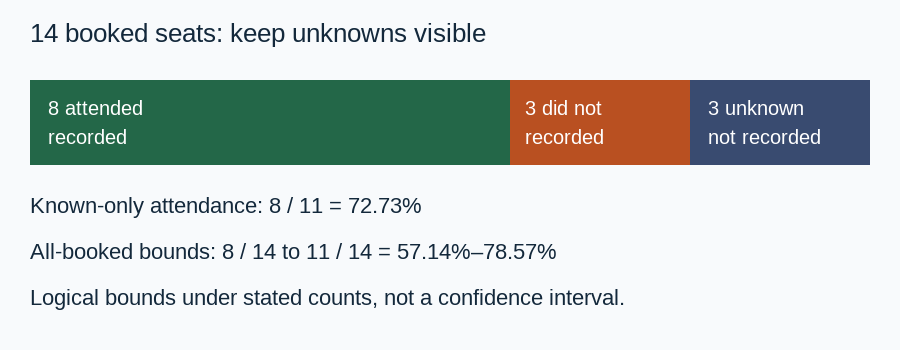
Complete text alternative: fourteen booked seats are partitioned into eleven seats with recorded attendance and three seats with attendance unknown. Of the eleven known seats, eight attended and three did not. Adding zero through three attended seats from the unknown group gives total attendance from eight through eleven, hence 8/14 to 11/14. The known-only ratio 8/11 is labelled separately and is not the midpoint of the bounds.
2. These are not confidence intervals
The lower and upper figures are logical bounds under stated missingness and count assumptions. They are not probabilities, sampling confidence intervals or predictions. We have not randomly sampled a population, fitted a model or justified a statistical uncertainty calculation.
Likewise, 72.73% is not automatically an unbiased estimate of the full attendance rate. Attendance may be missing for systematic reasons; the fixture does not tell us. The correct response is to label the recorded subset and show the sensitivity to unknown counts, not invent “missing at random” to obtain a tidier sentence.
Rounding is for display only. Calculate with full counts and round the percentage to two decimals at the end. If a decision threshold falls near a displayed value, inspect the original fraction rather than comparing rounded strings. In a small teaching dataset, two decimals aid answer checking; they should not be mistaken for precise knowledge of a real-world process.
3. Booking utilization is a different measure
The five open sessions have listed capacities 6+4+5+4+3=22. Fourteen seats are booked for those sessions, so the booking-to-capacity ratio is 14/22≈63.64%. Session 106 contributes capacity three and zero bookings. Cancelled session 104 is excluded by the open-session population rule, not merely because it happens to have zero capacity.
This is not attendance utilization. Booked seats can fail to attend, and some attendance values are missing. It is not a unique-person reach rate or satisfaction score. It is also not the unweighted mean of session booking percentages: sessions have unequal capacity. Keep the noun attached to the percentage.
The u07_capacity query separately aggregates open capacity at session grain and admitted booking seats for open sessions. Its CROSS JOIN combines two single-row aggregates, so it returns one row without multiplying raw records. This limited use of CROSS JOIN is safe because the row-count contracts are explicit; arbitrary cross joins can multiply rows dramatically.
4. Separate observation, interpretation and action
A useful note has three layers. Observation: “The fixture records fourteen booked seats against twenty-two open-session places.” Interpretation: “Some listed capacity is not represented by bookings; attendance completeness is uneven.” Action: “Check the missing attendance entries and the no-booking session record before using this snapshot to plan another round.”
An overclaim would be: “Design workshops failed because people dislike them; cancel them.” Topic, site, timing, capacity and missingness differ; the data cannot isolate causes. A weak but honest note would list all numbers without an actionable interpretation. The better middle path identifies what can be checked and what would change the recommendation.
The follow-up should be bounded. In this fictional case, ask the source custodian role to confirm whether missing attendance values and no-booking records are complete. Do not send messages or upload files as part of the course. Stop the immediate reconciliation when source corrections are documented and all reported totals agree; planning a real programme would require additional decision evidence beyond this exercise.
5. All unknown and no observations
Suppose one two-seat booking has unknown attendance. Known-only attendance is unavailable because its denominator is zero. The lower bound is 0/2=0%; upper bound 2/2=100%. That range states how little is established; it does not assign every value equal likelihood.
With no bookings at all, additive booked-seat and recorded lower-bound counts may be displayed as zero under our convention, but the all-booked rate has denominator zero and is unavailable. Both bounds should be NULL, not 0%–100%: there is no booked population to describe. If an open session still has positive capacity, its booking/capacity ratio can be 0% even while attendance rate is unavailable. Different denominators explain this apparent contrast.
Practice and checkpoint
Complete G7 and I7, writing the note before viewing the model. Each note must name the population, at least one numerator/denominator, the unknown component, one unsupported claim and an appropriate next step. C7 distinguishes all-unknown from empty data.
Save uncertainty-note.md and the exact SQL that generated its figures. During revision, highlight any sentence that sounds causal or predictive and ask whether the records support it. You are ready for the project when a reader can understand both what your numbers establish and why they should not be used for a broader claim.