An original beginner course in observation, joke construction, revision and low-pressure private practice
No comedy experience required. Read or use your preferred accessible reading method; keep notes on paper or in an existing local editor. A timer is helpful, not mandatory. No paid tool, account, recording, microphone or public audience is required.
Eight original lessons with eight explained concept checks, worked examples, practical drafts, two original diagrams and a two-minute-set capstone. Proposed 405 minutes including practice and project; unpiloted planning estimate, not academic credit. No automatic funny rating, verified performance assessment, qualification or employment promise. No public performance or upload is required.
Develop a specific comic premise from an ordinary observation.
Construct and explain setup/payoff, pattern breaks, tags and callbacks.
Audit audience fit, privacy, consent and originality.
Revise words and delivery with an honest evidence log.
Create and privately rehearse an original two-minute set, or identify delivery evidence still pending.
Turn an everyday observation into a specific comic premise.
STEP 2 OF 6
The idea
Stand-up is a crafted spoken point of view, not a test of whether you are naturally funny. In this beginner course, a premise means a particular situation plus your angle on it. A topic such as shopping is broad. A premise such as treating a shopping list like a demanding manager gives you a small relationship to explore. No public performance, audience, recording or upload is required. You can work seated, on paper, using signed delivery or a private text rehearsal.
Collect five harmless observations about objects, routines or your own fictional narrator. Separate observation from interpretation: a reusable bag is still by the door is observable; the bag is waiting for a promotion is an invented interpretation. Specific details help a listener imagine the situation. Avoid collecting identifying details about strangers. A narrator can be invented; the course does not require personal disclosure.
Choose one observation and write three attitudes toward it: puzzled, overconfident and excessively formal. These are performance lenses, not labels you must apply to yourself. Ask what the narrator wants and what gets in the way. A small contradiction supplies direction: I want to be organised, but I prepare so thoroughly that I never start. Build a list of possible consequences before deciding which is strongest.
For an eight-minute starter, spend two minutes noticing objects, two making interpretations, two selecting one angle and two writing a plain-language premise. Stop at the time limit; a messy list is useful material. This is an activity plan, not a validated productivity method. Do not rank your personality or worth by the result.
STEP 3 OF 6
Original worked example
Starting point
Topic: reusable bags. First draft: Bags are strange.
A checkable approach
Observation: I keep my reusable bags beside the door and still forget them. Angle: I have organised everything except myself. Premise: My reusable bags are fully prepared for a shopping trip they have never attended.
These are original fictional teaching examples, not copied routines or promises of laughter. Compare the construction, not your taste.
STEP 4 OF 6
Try it yourself
List five object-based observations. Choose one and write the observation, three possible attitudes, and a one-sentence premise. Then explain why “technology is weird” is less workable than a specific situation.
Fictional exercise · prewritten feedback, no live AI grading.
Write your answer on paper or in your own notes, then compare the options and worked answer.
Which is the most specific premise?
A. My shopping list has become my manager.
Correct. This gives a concrete object a relationship you can explore.
B. Life is funny.
This is a general claim without a particular situation.
C. Only embarrassing secrets make material.
No. Ordinary objects and fictional narrators provide material without disclosure.
STEP 5 OF 6
Worked answer & self-check
One model uses a timer: observation—my timer keeps reminding me to take a break while I am setting more timers; attitudes—grateful, suspicious, ceremonial; premise—I have hired a tiny supervisor whose only instruction is to stop working. “Technology is weird” names a large category without a scene or viewpoint. Your premise can differ: check that a listener can picture a situation and hear an attitude, not that it resembles this model.
Compare your answer
Separates an observation from an invented interpretation.
Uses a concrete detail and an identifiable viewpoint.
Keeps notes free of other people’s private identifying details.
Give yourself one check for each point your work meets. Revise any missing piece. This is a self-check, not a score sent to a teacher.
STEP 6 OF 6
Recap & next step
Turn an everyday observation into a specific comic premise.
Keep your first draft and one explained revision.
Continue with the next lesson when you can explain your choices.
Write a setup that supports an unexpected but understandable payoff.
STEP 2 OF 6
The idea
A setup gives the listener enough information to form an expectation. The payoff, or punchline, changes that expectation in a way that still connects to the setup. Surprise alone is not enough: an unrelated word can confuse rather than reframe. This is one useful construction, not a law that all comedy must follow. A quiet observation or longer story may work differently.
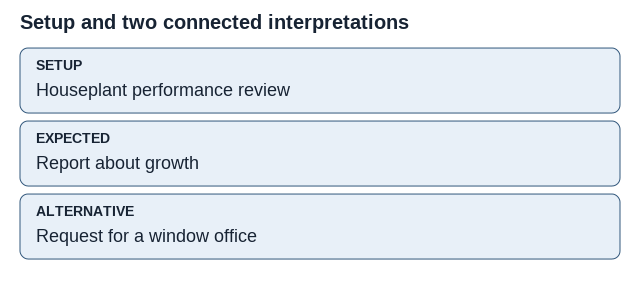
Write down the expected interpretation before drafting the alternative. In “I gave my houseplant a performance review,” the setup borrows workplace language. A listener can anticipate a review of growth. “It asked for a window office” extends the plant/workplace connection: light matters to a plant and office status matters to the imagined employee. The laugh is only an intention; the course cannot predict a response.
Check the information order. If you explain the surprise before the final turn, the listener has less to discover. Try putting the word that reveals the alternative interpretation near the end, then read once for sense. Do not remove a needed noun just to shorten the line. A listener cannot reread a spoken sentence as easily as a written paragraph.
Generate three endings before choosing. Label each as connected, unclear or too predictable, giving a reason rather than a numerical funny score. An optional diagram below maps the relationship. Its alternative branch represents an interpretation, not a scientific model of laughter.
STEP 3 OF 6
Original worked example
Starting point
I gave my houseplant a performance review. It grew a leaf. It wanted something.
A checkable approach
I gave my houseplant a performance review. It asked for a window office. The review establishes workplace expectations; the ending connects a plant’s need for light with an employee’s office request.
These are original fictional teaching examples, not copied routines or promises of laughter. Compare the construction, not your taste.
An original construction map, not a prediction of laughter. Both routes connect to the same setup.
Change the frame, then check the connection
If you remove “performance review,” the office request loses its workplace frame. If you remove “houseplant,” the light connection is hidden. Keep both facts before choosing the final phrase.
Sketch & check
Sketch two branches for your laundry-basket setup: one expected result and one connected alternative. Which setup words make both routes understandable?
Show diagram-practice feedback
A scheduling frame can lead to an expected tidy plan or a basket that postpones work. Name the basket and the scheduling role first; an unrelated ending about planets would need additional context. There is no single required joke.
Optional external teaching interview. Official publisher title, attribution and description checked; playback and full transcript were not reviewed. If you choose to watch, note one revision decision without copying the routine. This course is complete without it. YouTube may show ads or request sign-in; skip it if access is restricted. No embed or autoplay.
Link checked 2026-10-30.
STEP 4 OF 6
Try it yourself
Write a setup about an ordinary object treated as a person. State the expected interpretation. Write three payoffs, select one and explain the connection. Diagnose this version: “My plant wants a window office. I gave it a performance review.”
Fictional exercise · prewritten feedback, no live AI grading.
Write your answer on paper or in your own notes, then compare the options and worked answer.
Why is an unrelated surprise not automatically an effective payoff?
A. The listener still needs a connection to understand the turn.
Correct. A readable connection distinguishes a reframe from random interruption.
B. Every payoff must rhyme.
No. Sound can help, but rhyme is not required.
C. The last word must always be shouted.
No. Volume does not repair a missing connection.
STEP 5 OF 6
Worked answer & self-check
A new model: “I put my laundry basket in charge of scheduling. It postponed everything until the weekend.” Scheduling creates an expectation of organisation; the basket inherits the narrator’s delay. In the reversed plant version, “window office” arrives before the performance-review frame, weakening the discovery and possibly confusing the listener. Restoring the frame first is a reasoned revision, not proof of a better audience response.
Compare your answer
Names the expectation created by the setup.
Explains how the payoff connects while changing the interpretation.
Preserves necessary context and tests information order.
Give yourself one check for each point your work meets. Revise any missing piece. This is a self-check, not a score sent to a teacher.
STEP 6 OF 6
Recap & next step
Write a setup that supports an unexpected but understandable payoff.
Keep your first draft and one explained revision.
Continue with the next lesson when you can explain your choices.
Use a pattern, a follow-on line and a returning detail without confusing them.
STEP 2 OF 6
The idea
The rule of three is a pattern-building device: two related items establish a direction and a third changes it. It is a writing option rather than a compulsory count. Keep the first two items recognisably related; then choose a third that breaks the pattern but belongs to the situation. Three unrelated things do not provide the same guided expectation.
A tag is an additional payoff after an established joke, often needing little or no new setup. If you must introduce a new location, character and problem, you may be starting a new bit instead. Write the first payoff so it stands alone before adding a tag. A weak extra line can reduce the clarity of a strong ending.
A callback returns to an earlier recognisable detail in a new context. Repeating the same sentence is repetition; adding a changed meaning gives the return a purpose. Plant a memorable detail once, leave enough material between appearances for a return to feel like a return, and make the final line understandable. There is no universal minimum interval.
Try all three devices on different draft lines, not all at once. Label each in the margin. If a line only exists to tick a technique box, remove it. Your eventual two-minute set needs a coherent viewpoint more than a catalogue of terminology.
STEP 3 OF 6
Original worked example
Starting point
My desk has a pen, a notebook and a stapler. There is a list of three, but all items follow the same direction.
A checkable approach
Pattern break: “For a productive morning I need a pen, a notebook and a formal apology from my alarm.” The first two are supplies; the third treats the alarm as an employee who has wronged the narrator. Possible tag: “It keeps calling the meeting before I arrive.”
These are original fictional teaching examples, not copied routines or promises of laughter. Compare the construction, not your taste.
STEP 4 OF 6
Try it yourself
Write two related items and a third connected surprise about packing a bag. Add a tag to the alarm example using different wording from the model. Then describe how a window-office callback could close a later story about rearranging furniture.
Fictional exercise · prewritten feedback, no live AI grading.
Write your answer on paper or in your own notes, then compare the options and worked answer.
A line returns to the plant’s office request near the end of a furniture story. What device is intended?
A. A callback.
Correct. It returns to an earlier planted detail in a new context.
B. A prerequisite.
No. That describes an entry requirement, not a comic device.
C. Always a rule of three.
No. A return does not require a three-item list.
STEP 5 OF 6
Worked answer & self-check
One pattern model: “I packed a snack, a water bottle and a resignation letter for the hike.” The third item changes preparation into workplace protest while remaining about the trip. A tag could be “I have asked it to put mornings in writing.” A callback could move the narrator’s desk away from the window because the houseplant has been promoted. Keep enough earlier plant context for the return to be recognised. These alternatives illustrate structure, not a required answer or guaranteed joke.
Compare your answer
Makes the first two items establish a recognisable pattern.
Keeps the surprising third item connected to the scene.
Distinguishes a tag from a callback using context.
Give yourself one check for each point your work meets. Revise any missing piece. This is a self-check, not a score sent to a teacher.
STEP 6 OF 6
Recap & next step
Use a pattern, a follow-on line and a returning detail without confusing them.
Keep your first draft and one explained revision.
Continue with the next lesson when you can explain your choices.
Revise material for consent, context and an honest comic target.
STEP 2 OF 6
The idea
Before sharing anything, name the imagined setting: a private practice, a family gathering or an adult comedy event have different expectations. For this course, default to a general-audience fictional setting. Public performance is optional and outside the requirements. Nobody has to participate in a joke, disclose personal information or become material because they are nearby.
Ask four questions: who is the joke about, who bears its cost, what private information appears, and what must a listener know? “Punching up” is not an automatic safety certificate. A joke about an institution can still expose a private employee or rely on a stereotype. Target your narrator’s mistaken logic, a fictional object or an impersonal process when a real person’s vulnerability is doing the work.
Originality means creating your own situation, wording and turn, not replacing nouns in someone else’s routine. Studying a creator’s explanation of revision can teach a process without borrowing the joke. Keep a simple provenance note: invented here, based on my own non-identifying observation, or source studied for technique only. Accidental similarity is possible; if you recognise a close match, change the premise and structure or set the line aside.
If you invite feedback later, first ask whether the person wants to hear a short practice set and give a topic summary. Accept no without pressure. Do not record or publish them. If a line causes discomfort, listen and revise rather than demanding that the listener prove they understand comedy. You can complete every exercise alone with written self-review.
STEP 3 OF 6
Original worked example
Starting point
A draft mocks a named classmate’s speech and repeats a private message to establish the scene.
A checkable approach
Remove the name and private message, then change the target rather than merely disguising the person: “I rehearsed ordering a sandwich so thoroughly that I asked the menu for feedback.” The narrator’s over-preparation now supplies the contradiction; another person’s speech is not the target.
These are original fictional teaching examples, not copied routines or promises of laughter. Compare the construction, not your taste.
STEP 4 OF 6
Try it yourself
Audit two of your drafts using target, privacy, context and originality headings. Rewrite one risky line by changing the target, not just removing a name. Write a low-pressure invitation for optional feedback; do not send it as part of this exercise.
Fictional exercise · prewritten feedback, no live AI grading.
Write your answer on paper or in your own notes, then compare the options and worked answer.
Which revision best addresses a private-person joke?
A. Change the premise so private vulnerability is no longer the mechanism.
Correct. A changed name alone may leave the same person identifiable and targeted.
B. Keep the private message but omit the first name.
No. Context can still identify someone and the message remains private.
C. Say “just joking” after it.
No. A disclaimer does not undo disclosure or pressure.
STEP 5 OF 6
Worked answer & self-check
A model invitation: “Would you like to hear a two-minute fictional set about over-organising? No problem if not; I only want feedback on clarity.” A strong audit specifies what was removed and why. Changing a person’s name alone does not remove identifiable details or the same humiliating premise. A self-contained object-based scene can preserve the tension without exposing a person. If no risky line exists, explain your safeguards rather than inventing one.
Compare your answer
Identifies the target and possible cost to others.
Removes identifying/private material, not only a name.
Records originality checks and treats feedback as optional.
Give yourself one check for each point your work meets. Revise any missing piece. This is a self-check, not a score sent to a teacher.
STEP 6 OF 6
Recap & next step
Revise material for consent, context and an honest comic target.
Keep your first draft and one explained revision.
Continue with the next lesson when you can explain your choices.
Make a controlled revision and explain what it changes.
STEP 2 OF 6
The idea
Revision is more useful than waiting for a perfect first draft. Save version A, then identify a single issue: unclear situation, delayed turn, repeated information or a weak connection. Change one feature for version B. If you replace every element simultaneously, you cannot easily say which change helped comprehension.
Underline the words that establish who, what and why the surprise makes sense. Circle phrases that only announce that a joke is coming: “this is really funny” and “you had to be there” usually do not supply the scene. Try deleting one, but check the result aloud or through your preferred accessible delivery. The shortest sentence is not automatically the clearest.
For a payoff, test where the revealing phrase appears. Ending with an explanation can flatten a turn by telling the listener how to interpret what they already understood. Cut the explanation in one version and compare. If the setup becomes incomprehensible, restore the missing information earlier rather than defending the ending with extra explanation.
Keep a revision log with draft, change, reason and next check. Distinguish a prediction from an observation: “I predict this ending is easier to follow” is honest before a rehearsal; “one listener asked what the plant represented” is an observation only if that happened. No automatic funny rating, confidence score or imaginary audience reaction belongs in the log.
STEP 3 OF 6
Original worked example
Starting point
“Yesterday at home, which is where I keep my plant, I gave it a sort of employee performance review, and it asked for a window office, because plants need light.”
A checkable approach
Version B: “I gave my houseplant a performance review. It asked for a window office.” Removing the obvious home detail and the after-explanation leaves the plant/workplace frame intact and the reveal at the end. This is a clarity hypothesis, not recorded audience evidence.
These are original fictional teaching examples, not copied routines or promises of laughter. Compare the construction, not your taste.
STEP 4 OF 6
Try it yourself
Revise one draft in two controlled passes: remove a redundant phrase, then test information order. Keep all versions. For each pass write the change, expected effect and a check you can do privately.
Fictional exercise · prewritten feedback, no live AI grading.
Write your answer on paper or in your own notes, then compare the options and worked answer.
What belongs in an honest revision log before anyone hears the line?
A. A predicted clarity improvement and a planned check.
Correct. You can state a hypothesis without inventing evidence.
B. An audience laughter percentage.
No. There is no audience measurement yet, and the course provides none.
C. A claim that shorter is always funnier.
No. Cutting necessary context can make a line harder to understand.
STEP 5 OF 6
Worked answer & self-check
A log might read: A includes “because plants need light”; B removes it; reason—the ending already links office and light; private check—can I explain the connection without adding facts? Then C moves “houseplant” earlier; reason—identify the character before workplace language. If C sounds clumsy, retain B. A rejected change still teaches something when the reason is recorded.
Compare your answer
Preserves versions and isolates changes.
Keeps enough setup to understand the payoff.
Labels predictions and actual observations accurately.
Give yourself one check for each point your work meets. Revise any missing piece. This is a self-check, not a score sent to a teacher.
STEP 6 OF 6
Recap & next step
Make a controlled revision and explain what it changes.
Keep your first draft and one explained revision.
Continue with the next lesson when you can explain your choices.
Rehearse a short passage and adjust one delivery choice at a time.
STEP 2 OF 6
The idea
Timing includes pace, emphasis and space for comprehension. It is not a fixed number of seconds before every payoff. First make the words understandable at a comfortable pace. Mark a short pause with a slash and an emphasis word with brackets. Treat these marks as experiments rather than stage instructions you must obey.
Try the same two lines in a neutral delivery and then with one changed emphasis. Do not simultaneously add shouting, gestures and a long pause. Compare whether the character and turn remain clear. You can rehearse silently, sign, use your existing communication method or read seated. Do not force your voice, hold your breath or adopt a painful posture. Comfort and access matter more than imitating another performer.
A private timer helps estimate duration, not quality. Run from the first intended word through the last, including deliberate pauses. Reading 200 words does not guarantee two minutes: individual delivery, communication method and pauses differ. If you choose not to deliver aloud, time a silent rehearsal and label it as such. Leave spoken delivery pending rather than claiming it was assessed.
If you lose your place, stop, look at a small cue card and resume. Practise this once on purpose. A recovery line can be as simple as “Back to the shopping list.” Do not turn a missed word into self-abuse. In an optional real audience setting, wait for actual reactions when needed rather than talking over them; no audience reaction is assumed during private practice.
STEP 3 OF 6
Original worked example
Starting point
Draft marked with a long pause after every word: “I / gave / my / houseplant / a / review.”
A checkable approach
Try “I gave my houseplant a performance review. / It asked for a [window office].” One pause separates frame from turn; the phrase receives emphasis without needing to be loud. Then try no marked pause and compare which is easier to follow in your chosen delivery.
These are original fictional teaching examples, not copied routines or promises of laughter. Compare the construction, not your taste.
STEP 4 OF 6
Try it yourself
Take a 30–45-second draft passage. Make two private runs, changing only one pause or emphasis. Record actual durations, delivery mode and what became easier or harder. If timing is not possible, mark it pending and still annotate the passage. Practise a cue-card recovery.
Fictional exercise · prewritten feedback, no live AI grading.
Write your answer on paper or in your own notes, then compare the options and worked answer.
What does a two-minute timer reading establish?
A. The duration of that particular timed run.
Correct. It does not establish audience enjoyment or general performance competence.
B. That the set is professionally ready.
No. Duration alone cannot establish readiness.
C. That every future audience will laugh.
No. Timing is not a guarantee of reactions.
STEP 5 OF 6
Worked answer & self-check
A blank log is better than invented data: Run A duration ___, mode ___, observation ___; Run B duration ___, one change ___, observation ___. A valid conclusion can be “I lost the thread when I paused between the noun and its description; I will pause at the sentence boundary instead.” Do not fill in the blanks with this lesson’s target duration. A silent rehearsal supports planning but does not demonstrate vocal audibility.
Compare your answer
Records actual duration or explicitly marks timing pending.
Changes one delivery feature and notes a concrete effect.
Uses a comfortable accessible method and rehearses recovery.
Give yourself one check for each point your work meets. Revise any missing piece. This is a self-check, not a score sent to a teacher.
STEP 6 OF 6
Recap & next step
Rehearse a short passage and adjust one delivery choice at a time.
Keep your first draft and one explained revision.
Continue with the next lesson when you can explain your choices.
Arrange a short set and turn an observation into a revision decision.
STEP 2 OF 6
The idea
A short set is a sequence, not just a pile of separate lines. Choose a viewpoint and a small subject family. Start with a line that establishes your narrator and can stand without a long introduction. Group related bits, add short transitions and finish on a deliberate final turn. A callback is optional; do not force it if it needs lengthy explanation.
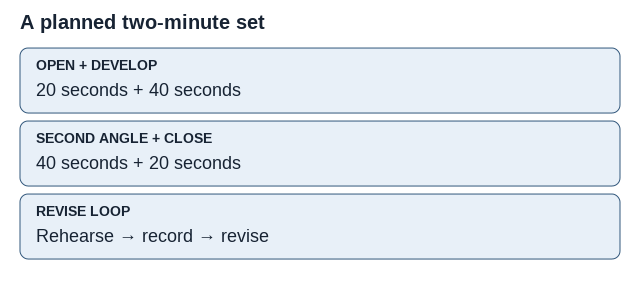
Make a four-part outline: opening, development, second angle and closer. A planning allocation of 20, 40, 40 and 20 seconds totals two minutes, but it is only a starting budget. Your actual rehearsal may require different proportions. Leave room for comprehension; if the piece runs long, cut a lower-priority idea instead of racing through every sentence.
Feedback must refer to something observable. Useful questions include “Which word or reference was unclear?”, “Where did the subject change?” and “What detail did the ending return to?” A listener’s taste matters, but one response is not a universal verdict. Do not invent a panel of reviewers or treat a check-box answer as live assessment of your set.
For solo feedback, put the draft aside for a break, then summarise each bit in one sentence. If you cannot explain how two bits connect, add a short bridge or remove one. For optional consenting feedback, note the exact point of confusion without names or recordings. Decide whether to revise, test another version or retain the line, and write why. There is no requirement to send your work to anyone.
STEP 3 OF 6
Original worked example
Starting point
Outline: houseplant, unrelated airport story, shopping list, long explanation of what callbacks mean.
A checkable approach
Reordered outline: “I organise everything except myself”; shopping list becomes a manager; houseplant asks for an office; narrator loses the window to the plant. The organisational viewpoint connects the objects, and the office return supplies an ending without explaining the technique.
These are original fictional teaching examples, not copied routines or promises of laughter. Compare the construction, not your taste.
A 120-second planning budget, not a measured performance. Adjust for your own delivery and access needs.
Budget is not evidence
20 + 40 + 40 + 20 = 120 seconds on paper. If a real run takes 145 seconds, retain that observation and cut or restructure before retiming; do not relabel the run as 120.
Sketch & check
Your measured run takes 145 seconds. Sketch a revision loop and name one thing to change before the next run. What can you honestly record now?
Show diagram-practice feedback
Record 145 seconds for that run and your delivery mode. You might remove a repeated setup, then run the revised script again. The next duration is unknown until measured; a planned 25-second cut is not a verified result.
Optional external teaching interview. Official publisher title, attribution and description checked; playback and full transcript were not reviewed. If you choose to watch, note one revision decision without copying the routine. This course is complete without it. YouTube may show ads or request sign-in; skip it if access is restricted. No embed or autoplay.
Link checked 2026-10-30.
STEP 4 OF 6
Try it yourself
Arrange three of your bits in two possible orders. Write a one-sentence reason for your chosen order and a transition between each pair. Create a four-part time budget totalling 120 seconds. Draft three concrete feedback questions or answer them yourself after a break.
Fictional exercise · prewritten feedback, no live AI grading.
Write your answer on paper or in your own notes, then compare the options and worked answer.
Which feedback is most actionable?
A. I could not tell when the shopping-list scene ended.
Correct. This identifies a transition to inspect and revise.
B. You are either funny or not.
No. This judges a person rather than a revisable part of the work.
C. The system gives you 97% funny.
No. This course does not measure funniness automatically.
STEP 5 OF 6
Worked answer & self-check
One possible budget is 20 + 35 + 40 + 25 = 120 seconds. It is not measured performance. A bridge from list to plant could be “Once the shopping list took charge, the rest of the house wanted job titles.” A concrete question is “Did the word ‘review’ make sense before the plant asked for an office?” If a self-review finds an unclear transition, revise that join before changing unrelated punchlines.
Compare your answer
Makes the sequence and transitions understandable.
Labels time budgets as plans and distinguishes them from measurements.
Uses specific feedback questions and an explained next decision.
Give yourself one check for each point your work meets. Revise any missing piece. This is a self-check, not a score sent to a teacher.
STEP 6 OF 6
Recap & next step
Arrange a short set and turn an observation into a revision decision.
Keep your first draft and one explained revision.
Continue with the next lesson when you can explain your choices.
Create, privately rehearse and revise an original short set with an honest self-review.
STEP 2 OF 6
The idea
Create an original set intended to last about two minutes using your chosen accessible delivery. Choose a harmless everyday theme and one viewpoint; include at least three connected bits, a clear opening, transitions and an intentional ending. Demonstrate setup/payoff construction and at least one additional device from lesson three. Do not copy the model set or any creator’s routine. A fictional narrator is welcome.
Keep a small portfolio: premise list, first draft, revised script, annotated delivery version, time log and self-review. A complete attempt includes two private rehearsals with one documented revision between them. Aim for 1 minute 45 seconds to 2 minutes 15 seconds as a flexible practice window, not a professional standard. If your communication needs require a different window, state it in advance and explain your pacing choices. No public performance, microphone, camera, account or upload is required.
Use the six rubric criteria below. For each mark not yet, developing or evidenced, then cite a line or log entry. These labels are self-review prompts, not a course grade. “Evidenced” needs a specific example; completing the concept checks alone is insufficient. In particular, no text quiz can establish timing, audience rapport or vocal control. If you only wrote the script, record delivery as pending.
For the final revision, select the weakest evidenced criterion rather than trying to repair everything. If your first run is too long, cut a dispensable bit or redundant setup and retime; do not merely estimate a faster delivery. If you receive no laughs in optional feedback, separate clarity, audience fit and preference before drawing conclusions. Private completion is valid self-study, but the course grants no qualification, employment promise or verified performance credential.
STEP 3 OF 6
Original worked example
Starting point
A learner submits only a list of punchlines and writes “Exactly two minutes; everyone will love it” without a rehearsal.
A checkable approach
A stronger submission includes a connected original script, actual timed run entries or an honest pending note, a documented edit and six evidence-based rubric comments. A learner may conclude “The closing callback is clear, but the middle transition needs another rehearsal.” That is more informative than a claimed funny score.
These are original fictional teaching examples, not copied routines or promises of laughter. Compare the construction, not your taste.
STEP 4 OF 6
Try it yourself
Write your original two-minute set and assemble the portfolio described above. Rehearse twice privately if possible, document one change between runs and complete all six rubric comments. Use the optional local project pack for a blank log and an original worked model to analyse only after your own first draft.
Fictional exercise · prewritten feedback, no live AI grading.
Write your answer on paper or in your own notes, then compare the options and worked answer.
Which completion claim is justified by a written script alone?
A. I completed a draft; rehearsal evidence is still pending.
Correct. This accurately separates writing from delivery.
B. I have a professional comedy qualification.
No. This is independent non-credit self-study.
C. My audience response has been validated.
No. A written script is not evidence of an audience response.
STEP 5 OF 6
Worked answer & self-check
A complete model is in the local project pack linked in Sources. It illustrates an outline, script, proposed timing budget and revision reasoning, not a recorded or tested performance. Your own submission must use a different premise and wording. Example self-review: “Structure developing: the opening introduces over-preparation, but bit two changes objects without a bridge. Revision: add one short transition and remove the repeated introduction. Timing pending until I can run the revised version.” Nothing in this example asserts laughter or an actual duration.
Compare your answer
Originality and care: identify your own premise, check source overlap and remove private-person targeting.
Structure: cite the opening, three connected bits, transitions and final turn.
Technique: explain one setup/payoff and one pattern break, tag or callback.
Revision: preserve two versions and explain a specific change.
Delivery: record two actual private rehearsals and a timing adjustment, or honestly mark this criterion pending.
Reflection: cite evidence for each criterion and name one realistic next practice step.
Give yourself one check for each point your work meets. Revise any missing piece. This is a self-check, not a score sent to a teacher.
STEP 6 OF 6
Recap & next step
Create, privately rehearse and revise an original short set with an honest self-review.
Keep your first draft and one explained revision.
Keep your portfolio private. Revisit the criterion that needs evidence; optional sharing or live performance is not required.
Examples, exercises and worked answers are original fictional teaching material. Source checks inform the factual explanations; these organisations do not endorse this course.
Optional free publisher article on premise, setup and revision; page text checked. The site promotes paid courses, none of which are required. No routines are reproduced; this course’s examples are original. External links may contain adult material. Checked 2026-10-30.
Optional external teaching interview. Official publisher title, attribution and description checked; playback and full transcript were not reviewed. If you choose to watch, note one revision decision without copying the routine. This course is complete without it. YouTube may show ads or request sign-in; skip it if access is restricted. No embed or autoplay. Checked 2026-10-30.
Original plain-text project pack with full illustrative script, rubric prompts and blank logs. The model is not a measured performance or an audience-tested routine. Checked 2026-10-30.
This independent course is general education, not accreditation, a degree, professional advice or a promise of competence. No institutional affiliation or endorsement is implied. The illustrated setting is fictional.