Business Foundations: Customers, Value & Viability

24 original lessons · 108-hour study plan · 12 weeks plus delayed review · unpiloted · self-paced

Course details & full text

Connect customers and delivery promises to contribution, cash timing and a defensible business decision.

No prior business course. Be able to read a short case, distinguish a claim from an observation, multiply quantities and prices, calculate a percentage and keep a local note. Use the readiness check and existing shared foundations if needed. Calculator and paper or an existing local text editor suffice; spreadsheets are optional. No account, paid service, real customer research, interview, personal-data upload or spending is required.

24 substantial original lessons with guided and independent practice, 72 explained checks, two fictional capstone evidence packs, five weighted self-review components and annotated models. The 108-hour design target is unpiloted: 60 hours of lesson activities (24 teaching-equivalent and 36 practice) plus 48 hours of assessment, case studio and spaced review. The 3600 lesson minutes are INCLUDED in 108 hours, not additional. Teaching-equivalent means reading, worked reasoning and structured activity, not staffed contact hours. This self-study edition is not evidence of equivalence, credits, a degree, certified competence or an instructor-marking service. All prices and observations are fictional CAD teaching inputs. Excludes full financial accounting, advanced marketing, general writing/spreadsheet instruction, business law, tax and actual venture launch.

  • Distinguish customers, users, decision makers and payers; evaluate what supplied observations do and do not show about demand.
  • Compare alternatives and switching costs, then justify a bounded value promise for a specified segment.
  • Connect channels, revenue mechanisms, delivery activity, resources and capacity in one internally consistent model.
  • Calculate and interpret contribution, whole-unit break-even, capacity and changed-case sensitivity, including nonpositive contribution.
  • Reconcile simplified operating profit with dated cash receipts, payments and working-capital changes under explicit assumptions.
  • Challenge a consequential business assumption with a bounded ethical test and interpret conflicting signals without inventing validation.
  • Produce, challenge and revise an integrated feasibility dossier supported by auditable calculations and a delayed transfer response.
Practice files & complete project

Download once; all fixtures are fictional. Keep your first attempt before reading the model. No upload is used.

My Project Desk saves only after you choose Save in this browser on this device. Manual export/import is available; cross-device sync is not active. Lesson review marks do not grade your project.

LESSON 1 OF 24 · PLANNED 150 MINUTES

Customers, problems and payers

STEP 1 OF 6

Your objective

Build a customer–problem–payer map that separates use, choice, payment and affected interests, then explain what must be true for an offer to help someone and sustain an organization.

STEP 2 OF 6

The idea

A business offers something people or organizations find useful and arranges resources to keep delivering it. This includes a service, a product maker and many social enterprises; it does not mean every useful activity must become a business. A business model explains value creation, delivery and continuing resources. Start with people and their difficulty. A clever product description can hide the absence of a pressing reason to use or fund it.

A customer is not always one person playing every role. The user experiences the offer; the chooser selects it; the payer provides money. One adult buying a notebook may fill all three roles. In a fictional workplace meal service, employees eat, a coordinator chooses the supplier and the employer pays. Preferences, ordering effort and spending limits all matter. Satisfying only one role can fail even when the food is excellent.

A problem is a difficulty accomplishing something in a particular situation. “People need our app” names a solution. “Volunteer coordinators lose track of last-minute shift changes” identifies an activity and difficulty, but still needs boundaries: which coordinators, how often, and with what consequences? These distinguish an irritation from a problem someone will act to solve. Consequences can include lost time, uncertainty and exclusion as well as money.

Need does not establish willingness or ability to pay. Someone may urgently need a service and lack money, authority or access to purchase it. An organization may pay to remove administrative work users barely notice. A nonprofit can connect beneficiaries with a separate funder; a cooperative can combine member use, control and funding. Each arrangement still needs an explanation of why its resource providers will support continuing delivery.

Build a map with each important role, its desired result, current difficulty and unresolved assumptions. Include affected nonpayers: a repair collection service may help commuters while adding work for reception staff. A matching platform may help buyers and sellers while increasing moderation work. Calling the payer the “real customer” erases these dependencies. Payment gives one role influence, but other people can determine whether delivery works.

Scope makes the map useful. “All bicycle owners” includes different skills, schedules and alternatives; “commuters at one office with difficult workshop access” is an investigable starting group. Label observations, interpretations and unknowns; /school/evidence-sources-syllabus.html refreshes that shared skill. The distinctive task here is mapping business roles. “The user benefits, but no continuing payer is identified” is a useful finding, not something a slogan can repair. Use only the supplied fictional material.

STEP 3 OF 6

Fictional case: Cedar Repair pickup service

Starting point

Cedar proposes office-lobby collection and next-afternoon bicycle return. Its founder writes: “Anyone who likes convenience is our customer; the employer will pay.” No employer agreement or employee purchasing record is supplied.

A checkable approach

Map commuters as users and possible individual payers; the office coordinator as an access decision-maker; and the employer as a possible, unconfirmed payer. Reception staff bear possible handover work. The problem hypothesis concerns workshop hours conflicting with commuters’ schedules.

This exposes three unknowns: whether the difficulty matters enough, who pays and whether lobby collection is workable. Employer payment remains a hypothesis.
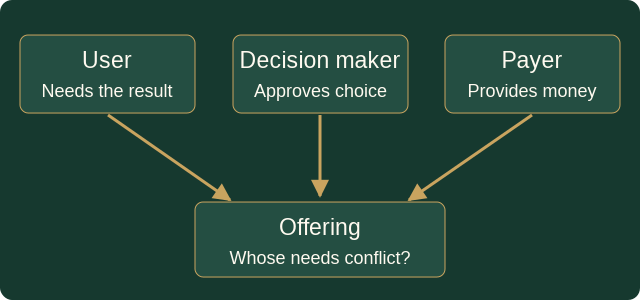
A fictional repair offer separates user, decision maker and payer; each connects to the offering and can impose a different constraint.
Different people may use, choose and pay for one offering.

Read the diagram

Different people may use, choose and pay for one offering. Trace each relationship and explain one assumption that could make the conclusion fail.

Sketch & check

Describe this diagram in words without relying on colour. Name one input, one relationship and one limitation.

Show diagram-practice feedback

A fictional repair offer separates user, decision maker and payer; each connects to the offering and can impose a different constraint. A sound response distinguishes the given relationship from evidence that a real business can deliver it.

STEP 4 OF 6

Try it yourself

Spend 25 minutes mapping commuter, employer, office coordinator, reception staff and repair worker: role, desired result, possible burden and unknown. Then write two arrangements: employees pay individually, or the employer buys a defined benefit. Explain which roles change. Select a response below, then review your own map against every rubric criterion. Revise two claims that exceed the supplied facts and retain the revision. Use paper or local notes; no external contact is required.

Fictional exercise · prewritten feedback, no live AI grading.

Navigation within this player keeps your notes. Use the optional notebook Save or Export controls to keep a snapshot before leaving. Nothing typed here is uploaded.

Guided practice

Fictional case: a center lends reading lamps to residents; a foundation funds the first batch, volunteers manage loans and the center selects the design. Identify roles and two continuation questions.

Optional hint 1

Separate the first purchase from the resources needed for future lending.

Optional hint 2

A volunteer role can affect continuation without becoming a paying-customer role.

Compare the explained guided answer

Residents use, the center chooses and the foundation initially funds the lamps. Volunteers deliver the process. Who funds replacements, and is continuing volunteer time available? Initial funding does not establish a continuing payer. Other questions work when connected to sustaining delivery.

Independent transfer

Fictional case: a tutoring marketplace offers free learner search and paid tutor listings. Explain why “only tutors matter because they pay” is incomplete.

Keep your attempt before opening the explanation. Reading an answer is different from producing your own response.

Compare the explained transfer answer

Tutors might want suitable inquiries with manageable administration; learners might want available teaching that fits their needs. These are hypotheses. Tutor payment may depend on learner participation, while learners need useful listings. The marketplace also needs to manage inaccurate listings. Naming two groups is incomplete without explaining that dependence.

Check 1: Who pays in the supplied Cedar proposal?

Choose an option to see its reasoning. You can try again. No score is recorded.

Check 2: Which statement describes a problem?

Choose an option to see its reasoning. You can try again. No score is recorded.

Check 3: Why include affected nonpayers?

Choose an option to see its reasoning. You can try again. No score is recorded.

STEP 5 OF 6

Worked answer & self-check

A defensible map gives commuters the user role and a possible benefit of avoiding a workshop trip. Its importance remains unconfirmed. The employer is a possible payer, not a committed one. The coordinator may control access; reception staff may bear handover work; repair workers need bicycles, instructions and resources arranged for reliable delivery. With individual payment, commuters choose and pay while the office permits access. With employer funding, the employer could choose and pay for a defined scope while employees decide whether to participate. Neither arrangement automatically supplies reception support. Explain these responsibilities rather than merely replacing one payer’s name. Other maps work when hypothetical roles remain labelled. “Everyone benefits, so everyone is a customer” is insufficient: identify each benefit, burden and unknown. Revise unsupported commitments into assumptions. Choosing an option does not grade your map; the worked answer supports your own review.

Compare your answer

  • Role accuracy: separates user, chooser, payer and affected participant; overlapping roles are explained rather than assumed.
  • Problem specificity: describes an activity and difficulty for a bounded group without defining the problem as buying Cedar’s service.
  • Assumption control: labels employer payment, access and the importance of convenience as unconfirmed; does not invent support.
  • Connected reasoning: explains how two payment arrangements alter responsibilities and incentives while retaining delivery burdens.
  • Revision evidence: identifies two changed claims and explains how each revision makes the map more faithful to the supplied case.

Give yourself one check for each point your work meets. Revise any missing piece. This is a self-check, not a score sent to a teacher.

STEP 6 OF 6

Recap & next step

Retrieve, then revisit

Without looking back, distinguish user, chooser and payer. Give one fictional case where the roles differ, then name an affected nonpayer.

Revisit in course week(s) 2, 5, 9; later dates are review visits, not extra required course slots.

Check the retrieval explanation

A user experiences the offer, a chooser selects it and a payer supplies money. In an employer-funded meal service, employees use, a coordinator chooses and the employer pays. Cleaning staff may be affected by delivery and packaging. Equivalent examples work when each role is explicit.

  • Use, choice and payment can belong to different people.
  • A meaningful need does not establish a paying customer.
  • People outside the sale can still determine whether delivery works.

Keep the revised map. In the next lesson, use it to judge whether a fictional observation provides evidence of demand or only evidence that someone noticed an offer.

A personal record of review; no grade or certificate.

Next lesson: Evidence of demand: interest, action and commitment →
LESSON 2 OF 24 · PLANNED 150 MINUTES

Evidence of demand: interest, action and commitment

STEP 1 OF 6

Your objective

Interpret a small fictional demand record without turning interest into sales, identify the unresolved business assumption, and propose a proportionate next check using only supplied scenarios.

STEP 2 OF 6

The idea

Demand is more specific than liking an idea. Ask who would choose a particular offer, under what conditions, and in sufficient numbers to support a workable arrangement. “That sounds useful” can be sincere without implying intention or authority to buy. Information requests, reservations and completed paid purchases answer different questions. Keep those events separate instead of adding them into one encouraging total. The conditions of the proposed transaction matter.

Evidence is more informative when it resembles the transaction being considered. A free sample can show use, but not demand at a stated price. A reservation shows intention, but may be cancelled. A completed paid purchase shows that one transaction occurred, not repeat purchasing or viability. Stronger evidence means more relevant to a particular claim, not universally conclusive. Even a purchase leaves questions about future need and delivery cost.

Keep the denominator and the route into the sample. Eight bookings from ten offer recipients differ from eight after ten thousand views. Neither automatically predicts another group. People who stop at a repair booth may differ from those who do not. State who encountered the offer, what they saw, what action was counted and what remains unknown. These are business applications of shared evidence skills, not a replacement for /school/evidence-sources-syllabus.html.

Fictional Cedar’s trial records 40 commuters receiving a CAD60 offer, 18 requesting details, eight reserving and five completing paid jobs. These are nested stages, not 71 independent expressions of demand. A purchaser may appear in every count. The record supports five transactions under those conditions. It does not explain why others stopped, establish repeat purchasing or show how another office would respond. Repairs also need not be monthly purchases.

Price, timing, scope and trust belong to the tested offer. Evidence from next-day return does not directly support a later offer with a week-long wait. If the founder personally reassures every participant, the trial may partly test that attention. Record the conditions so planning does not silently substitute another service. Then target a consequential unknown: cancellation reasons may deserve attention before attracting more people into an unresolved completion problem.

Respectful testing makes conditions visible rather than manufacturing pressure. A deceptive countdown or hidden fee might generate action while damaging trust and misleading the business about customer choice. Here you will interpret invented records and paper simulations; no outreach, money or personal information is required. The question is whether observed behavior supports this offer, this group and this way of continuing. A limited finding can justify a next check without proving a whole market.

STEP 3 OF 6

Fictional case: reading Cedar’s small trial

Starting point

A slide says: “66 positive responses prove demand: 40 saw the offer, 18 requested details and eight reserved. Half the office will buy monthly.”

A checkable approach

“Forty commuters received the CAD60 offer; 18 requested details, eight reserved and five completed paid jobs. Stage counts may include the same people. Cancellation reasons and future purchase timing are unresolved.”

The original combines unlike events and omits completed jobs. The revision recognizes five transactions without assuming unique respondents at every stage or monthly repair needs.

STEP 4 OF 6

Try it yourself

Build a one-page demand note. List each stage, its count and what it supports. Write one supported claim, one plausible but unconfirmed claim and one unsupported claim. Compare reviewing the three reservation cancellations with doubling offer recipients: which check would you do first, and what could each teach? Spend 20 minutes revising the overstated slide, then assess your note against the rubric. Attach every percentage to a denominator; it is optional, not evidence by itself.

Fictional exercise · prewritten feedback, no live AI grading.

Navigation within this player keeps your notes. Use the optional notebook Save or Export controls to keep a snapshot before leaving. Nothing typed here is uploaded.

Guided practice

Fictional case: 30 people try a free refillable pen; 24 like it. All 30 later receive a CAD12 offer, and six buy. What does each record support?

Optional hint 1

The free-use response and the purchase response answer different questions.

Optional hint 2

Do not assume that the 24 favorable respondents are exactly the group who later bought.

Compare the explained guided answer

The first records favorable reactions from 24 free users; the second records six purchases among 30 offer recipients. Without linked records, you cannot identify which favorable respondents bought. Neither establishes refill demand or purchasing beyond this group. A next scenario could examine actual refill needs.

Independent transfer

Fictional case: a meal cooperative has 50 interested people, 16 first-month contributors and ten who collect all four meals. What continuation questions remain?

Keep your attempt before opening the explanation. Reading an answer is different from producing your own response.

Compare the explained transfer answer

Interest, funding and use are different events. Questions remain about partial collection, renewals and sustainable preparation work. Some members may value supporting the cooperative even when missing meals, so collection does not establish their motives. Include a nonfinancial question such as whether volunteer workload is fair and reliable.

Check 1: What do Cedar’s five paid completions establish?

Choose an option to see its reasoning. You can try again. No score is recorded.

Check 2: Can the 40, 18 and eight stage counts be added as customers?

Choose an option to see its reasoning. You can try again. No score is recorded.

Check 3: What is a useful cancellation check?

Choose an option to see its reasoning. You can try again. No score is recorded.

STEP 5 OF 6

Worked answer & self-check

A supported claim is “five of 40 offer recipients completed a paid job during this trial.” A plausible but unconfirmed claim is “timing may explain some cancellations.” “Half the office will buy monthly” is unsupported. Five divided by 40 is 12.5%, describing this trial group rather than forecasting future demand. Reviewing cancellations first is defensible because timing, unclear scope or changed need would imply different responses. The reasons may still be incomplete. Expanding recipients could test another group while leaving the completion gap unexplained. Favoring expansion can also be defensible if representativeness is the more consequential uncertainty; explain why. A revised slide retains price, group, trial boundary and separate stages. It neither counts attention as sales nor dismisses limited evidence as useless. Mark missing conditions unknown. Your written interpretation, not the option selection alone, is the learning evidence.

Compare your answer

  • Event separation: keeps exposure, inquiry, reservation and paid completion distinct and avoids adding overlapping counts.
  • Claim calibration: includes a supported claim with the correct conditions and identifies at least two conclusions the record cannot justify.
  • Denominator clarity: attaches any share to the correct group; does not convert the trial share into an unsupported forecast.
  • Next-check reasoning: targets a named uncertainty, explains what different findings would change and considers the alternative check.
  • Responsible scope: uses fictional records only and avoids deceptive conditions or unnecessary information collection.

Give yourself one check for each point your work meets. Revise any missing piece. This is a self-check, not a score sent to a teacher.

STEP 6 OF 6

Recap & next step

Retrieve, then revisit

Write three increasingly transaction-like behaviors and a limitation of each. Explain why a paid purchase still does not prove viability.

Revisit in course week(s) 3, 6, 10; later dates are review visits, not extra required course slots.

Check the retrieval explanation

For example: requesting details shows attention but not commitment; reserving shows intention but may be cancelled; completing payment records a transaction but not repeat demand. Viability also depends on what delivering that purchase costs, available capacity and continuing resources.

  • Interest, commitment and completed payment are different evidence.
  • A result belongs to the group and offer conditions that produced it.
  • A small record can justify a next check without proving a market.

Compare your demand note with the customer map. Circle any role whose behavior is still missing, then carry those unknowns into the lesson on alternatives and switching.

A personal record of review; no grade or certificate.

Next lesson: Alternatives and the cost of switching →

LESSON 3 OF 24 · PLANNED 150 MINUTES

Alternatives and the cost of switching

STEP 1 OF 6

Your objective

Compare an offer with direct, indirect and do-nothing alternatives, then explain a customer’s switching decision using benefits, burdens and uncertainty.

STEP 2 OF 6

The idea

Competition starts with the customer’s task, not a list of similar companies. Someone needing a working bicycle can choose a repair shop, self-repair, borrowing, a bus or postponement. Alternatives may solve only part of the problem or create other burdens. Comparing only similarly named products can miss strong competition. “Do nothing for now” can be a choice even when it has consequences. Begin with what the person is trying to accomplish.

A direct alternative offers a similar way of achieving the result; an indirect alternative uses another route. These labels organize a comparison without ranking its strength. A bus may compete strongly with repair for someone needing transport tomorrow. For someone restoring a valued bicycle, transport addresses only part of the task. The same offer can therefore face different alternatives because its customers seek different results in different circumstances.

Compare options on relevant dimensions: money, time, reliability, effort, accessibility, control and result achieved. Avoid giving your own idea every advantage. Mark unknown quality or prices as unknown rather than awarding low scores. Fictional comparison makes assumptions visible; it does not justify inventing competitors’ shortcomings. A low price alone may not compensate for an unreliable outcome, especially when failure would disrupt other people or important activities.

Switching means leaving a familiar arrangement as well as acquiring a new one. Customers may need to learn a process, move information, coordinate people, replace compatible equipment or risk failure. A predictable existing service can be attractive even when imperfect. In Cedar’s model, avoiding a workshop trip comes with scheduled handover, overnight separation from the bicycle and trust in a new provider. Reluctance can reveal those burdens rather than ignorance.

Advantage depends on situation. A commuter who already passes a trusted workshop may gain little from Cedar; one whose work hours prevent workshop access may gain more. “More convenient” needs a situation and comparison. Reducing switching burdens through clear scope and realistic timing differs from hiding conditions or pressuring adoption. Consider both a fair route into the service and a fair route out; no legal or regulatory guidance is provided here.

Comparison may support a narrower offer, a different group or keeping the existing alternative. Each can be progress. Connect the choice to the customer map: whose time is saved, whose work increases and who evaluates risk? A payer may prefer a cheap option while its user faces a difficult process. An unexplained conflict is part of the business problem. A strong analysis can justify both switching and staying under different stated conditions.

STEP 3 OF 6

Fictional case: ways to get a bicycle working

Starting point

Cedar claims no competitors because its lobby pickup is unique. Supplied alternatives include a familiar workshop needing a separate trip and self-repair needing tools and skill. Cedar requires a scheduled handover and overnight separation. Comparative prices and quality are unknown.

A checkable approach

Compare each route against the commuter’s task. Cedar may reduce travel but adds coordination and trust burdens. Self-repair offers control but requires capability. The workshop adds travel yet provides familiarity.

A distinctive delivery method does not remove competition. Any advantage remains conditional on the commuter’s circumstances.

STEP 4 OF 6

Try it yourself

Spend 20 minutes creating a four-column comparison: Cedar, familiar workshop, self-repair and temporary alternative transport. Use five dimensions drawn from the fictional commuter’s situation. Mark missing facts rather than fill them with guesses. Next write two 120-word choice explanations: one commuter reasonably switches to Cedar, and another reasonably keeps the workshop. Give each a different circumstance, labelled as an invented extension. Spend 15 minutes proposing one honest way Cedar could reduce a switching burden. Check your work with the rubric and revise the weakest comparison.

Fictional exercise · prewritten feedback, no live AI grading.

Navigation within this player keeps your notes. Use the optional notebook Save or Export controls to keep a snapshot before leaving. Nothing typed here is uploaded.

Guided practice

Fictional case: a tool-lending cooperative offers drills with weekend pickup. A resident can also borrow from a neighbor or buy a drill. Compare two relevant switching burdens without assuming any option is cheapest.

Optional hint 1

Consider availability and coordination, not only ownership.

Optional hint 2

A neighbor relationship can bring both trust and an obligation to return promptly.

Compare the explained guided answer

Cooperative use requires joining and meeting pickup times; neighbor borrowing requires coordination and may create a personal obligation. Buying may remove scheduling dependence but requires storage and payment. Which burden matters depends on frequency and timing of use. The supplied facts do not justify a cheapest-option ranking.

Independent transfer

Fictional case: a small theatre is considering a digital seat-reservation product instead of telephone bookings. Explain why a feature comparison alone would be incomplete.

Keep your attempt before opening the explanation. Reading an answer is different from producing your own response.

Compare the explained transfer answer

The theatre must consider staff learning, moving existing reservations, patrons who rely on telephone access and the consequences of booking errors. A feature-rich product may create more work during transition. A sound answer identifies a circumstance where adoption helps and a circumstance where keeping telephone access remains valuable; it need not choose one universal system.

Check 1: Can a bus compete with bicycle repair?

Choose an option to see its reasoning. You can try again. No score is recorded.

Check 2: Which is a switching burden?

Choose an option to see its reasoning. You can try again. No score is recorded.

Check 3: How should unknown competitor quality be handled?

Choose an option to see its reasoning. You can try again. No score is recorded.

STEP 5 OF 6

Worked answer & self-check

Compare travel, coordination, time without a bicycle, confidence and ability to complete the required repair. Do not fabricate price or quality rankings. Alternative transport can solve tomorrow’s travel need while leaving the bicycle unrepaired. An invented commuter with long workdays may accept handover coordination to avoid an otherwise difficult workshop trip. Another who passes a trusted workshop daily may gain little and reasonably stay. Both choices can make sense; connect them to circumstances rather than declare a universal winner. Cedar could reduce uncertainty through clear package scope and a realistic timetable. A promise of perfect repairs lacks support. Revise unsupported rankings into conditional claims and name the information needed to strengthen them. Other comparisons are defensible when they keep supplied facts separate from invented scenario details.

Compare your answer

  • Alternative range: includes similar providers, a different route and postponement or temporary substitution where relevant.
  • Comparison quality: uses customer-relevant dimensions and marks unknown prices, quality or performance honestly.
  • Switching explanation: identifies at least two burdens beyond purchase price and explains why they differ across customers.
  • Conditional judgment: supplies defensible reasons both to switch and to retain an alternative.
  • Responsible improvement: reduces a named burden through a credible change without pressure or an unsupported promise.

Give yourself one check for each point your work meets. Revise any missing piece. This is a self-check, not a score sent to a teacher.

STEP 6 OF 6

Recap & next step

Retrieve, then revisit

Define a direct alternative, an indirect alternative and a switching burden, using a new fictional service example.

Revisit in course week(s) 4, 7, 11; later dates are review visits, not extra required course slots.

Check the retrieval explanation

For a laundry collection service, a laundromat is a direct alternative, buying extra clothes to delay laundry is an indirect workaround, and learning collection schedules is a switching burden.

  • Customers compare ways of getting a result, including postponement.
  • A distinctive product still competes with alternatives.
  • Switching must offer enough value to justify effort and uncertainty.

Retain your comparison and choose the most credible conditional advantage. The next lesson turns that advantage into a value promise with clear limits.

A personal record of review; no grade or certificate.

Next lesson: Value promises with credible boundaries →

LESSON 4 OF 24 · PLANNED 150 MINUTES

Value promises with credible boundaries

STEP 1 OF 6

Your objective

Write and evaluate a value promise that names a customer, a relevant result, the reason to prefer the offer and the limits delivery must respect.

STEP 2 OF 6

The idea

A value promise explains the result an offer aims to create for a particular customer and why it is worth choosing. “Fast, friendly and innovative” could describe almost anything. “Scheduled bicycle collection helps office commuters avoid a workshop trip” identifies a result and situation. It still needs scope and delivery conditions before someone can judge fit. A usable promise connects customer, problem, alternative and offer rather than replacing them with a slogan.

Features describe what an offer contains or does; benefits describe a useful change for someone. A collection window is a feature; reduced coordination may be a benefit. The connection is conditional: a fixed window can help one person and exclude another. Explain why a feature supports a relevant result in the stated situation. A long feature list can hide the absence of a benefit that matters enough to influence choice.

Give a credible reason delivery is possible. A limited area, defined work scope and booked capacity can support a timetable; “we care more” does not explain how work gets done. A small trial can support a statement about that trial, while a promise about every future customer needs more support. For each important phrase ask what the organization must do consistently for it to be true. An unanswered phrase may be a hope.

Boundaries are part of the offer. State inclusions, exclusions, timing conditions and what happens outside scope. A package cannot promise every repair if some need unavailable parts. A tutor can promise scheduled support but cannot control every future learning result. Clear limits help customers judge fit before committing. A narrower truthful promise can attract fewer people yet reduce incompatible expectations and wasted effort for both users and delivery staff.

Promises create operating requirements. Predictable timing needs capacity, handover and communication arrangements; personal attention requires available staff time. Different stakeholders may value different results: commuters want access, coordinators want manageable processes and employers want useful benefits within scope. Separate messages can address those interests, but must remain compatible. “Any repair, anytime” for employees contradicts “limited scheduled service” for their payer, leaving delivery staff an impossible task.

Revise promises when evidence changes. Use /school/clear-writing-syllabus.html for shared clarity skills; this lesson adds the business test of relevance and deliverability. A clearly written statement can still be unsupported or impossible. Track which words rest on supplied facts, which describe a proposed design and which require further support. The final draft should help someone make an informed choice while showing the organization what it must actually deliver.

STEP 3 OF 6

Fictional case: revise Cedar’s promise

Starting point

“Every bicycle repaired instantly, at the lowest price, with zero hassle.” The case supplies scheduled handovers and intended next-afternoon return for standard package work, with no comparative price evidence.

A checkable approach

“For office commuters with difficult workshop access, Cedar offers scheduled lobby collection and next-afternoon return for work within its defined package. Out-of-package requests require a separate decision before work proceeds.”

This remains conditional on delivery capability. It removes unsupported superlatives and exposes scope, but the package still needs a concrete list of included work.

STEP 4 OF 6

Try it yourself

Write a 60–90-word value promise for Cedar using the supplied delivery conditions. Then annotate each sentence with customer, result, alternative, delivery reason or boundary. Spend 20 minutes identifying three operating requirements created by your wording. Next write a separate 50-word explanation for the office coordinator, keeping it compatible with the commuter promise. Use 15 minutes to compare both messages against the rubric and revise one overclaim or ambiguity. Finish by explaining what the revised promise intentionally leaves uncertain; do not fill gaps with invented guarantees.

Fictional exercise · prewritten feedback, no live AI grading.

Navigation within this player keeps your notes. Use the optional notebook Save or Export controls to keep a snapshot before leaving. Nothing typed here is uploaded.

Guided practice

Fictional case: a nonprofit offers a weekly homework room with volunteers and quiet tables. Revise “We guarantee better grades for every child” into a useful promise and explain the limit.

Optional hint 1

Promise a controllable service and a relevant benefit.

Optional hint 2

Do not imply that attendance controls every factor affecting grades.

Compare the explained guided answer

“Our weekly homework room gives participating learners a quiet place and volunteer support for working through school tasks during the scheduled session.” This promises access and a process, while improved grades remain a hoped-for outcome influenced by many factors. The organization still needs to specify attendance arrangements and what help volunteers can provide.

Independent transfer

Fictional case: a product maker sells a compact lunch container. Draft two compatible value statements for a commuter user and a shop that might stock it, without inventing sales or performance evidence.

Keep your attempt before opening the explanation. Reading an answer is different from producing your own response.

Compare the explained transfer answer

For the user, a conditional draft could emphasize carrying a meal in a compact container, with portability conditional on checking the actual container and bag dimensions; it must not claim leak resistance without support. For the shop, the maker could describe the product, packaging and proposed ordering arrangement, while identifying demand as untested. A sound response distinguishes user benefit from retailer needs and leaves unsupported performance claims out.

Check 1: Which statement is a benefit?

Choose an option to see its reasoning. You can try again. No score is recorded.

Check 2: What makes a timing promise credible?

Choose an option to see its reasoning. You can try again. No score is recorded.

Check 3: What should happen when stakeholder promises conflict?

Choose an option to see its reasoning. You can try again. No score is recorded.

STEP 5 OF 6

Worked answer & self-check

A defensible promise names office commuters with difficult workshop access, booked lobby collection and next-afternoon return for defined package work. It explains the saved trip and required handover without claiming every repair qualifies. Operating requirements include feasible booking limits, ready workers and materials, and prompt identification of out-of-scope requests. A coordinator message can describe the handover process but cannot promise no reception work without an agreed arrangement. Different wording works if the messages remain compatible and each promise connects to delivery. Unknowns include exact package contents and evidence that timing can be met consistently. State them rather than invent guarantees. A meaningful revision might replace “zero hassle” with a specific saved task while acknowledging remaining coordination. That improves both customer choice and the organization’s understanding of its obligations.

Compare your answer

  • Customer and result: names a bounded group and an outcome that connects to its problem.
  • Comparative relevance: explains a reason to choose the offer without unsupported superiority claims.
  • Delivery connection: identifies at least three operating requirements created by the promise.
  • Visible boundaries: states scope and customer effort, with material unknowns labelled.
  • Promise consistency: keeps user and coordinator messages compatible and documents one meaningful revision.

Give yourself one check for each point your work meets. Revise any missing piece. This is a self-check, not a score sent to a teacher.

STEP 6 OF 6

Recap & next step

Retrieve, then revisit

Recall the difference between a feature, a benefit and a boundary. Show how all three can appear in one service promise.

Revisit in course week(s) 5, 8, 12; later dates are review visits, not extra required course slots.

Check the retrieval explanation

For a fictional laundry service, evening collection is a feature, avoiding a daytime trip is a possible benefit, and collection only within a stated area and time window is a boundary. The benefit is conditional on the customer’s situation; naming a feature does not establish it for everyone.

  • A feature matters when it helps create a result the customer values.
  • A credible promise connects benefit to delivery conditions.
  • Boundaries help people judge fit and prevent incompatible expectations.

Save the promise and its operating requirements. Week three uses them to choose a starting customer segment and a practical route to reaching it.

A personal record of review; no grade or certificate.

Next lesson: Segments: choosing whom to serve first →

LESSON 5 OF 24 · PLANNED 150 MINUTES

Segments: choosing whom to serve first

STEP 1 OF 6

Your objective

Compare plausible customer segments, make a conditional starting choice and explain both its business logic and the people it leaves outside the initial offer.

STEP 2 OF 6

The idea

A segment is a group whose relevant circumstances suggest a similar problem, buying process or response to an offer. It is a working tool for deciding whom to serve, not a permanent label attached to people. A useful segment for a repair pickup service might be commuters whose workshop access conflicts with their working hours. That condition is more directly relevant than a broad age category. Group people by the reason the offer may fit, then test whether the grouping explains behavior.

A segment should be specific enough to guide an offer and practical enough to reach. “People who like convenience” describes nearly everyone without explaining a purchasing situation. “Employees at one participating office who commute by bicycle and cannot use workshop opening hours” identifies a context, possible access route and likely difficulty. It remains a hypothesis. Some members may repair bicycles themselves or have a convenient alternative, so membership alone does not establish demand.

Choosing a starting segment means choosing where limited attention and delivery capacity go first. It does not require claiming that every other group lacks value. Compare candidates on problem fit, evidence of behavior, ability to reach them, payer clarity, delivery fit and relevant burdens. Avoid treating a large population as automatically attractive. A smaller reachable group with a clear need may be more feasible than a large group whose needs and purchasing process remain unknown.

Keep criteria connected to facts and uncertainty. If one segment has completed purchases and another only friendly comments, do not score their demand evidence as equal. If a group is easy to reach through a partner, check what access depends on; a hoped-for partnership is not an existing channel. A numerical scoring table can organize thinking, but invented precision can hide weak assumptions. Explain the strongest reasons and the condition that could reverse your choice.

Segmentation can create exclusion or misleading stereotypes. A limited pickup area may be necessary for delivery, yet exclude people whose need is substantial. Identify that consequence and consider whether another arrangement could serve them later. Do not assume preferences, ability or willingness to pay from irrelevant personal characteristics. In this course, make choices from the supplied circumstances and actions. Distinguish a temporary operating boundary from a judgment about who deserves service.

A starting choice should lead to a specific offer and a next learning question. For Cedar, selecting office commuters with difficult workshop access supports scheduled lobby collection, but leaves office permission and actual handover effort to resolve. Selecting remote residents would imply a different collection route and cost structure. The segment is therefore connected to delivery and resources. Use the shared decision-framing course at /school/decision-framing-syllabus.html for general option comparison; here explain the business consequences of the segment choice.

STEP 3 OF 6

Fictional case: Cedar compares three starting groups

Starting point

Cedar considers Office A commuters, hobby cyclists and residents spread across several distant neighborhoods. Its supplied Office A trial has five paid completions; two hobby cyclists offered favorable comments; the distant group has no recorded demand evidence. Only Office A has a proposed single collection point, and permission remains unconfirmed.

A checkable approach

Office A is a defensible provisional starting segment because it combines observed transactions with a potentially compact collection arrangement. The choice depends on access and a workable handover. Hobby cyclists and distant residents remain possible future groups, with different uncertainties.

This is a conditional choice, not proof of the best market. The evidence is uneven, and a failed access arrangement could change the decision.

STEP 4 OF 6

Try it yourself

Create a three-row segment comparison using the supplied case. Spend 20 minutes describing problem fit, demand evidence, access, delivery implications and unknowns for each group. Write a 150-word provisional recommendation, one condition that would reverse it and one consequence for people excluded initially. Spend 15 minutes comparing your answer with the rubric and revising an unsupported ranking. Do not invent population sizes, income levels or market research.

Fictional exercise · prewritten feedback, no live AI grading.

Navigation within this player keeps your notes. Use the optional notebook Save or Export controls to keep a snapshot before leaving. Nothing typed here is uploaded.

Guided practice

Fictional case: a refill shop considers office kitchens and individual commuters. Offices can order larger quantities but require approval; commuters can buy directly but need convenient opening hours. Name two criteria for a starting choice.

Optional hint 1

Separate purchasing volume from ease of purchase.

Optional hint 2

Include delivery or access, not only revenue potential.

Compare the explained guided answer

Compare approval time and payer clarity, plus access and delivery requirements. Larger office orders may bring fewer transactions but more coordination. Commuters may decide quickly yet be unable to visit. Without demand and cost evidence, neither segment is automatically superior.

Independent transfer

Fictional case: a nonprofit reading club has space for one initial group. Choose between learners who can attend the existing session and learners with greater reported need who cannot attend it. Explain the unresolved design choice.

Keep your attempt before opening the explanation. Reading an answer is different from producing your own response.

Compare the explained transfer answer

Serving available learners fits the current delivery arrangement, but may miss those with greater need. Choosing the second group requires changing timing or access. A sound answer states its objective, identifies that trade-off and proposes a supplied-scenario comparison of alternate schedules. It does not equate easy access with greater worth or invent capacity.

Check 1: Which segment definition is most useful for Cedar’s starting offer?

Choose an option to see its reasoning. You can try again. No score is recorded.

Check 2: What can reverse a provisional segment choice?

Choose an option to see its reasoning. You can try again. No score is recorded.

Check 3: What does a larger population establish?

Choose an option to see its reasoning. You can try again. No score is recorded.

STEP 5 OF 6

Worked answer & self-check

Office A is a reasonable provisional choice because five people completed paid jobs and a single collection point could reduce coordination. Neither fact proves repeat demand or grants permission. A strong recommendation says that loss of access, excessive handover work or evidence that the offer fails this group’s actual needs could reverse the choice. Hobby cyclists may have relevant needs, but two comments do not establish purchasing behavior or fit with a standard package. Distant residents may face serious access difficulties, yet their dispersed locations change collection requirements and the case supplies no demand record. Calling either group unattractive would exceed the evidence. A responsible recommendation names the initial exclusion: people outside the office cannot use this starting arrangement. It can suggest a later fictional comparison of another collection point without promising expansion. A different starting choice is defensible only if it openly explains why its assumptions outweigh Office A’s stronger supplied evidence.

Compare your answer

  • Relevant grouping: defines segments by circumstances connected to the offer rather than unsupported stereotypes.
  • Evidence comparison: distinguishes completed purchases, comments and missing information.
  • Business connection: links the choice to access, payer clarity and delivery requirements.
  • Conditional recommendation: states a reversal condition and acknowledges an initially excluded group.
  • Revision: corrects an unsupported ranking without inventing new facts.

Give yourself one check for each point your work meets. Revise any missing piece. This is a self-check, not a score sent to a teacher.

STEP 6 OF 6

Recap & next step

Retrieve, then revisit

Recall three reasons a large segment might be a poor starting choice.

Revisit in course week(s) 6, 9, 13; later dates are review visits, not extra required course slots.

Check the retrieval explanation

It may be difficult to reach, have an unclear payer or require delivery beyond available capacity. Weak demand evidence or strong existing alternatives also matter. Explain each reason as a connection to this offer, not a universal rule.

  • A useful segment shares a relevant situation, not merely a label.
  • Market size alone does not establish reachable demand.
  • A starting choice creates delivery consequences and exclusions.

Keep the segment recommendation beside the value promise. Next, design how this group learns about, chooses, receives and gets help with the offer.

A personal record of review; no grade or certificate.

Next lesson: Channels and customer relationships →

LESSON 6 OF 24 · PLANNED 150 MINUTES

Channels and customer relationships

STEP 1 OF 6

Your objective

Map a customer journey through communication, purchase, delivery and support, identifying responsibilities, channel dependencies and relationship costs.

STEP 2 OF 6

The idea

A channel is a route through which people encounter an offer, evaluate it, purchase it, receive it or obtain help. An advertisement is a communication channel; an order form supports purchasing; a collection point supports delivery. One route can serve several stages, but naming “social media” does not explain how an item reaches the customer or how a problem gets resolved. Map the complete journey so the business does not attract interest into an unfinished process.

Start with the chosen segment’s actual situation. Office commuters might learn about Cedar through an approved workplace notice, consider a clear package description, reserve a slot, hand over a bicycle and receive it back. Each step needs an owner and an arrangement. The word “approved” is a dependency in this fictional model because permission has not been supplied. Treat a partner’s audience or location as available only when the case supports it.

Channels have costs beyond advertising expenditure. Staff answer questions, maintain listings, coordinate partners, correct orders and resolve missed handovers. A free noticeboard can still produce work. A marketplace can provide access to customers while requiring fees, specific processes or reliance on its rules. This lesson does not supply real platform terms; it asks you to make the categories visible. Later cost lessons will connect those activities to contribution, capacity and cash.

A customer relationship describes the pattern of interaction the organization maintains. It may emphasize personal assistance, self-service, membership, scheduled follow-up or community participation. A relationship is not simply a friendly tone. Personal assistance requires staff time and judgment; self-service requires clear information and a usable way to recover from mistakes. Match the pattern to the customer’s task, the promise and the organization’s capacity. More contact is not automatically more valuable.

Relationships also involve trust and expectations. A subscription implies continuing access or delivery; a one-time repair may require support about that job without implying indefinite service. Ask what information is necessary at each stage and why. Collecting extensive details “for marketing later” can add burden without helping delivery. In the fictional exercises, use invented information only. Consider whether customers can understand the process, obtain help and leave an ongoing relationship without being misled or pressured.

A strong channel map exposes handoffs and failures. What happens if a person sees the notice after all slots are filled? Who responds when the bicycle is not ready at collection time? Does the office coordinator become an unpaid help desk? A channel change can move effort from the business to the customer or partner. Record that movement rather than presenting it as a cost disappearing. The useful output is a workable sequence with responsibilities and a recovery route, not a list of fashionable platforms.

STEP 3 OF 6

Fictional case: Cedar’s incomplete journey

Starting point

Cedar’s plan says: “Post a workplace notice and collect bookings.” It does not explain who confirms scope, where customers bring bicycles, who handles missed handovers or how a return-time question reaches the repair team.

A checkable approach

Map notice → package information → booking confirmation → scheduled handover → repair and return → job-related support. Assign Cedar the package explanation, confirmation and repair questions. Treat office access and any reception involvement as unresolved arrangements. Show a route for a customer who cannot use the scheduled handover.

The sequence reveals work that the original promotion-only plan omitted. A recovery route may be a clear rescheduling choice, not a promise to provide collection at any time.

STEP 4 OF 6

Try it yourself

Draw Cedar’s six-stage journey on paper or in notes. For each stage, list the customer action, responsible role, information needed and one possible breakdown. Spend 20 minutes tracing a missed handover through the map without inventing unlimited staff availability. Then compare a staff-assisted booking process with self-service booking in 150 words. Use the rubric to revise one handoff that silently transfers work to the office. Optional extension: open “Optional Google Analytics pathway” in Practice files & complete project above. Its original synthetic exercise connects journey stages with carefully defined metrics; the separate Google-issued certification is optional and is not awarded by Brule. Skipping it does not change this lesson’s requirements.

Fictional exercise · prewritten feedback, no live AI grading.

Navigation within this player keeps your notes. Use the optional notebook Save or Export controls to keep a snapshot before leaving. Nothing typed here is uploaded.

Guided practice

Fictional case: a cooperative meal service uses a member newsletter, an order form and a weekly collection table. Which stages are covered and what is missing?

Optional hint 1

Separate learning about meals from receiving them.

Optional hint 2

Consider changes, missed collections and feedback.

Compare the explained guided answer

The newsletter supports awareness and evaluation, the form supports ordering and the table supports delivery. The plan still needs confirmation, payment arrangements if relevant, and help with changes or missed collections. Volunteers need clear responsibilities. The existing channels may serve these functions, but that cannot be assumed.

Independent transfer

Fictional case: a craft marketplace connects makers and buyers. Buyers ask the marketplace about late parcels, while makers believe they only owe the platform a listing fee. Identify the model gap.

Keep your attempt before opening the explanation. Reading an answer is different from producing your own response.

Compare the explained transfer answer

The customer journey lacks an agreed support responsibility. Marketplace promotion and payment do not settle who investigates delivery problems or communicates updates. A sound answer specifies a proposed division of work, labels it as a design choice and considers the effort for makers and platform staff. It does not claim the fictional fee creates obligations that were never stated.

Check 1: What is missing from a promotion-only channel list?

Choose an option to see its reasoning. You can try again. No score is recorded.

Check 2: What does self-service require?

Choose an option to see its reasoning. You can try again. No score is recorded.

Check 3: How should Cedar treat reception support?

Choose an option to see its reasoning. You can try again. No score is recorded.

STEP 5 OF 6

Worked answer & self-check

A defensible journey specifies what the commuter does and what Cedar must do at every stage. At booking, for example, Cedar needs enough information to establish package fit and arrange handover; it does not need unrelated personal details. If scope cannot be established, the process should pause for clarification instead of automatically accepting every job. For a missed handover, a workable fictional response could be a published rescheduling process within available collection windows. It should state who communicates and avoid assigning reception staff a task they have not accepted. Other recovery arrangements are possible if their resource implications are visible. Staff-assisted booking can help with unusual requests but consumes attention. Self-service may suit straightforward package work, yet needs clear instructions and an exception path. A strong comparison chooses conditionally rather than declaring one universally cheaper or better. Review whether the entire journey supports the value promise, including customers who need assistance or cannot use the preferred route.

Compare your answer

  • Journey completeness: covers awareness, evaluation, purchase, receipt and support without treating promotion as the whole journey.
  • Responsibility: assigns actions to named roles and labels unconfirmed partner participation.
  • Recovery: provides a feasible response to a breakdown with visible resource implications.
  • Relationship fit: compares assistance and self-service in relation to customer needs and capacity.
  • Information restraint: requests only invented information relevant to the stated task and identifies unnecessary collection.

Give yourself one check for each point your work meets. Revise any missing piece. This is a self-check, not a score sent to a teacher.

STEP 6 OF 6

Recap & next step

Retrieve, then revisit

Recall the difference between a channel and a customer relationship. Give an example of a channel that supports two stages.

Revisit in course week(s) 7, 10, 14; later dates are review visits, not extra required course slots.

Check the retrieval explanation

A channel is a route for interaction or delivery; a relationship is the continuing pattern of support and engagement. A staffed counter can support both purchase and later help. Their fit depends on available people, customer needs and the promised service.

  • Channels connect the whole journey, from awareness to support.
  • Self-service changes work rather than eliminating it.
  • A partner’s time and access are dependencies, not free assumptions.

Use the journey to identify where a customer or another payer might provide revenue. Next examine how different payment mechanisms change responsibilities and expectations.

A personal record of review; no grade or certificate.

Next lesson: Revenue mechanisms: who pays, for what and when →

LESSON 7 OF 24 · PLANNED 150 MINUTES

Revenue mechanisms: who pays, for what and when

STEP 1 OF 6

Your objective

Compare transaction, recurring and intermediary revenue mechanisms, explain the behavior each depends on and identify the obligations and incentives each creates.

STEP 2 OF 6

The idea

A revenue mechanism explains who provides money, what they receive in exchange and what event creates a charge. Selling one repair at a stated price is different from charging for continuing access to repair appointments. Both might serve similar customers, but they create different expectations and operating requirements. Naming “sales” does not finish the model. State the unit: one item, one completed job, one hour, one membership period or one matched transaction.

Transaction pricing charges for a discrete purchase and depends on repeated new or returning purchases. Usage pricing ties charges to a measured quantity, such as equipment hours. It can align payment with use while creating uncertainty for customers who cannot predict their bill. A fixed package improves price predictability only if scope is clear and out-of-package requests have a defined response.

Recurring mechanisms include subscriptions, memberships and retainers, but these words do not all promise the same thing. A subscription might deliver a monthly product; a membership might provide access to shared equipment; a retainer might reserve a defined amount of professional availability. Each must specify what continues, what is limited and how the arrangement ends. Calling revenue recurring does not make renewal automatic or eliminate the work needed to retain trust and deliver the promised service.

Intermediaries may charge commissions or fees for listings or access. In a fictional craft marketplace, commission depends on completed platform purchases; a listing fee can apply even when sellers make no sale. These distribute demand uncertainty differently. Buyers also matter because their participation affects sellers’ reasons to pay. A two-sided model needs value for both sides, not only a charge to one.

Some resource providers do not use the service. A donor or institutional funder may support beneficiaries’ results. Explain continuing motivation and related delivery work without assuming all funding is a sale. In a cooperative, members may pay and contribute labor. Money and volunteer effort are different resources; both belong in the model. The course does not supply formal accounting classifications for these arrangements.

The mechanism affects incentives and the promise. Hourly charging can make a customer uncertain about total expense; a fixed fee can make unexpectedly complex work costly for the provider. Neither is automatically fair or unfair. A sound design makes scope and relevant uncertainty visible. Avoid a mechanism that works only because customers misunderstand what is included or forget an ongoing charge. Consider who benefits, who bears variation and what the organization must do to deliver honestly.

Revenue is not profit, and a completed sale does not always mean cash has arrived. Later lessons develop those distinctions; here state the transaction event and payment timing. Cedar’s CAD60 price covers one qualifying job, not money left after delivery. Charging CAD60 monthly would describe a different offer requiring redesigned scope, capacity and expectations. The mechanism belongs to the model.

STEP 3 OF 6

Fictional case: three ways to fund a repair offer

Starting point

Cedar considers CAD60 per qualifying repair, a monthly membership for priority booking, or an employer-funded block of defined jobs. Someone argues that the membership is best because “monthly revenue is guaranteed.” No membership price, renewal evidence or priority capacity has been supplied.

A checkable approach

Compare what triggers payment and what Cedar owes. Per-job charging funds completed qualifying work. A membership would require a clear continuing access promise and credible capacity. An employer block would require agreement on job scope, allocation and unused places. None is established as superior by its name.

The original CAD60 package remains the course’s base repair scenario. The other mechanisms are design alternatives, not revised case facts or invented financial forecasts.

STEP 4 OF 6

Try it yourself

Create a three-column mechanism comparison for Cedar. Spend 20 minutes defining payer, charge unit, customer expectation, delivery requirement and unresolved behavior for each alternative. Then recommend which mechanism is sufficiently specified for a small fictional starting offer, and what must be resolved before adopting either other mechanism. Use 15 minutes to trace how a missed or unusually complex job affects each arrangement. Review your response for hidden guarantees and unsupported renewal claims.

Fictional exercise · prewritten feedback, no live AI grading.

Navigation within this player keeps your notes. Use the optional notebook Save or Export controls to keep a snapshot before leaving. Nothing typed here is uploaded.

Guided practice

Fictional case: a tool cooperative considers a per-loan charge or a monthly membership with booking limits. Give one potential advantage and one unresolved question for each.

Optional hint 1

Consider occasional and frequent users separately.

Optional hint 2

Membership does not imply unlimited stock.

Compare the explained guided answer

Per-loan charging may suit occasional use, but future loan volume remains uncertain. Membership may simplify repeated access, but must explain booking limits and whether enough tools are available. Neither mechanism establishes fairness or financial viability without knowing member needs, resources and delivery conditions.

Independent transfer

Fictional case: a tutor marketplace compares a fee per completed lesson with a monthly tutor listing fee. Explain the different risks for tutors and the platform.

Keep your attempt before opening the explanation. Reading an answer is different from producing your own response.

Compare the explained transfer answer

A completed-lesson fee links platform revenue to observed transactions but requires a way to identify qualifying lessons. A listing fee produces a charge regardless of tutor bookings, shifting more demand uncertainty to tutors. The platform still needs useful learner participation to sustain listings. A sound answer also considers trust and administrative work rather than treating one fee as free of costs.

Check 1: What does a recurring mechanism establish by itself?

Choose an option to see its reasoning. You can try again. No score is recorded.

Check 2: Which question clarifies a revenue mechanism?

Choose an option to see its reasoning. You can try again. No score is recorded.

Check 3: Is CAD60 per job necessarily CAD60 profit?

Choose an option to see its reasoning. You can try again. No score is recorded.

STEP 5 OF 6

Worked answer & self-check

The per-job package is the most specified starting mechanism in the supplied case: a qualifying repair has a stated price of CAD60. That does not establish sufficient demand, full scope or profitability, but it gives a clear unit to examine. The membership requires a defined priority benefit, a price, rules for capacity allocation and evidence that people value continuing access. The employer block requires a payer agreement and a way to allocate jobs without incompatible promises to employees. An unusually complex job exposes scope in every mechanism. A per-job package needs an out-of-scope decision; a membership does not automatically include unlimited repairs; a funded block needs to specify what counts as one job. A missed job may also affect customer confidence or access to remaining capacity. Another recommendation can be defensible if it labels the additional assumptions and explains why that arrangement fits the payer and user. “Recurring is better” is insufficient because it does not identify the service owed or the behavior needed for continuation.

Compare your answer

  • Mechanism clarity: identifies payer, charge unit and payment trigger for each alternative.
  • Promise connection: explains what the organization owes under each arrangement.
  • Behavior and uncertainty: distinguishes transactions, use and renewal without assuming demand.
  • Capacity and incentives: identifies who bears variation and how complex or missed jobs affect delivery.
  • Financial restraint: does not confuse price with profit or change the base case silently.

Give yourself one check for each point your work meets. Revise any missing piece. This is a self-check, not a score sent to a teacher.

STEP 6 OF 6

Recap & next step

Retrieve, then revisit

Recall three revenue mechanisms and a distinct obligation created by each.

Revisit in course week(s) 8, 11, 14; later dates are review visits, not extra required course slots.

Check the retrieval explanation

A product sale requires delivery of the specified item; a subscription requires continuing delivery or access; a commission arrangement requires a defined qualifying transaction and intermediary service. Equivalent examples work when the obligation follows from the payment arrangement.

  • Specify who pays, what triggers payment and what is owed.
  • Recurring charges require continuing value and delivery.
  • Changing the revenue mechanism can change the whole offer.

Next connect customers, promises, channels, activities, resources and revenue into a model with inspectable assumptions.

A personal record of review; no grade or certificate.

Next lesson: A connected business model →

LESSON 8 OF 24 · PLANNED 150 MINUTES

A connected business model

STEP 1 OF 6

Your objective

Build an internally consistent business-model map, trace the consequences of a change across it and identify the assumptions that most need resolution.

STEP 2 OF 6

The idea

A business model is an explanation of how an organization creates value, reaches people, delivers its promise and obtains resources to continue. Its parts matter because they depend on one another. A list of customers, channels and prices can look complete while describing an impossible arrangement. The test is whether the parts connect: can these activities and resources deliver this promise to this group through these channels at the proposed scale?

Use nine elements: customer groups, value promises, channels, relationships, revenue mechanisms, key activities, key resources, partners and cost structure. These follow the business-model approach in the course’s OpenStax Entrepreneurship reference. This original teaching uses them to expose dependencies, not imply that filled boxes prove viability. Entries must connect: “great service” and “the internet” leave most of the explanation missing.

Key activities are repeated delivery work: bookings, scope checks, collection, repairs and returns. Key resources enable it, including skilled time, tools and workspace. Partners contribute things the organization relies on without directly controlling. Office access is a proposed partner arrangement, not Cedar’s owned resource. These distinctions expose dependencies; they do not require an exhaustive inventory of every minor item.

Cost structure describes resources consumed and spending patterns. It belongs beside revenue before the model is declared successful. Purchases can occur while delivery consumes unsustainable resources. Contribution and break-even calculations come next; here distinguish costs changing with jobs from those supporting the operating period. Connect each to the activity creating it. A number without that connection can be overlooked or misunderstood.

Changes propagate. If Cedar expands from one office to scattered collection locations, channels and activities change. Travel and coordination may increase, capacity may fall and the next-afternoon promise may become harder to keep. If Cedar replaces per-job charging with priority membership, the revenue mechanism and relationship change, but so does the need to reserve capacity. The map should show these consequences instead of treating each box as an independent choice.

A model can be internally coherent and still wrong about demand. It can also show demand and still depend on an unavailable resource or unwilling partner. Separate supported facts, reasonable but unconfirmed assumptions and contradictions. A contradiction is stronger than an unknown: promising unlimited personal help with no available support time cannot be repaired merely by writing “needs research.” The design itself needs revision. An unknown, such as whether an office will allow collection, calls for a decision-changing check.

A first model supports a recommendation to investigate, revise or stop a specific arrangement. Keep stakeholder effects visible, especially unpaid work and transferred inconvenience. Your week-four artifact joins the customer map, demand note, alternative comparison and value promise. The next unit adds numerical tests of whether this connected arrangement can cover its resources and payment timing.

STEP 3 OF 6

Fictional case: Cedar’s coherent map and unresolved links

Starting point

Cedar promises next-afternoon return to all city residents, uses one office lobby, assumes no coordination time and calls office access an owned resource. It expects CAD60 per qualifying job.

A checkable approach

Narrow the initial group to the office context, label access a partner dependency and include coordination work. Connect the package to skilled time and tools; retain CAD60 per job. Examine capacity, costs and payment timing next.

This repairs several contradictions without proving viability. The earlier five-job demand trial is a separate observation; it is not the later monthly financial scenario and must not be added to it.

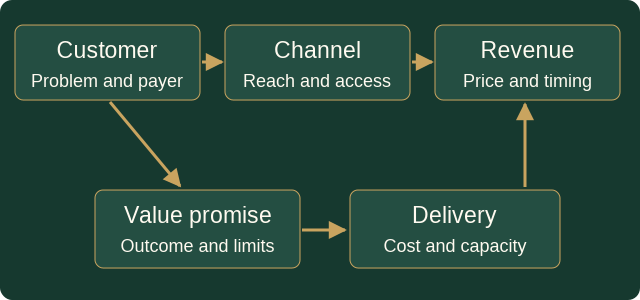
Customer links through channel to revenue; the value promise requires delivery activity with costs and capacity constraints.
Trace a connected model rather than five unrelated labels.

Read the diagram

Trace a connected model rather than five unrelated labels. Trace each relationship and explain one assumption that could make the conclusion fail.

Sketch & check

Describe this diagram in words without relying on colour. Name one input, one relationship and one limitation.

Show diagram-practice feedback

Customer links through channel to revenue; the value promise requires delivery activity with costs and capacity constraints. A sound response distinguishes the given relationship from evidence that a real business can deliver it.

STEP 4 OF 6

Try it yourself

Spend 30 minutes building Cedar’s nine-element model with six explicit connections. Label entries supplied fact, assumption or proposed design. Spend 20 minutes tracing distant collection points and priority membership: name three affected elements and one conflict for each. Write a 200-word recommendation stating what is coherent, what remains unknown and the most important revision or check. Review the rubric and retain this week-four checkpoint.

Fictional exercise · prewritten feedback, no live AI grading.

Navigation within this player keeps your notes. Use the optional notebook Save or Export controls to keep a snapshot before leaving. Nothing typed here is uploaded.

Guided practice

Fictional case: a meal cooperative promises low-effort weekly meals, relies on member cooking shifts and charges a monthly contribution. Identify a possible contradiction and one coherent revision.

Optional hint 1

Ask whose effort is reduced and whose is required.

Optional hint 2

A contribution may include money, labor or both, but those must be stated.

Compare the explained guided answer

“Low effort for every member” conflicts with required cooking shifts unless the promise explains how labor is shared. A revision could promise fewer individual cooking days through an explicit rota, with both money and work contributions visible. Feasibility still depends on participation, kitchen access and delivery capacity.

Independent transfer

Fictional case: a digital directory offers free access to buyers and paid listings to suppliers, but has no plan to maintain listings or help buyers compare them. Identify three connected model gaps.

Keep your attempt before opening the explanation. Reading an answer is different from producing your own response.

Compare the explained transfer answer

Supplier revenue depends partly on useful buyer participation; buyer value depends on accurate, usable listings; maintaining that quality requires activities and resources. A model that lists only “website” and “subscription” omits the work connecting both sides. A sound recommendation specifies a manageable listing scope and a maintenance arrangement before treating supplier fees as sustainable.

Check 1: What does a completed model map prove?

Choose an option to see its reasoning. You can try again. No score is recorded.

Check 2: What follows from adding distant collection points?

Choose an option to see its reasoning. You can try again. No score is recorded.

Check 3: How should unconfirmed office access appear?

Choose an option to see its reasoning. You can try again. No score is recorded.

STEP 5 OF 6

Worked answer & self-check

A defensible starting map connects office commuters with difficult workshop access to a scheduled pickup promise. Workplace communication and a booked lobby handover form part of the channel, while clear job-related support forms part of the relationship. Per-job revenue depends on qualifying completed work. Booking, scope checks, collection, repair and return require skilled time, tools, space and coordination. Office access is a dependency, and costs arise from the resources those activities consume. Expansion to distant locations changes collection activity, required time and the credibility of next-afternoon return. Priority membership changes the payment unit, continuing promise and capacity allocation. A strong answer traces these links rather than merely adding “marketing” to both changes. The recommendation can support continued investigation of the narrow office arrangement while withholding a launch claim. It should identify access and workable handovers as consequential unknowns and flag financial viability for the next unit. Other priorities are defensible when linked to a specific failure in the map. No fictional observation establishes that all city residents want the service.

Compare your answer

  • Model coverage: describes all nine elements with specific entries rather than generic labels.
  • Connections: explains at least six causal or operational links across the elements.
  • Fact discipline: distinguishes supplied facts, assumptions and proposed changes, including partner access.
  • Change analysis: traces each proposed change through three elements and names a potential conflict.
  • Recommendation: identifies a concrete revision or check and avoids declaring viability from completeness alone.

Give yourself one check for each point your work meets. Revise any missing piece. This is a self-check, not a score sent to a teacher.

STEP 6 OF 6

Recap & next step

Retrieve, then revisit

From memory, name the nine model elements and explain one dependency involving at least three of them.

Revisit in course week(s) 9, 12, 15; later dates are review visits, not extra required course slots.

Check the retrieval explanation

Customer groups, value promises, channels, relationships, revenue mechanisms, activities, resources, partners and cost structure. For example, a next-day delivery promise requires delivery activities and staff resources, whose costs must fit the revenue arrangement. Naming boxes without explaining the connection is incomplete.

  • A model explains connections among value, delivery and resources.
  • Changing one element can change several others.
  • A coherent map still needs demand and financial tests.

Keep the week-four model and the earlier artifacts. Next calculate how price, job costs, fixed costs and capacity affect the viability of the explicitly defined monthly repair scenario.

A personal record of review; no grade or certificate.

Next lesson: Delivery promises and usable capacity →

LESSON 9 OF 24 · PLANNED 150 MINUTES

Delivery promises and usable capacity

STEP 1 OF 6

Your objective

Connect a customer promise and sales channel to a defensible delivery limit, then distinguish that limit from demonstrated demand.

STEP 2 OF 6

The idea

A business earns a repeat purchase by delivering the promised result under the promised conditions. A channel can generate enquiries, bookings or payments, but none is automatically a completed delivery. Define the sale unit in business terms before estimating revenue: one completed standard repair, accepted by its customer, at the stated price. A booking may be cancelled, an enquiry may be unsuitable, and an advance payment may relate to future work. Keep these states separate so a busy sales channel does not become an imaginary income statement.

Our recurring invented Canadian-dollar case is a small repair service. Its monthly sustainable capacity is 30 completed standard repairs. The standard price is CAD 60; the variable cost is CAD 24 per completed repair, including the specified labour, materials and transaction cost. Monthly fixed costs are CAD 720. In the unchanged base month, 25 repairs are delivered and 20 of those are paid. All current-month costs are paid. There are no opening receivables, debt, tax, inventory or capital purchases. Opening cash is unspecified. These assumptions are a model boundary, not a claim about typical repair businesses.

Capacity needs an operating basis. Suppose the service has 60 hours available for standard delivery after planned administration, breaks and maintenance, and each standard repair consumes two of those hours. This supports 30 repairs in the stated month. Do not subtract those allowances again. Equally, do not calculate from every hour on a calendar and call that sustainable capacity. A limit that relies on skipping promised checks, unpaid work or permanent overtime changes the business promise and its cost assumptions.

A capacity number belongs to a defined offer and time period. A complicated repair taking four hours is not one standard two-hour repair for planning purposes. If two offers share the same available hours, their quantities must fit together. With 60 usable hours, 18 standard repairs consume 36 hours and eight three-hour specialist jobs consume 24: together they use the full 60. Counting them as only 26 jobs and assuming four more fit would ignore the changed mix. A limit can also come from equipment, specialist availability or a contractual booking restriction.

Demand is a separate claim. A forecast of 30 possible deliveries does not establish 30 customers willing to pay. A channel record might show 40 qualified enquiries, 30 bookings and 25 completed repairs. The enquiry-to-booking rate is 75%; booking-to-delivery is about 83.3%; enquiry-to-delivery is 62.5%. These describe this record, not dependable conversion probabilities for every future month. Determine why five bookings did not become deliveries before proposing more advertising: cancellations, unsuitable requests and unavailable appointment times suggest different decisions.

A new channel can alter both the customer promise and the economics. An invented marketplace may charge CAD 6 per delivered repair. If the price stays CAD 60 and that fee is additional to the base CAD 24, the channel-specific variable cost becomes CAD 30. It may still bring worthwhile customers, but the fee must appear in later contribution calculations. Conversely, a channel that promises same-day service may require unused appointment capacity. Do not import the old 30-job limit unchanged if the new promise requires reserved slots.

Create a delivery assumptions card containing the offer, completion criterion, usable resource, resource required per unit, maximum deliveries, and evidence of demand. Mark estimates and observations separately. When evidence is weak, describe the next bounded test: for example, offer five existing unfilled appointments through one channel and record completed paid repairs, additional cost and reasons for failed bookings. A capacity calculation supports a limit; a test of actual customer behaviour supports demand. Neither alone proves that the business can fund its commitments.

STEP 3 OF 6

Trace the channel through to delivery

Starting point

An owner reports 40 qualified enquiries, 30 bookings, 25 completed standard repairs and 20 customer payments. They call this 40 sales and plan to add ten more bookings because monthly capacity is 30. The 60 usable delivery hours and two-hour standard are unchanged.

A checkable approach

Record 25 delivered sales units, 20 paid current deliveries and five delivered but unpaid repairs. The 25 completed jobs use 50 of 60 usable hours, leaving ten hours or five standard jobs of theoretical delivery capacity. Ten extra bookings are not ten extra deliverable jobs; completion and timing remain uncertain. The recorded enquiry-to-delivery rate is 25 ÷ 40 = 62.5%, without assuming that the next ten enquiries behave identically.

All figures are invented. This lesson establishes the business units; the next lessons determine cost, profit and cash.

STEP 4 OF 6

Try it yourself

Independent task: Write a delivery assumptions card for the base repair offer and diagnose the owner’s two errors in the demonstration. Then assess a changed offer mix: 18 standard repairs at two hours each and nine specialist jobs at three hours each, sharing the same 60 usable hours. State whether the promise fits and give two feasible revisions without reducing the promised standard of work.

Fictional exercise · prewritten feedback, no live AI grading.

Navigation within this player keeps your notes. Use the optional notebook Save or Export controls to keep a snapshot before leaving. Nothing typed here is uploaded.

Guided practice

A separate service has 48 usable hours per month and needs three hours per completed installation. It receives 22 enquiries, books 18 installations and completes 15. Identify capacity, delivered sales units and unused delivery capacity.

Optional hint 1

Use usable hours and the installation requirement for the resource limit.

Optional hint 2

Bookings and enquiries do not change the count of completed installations.

Compare the explained guided answer

Capacity is 48 ÷ 3 = 16 completed installations. Delivered sales units are 15, using 45 hours. The remaining three hours support one more installation if demand and scheduling permit. The 18 bookings exceeded the stated capacity unless some belonged to a later month.

Independent transfer

An invented studio has 80 usable hours. It promises 12 basic sessions requiring four hours each and seven extended sessions requiring five hours each. Independently recommend a feasible revision and identify one demand fact still missing.

Keep your attempt before opening the explanation. Reading an answer is different from producing your own response.

Compare the explained transfer answer

The promise requires 12 × 4 + 7 × 5 = 83 hours and does not fit. Keeping 12 basic sessions and reducing extended sessions to six uses 78 hours. Keeping 11 basic and seven extended uses 79 hours. Either leaves too little time for another complete session. Customer willingness to accept a new date or buy the offered session remains unknown; resource feasibility cannot answer that.

Check 1: Which base-month count measures completed repair units?

Choose an option to see its reasoning. You can try again. No score is recorded.

Check 2: A marketplace adds CAD 6 per completed repair. What must change?

Choose an option to see its reasoning. You can try again. No score is recorded.

Check 3: What does a calculated spare five-job capacity establish?

Choose an option to see its reasoning. You can try again. No score is recorded.

STEP 5 OF 6

Worked answer & self-check

The card should identify one completed standard repair, acceptance as the delivery condition, 60 usable hours, two hours per standard job, and a 30-job monthly ceiling. Observed output is 25 delivered jobs; observed collections cover 20 jobs. The owner confuses enquiries with delivered sales and additional bookings with deliverable output. Five more standard deliveries could fit the resource calculation, but customer demand and appointment timing still need evidence. The changed mix requires 18 × 2 + 9 × 3 = 63 hours, exceeding capacity by three hours. One feasible revision is 18 standard repairs and eight specialist jobs, using 60 hours. Another is 16 standard and nine specialist jobs, using 59 hours; the one remaining hour cannot fit another complete job of either type. Simply promising shorter work without evidence changes the offer. A reasonable artifact records which customer promises must be renegotiated, rather than silently treating incomplete jobs as completed sales.

Compare your answer

  • Defines a completed sale separately from an enquiry, booking and payment.
  • Shows a resource-based capacity calculation with the correct offer and period.
  • Labels conversion evidence as observed history rather than guaranteed future demand.
  • Produces a feasible revised offer mix and explains the customer consequence.

Give yourself one check for each point your work meets. Revise any missing piece. This is a self-check, not a score sent to a teacher.

STEP 6 OF 6

Recap & next step

Retrieve, then revisit

Without reopening the lesson, explain why 30 available repair appointments, 30 bookings and 30 payments are three different business claims.

Revisit in course week(s) 6, 9, 13; later dates are review visits, not extra required course slots.

Check the retrieval explanation

Appointments describe a resource-supported offer limit. Bookings describe intended customer activity that may not complete. Payments describe cash collection and can occur before or after delivery. Revenue depends on the stated completion condition, not merely on any one of these counts.

  • Capacity belongs to a stated offer, resource and period.
  • A channel creates stages of customer activity; delivery and payment are separate events.
  • Test demand and channel-specific costs before treating unused capacity as future profit.

Carry the delivery assumptions card into Costs and relevant range; it defines the activity level to which costs must relate.

A personal record of review; no grade or certificate.

Next lesson: Costs, commitments and the relevant range →

LESSON 10 OF 24 · PLANNED 150 MINUTES

Costs, commitments and the relevant range

STEP 1 OF 6

Your objective

Classify costs by their stated behaviour and decision relevance, and refuse to extend a cost model beyond its supported operating range.

STEP 2 OF 6

The idea

Cost labels are statements about behaviour within a particular decision, not permanent properties of an item. Materials used once per repair usually vary with completed repairs in this simplified model. A monthly premises commitment may remain unchanged whether the service delivers five or 25 repairs. Labour can behave either way: an hourly technician paid only for performed jobs differs from an employee paid a fixed monthly salary. Always ask what agreement and time horizon make the classification true. The word labour by itself does not answer the question.

In our unchanged repair case, the CAD 24 variable cost per completed repair already includes the specified labour. For an explanatory breakdown, use CAD 10 materials, CAD 12 paid delivery labour and CAD 2 transaction cost, totalling CAD 24. Fixed monthly costs are CAD 720: CAD 400 premises, CAD 120 insurance and CAD 200 scheduling support. These invented amounts are held constant within the current offer and capacity limit of 30 repairs per month. Do not add delivery labour again, and do not treat the fixed scheduling commitment as another per-repair fee.

Within that relevant range, total variable cost equals CAD 24 multiplied by completed repairs, while total cost equals CAD 720 plus that variable total. At 25 repairs, variable cost is CAD 600 and total cost is CAD 1,320. At zero repairs, the stated commitments still cost CAD 720. Fixed cost per unit is different from total fixed cost: allocating CAD 720 over 20 repairs gives CAD 36 per repair; over 30 gives CAD 24. The allocation changes because the denominator changes, not because the monthly bill shrinks.

The relevant range is the range of activity for which these relationships remain a reasonable description. The base formula covers zero through 30 completed standard repairs in the month, with unchanged agreements. Beyond 30, the service needs an operating change. In an explicitly changed arrangement, it secures 90 usable delivery hours at the same two hours per repair, supporting 45 repairs. All per-job labour remains included in CAD 24 variable cost. Additional equipment access costs CAD 300 per month; that charge buys equipment access, not labour. The new arrangement therefore has CAD 1,020 fixed cost and sufficient stated labour hours as well as equipment access. Neither change may be assumed without the new agreement.

Compare decisions using costs that differ between feasible alternatives. A completed purchase from last year cannot be undone by choosing today’s channel and is a sunk cost for that choice. An existing monthly commitment may be unavoidable this month but avoidable before renewal. A new channel fee is incremental if it arises only when using that channel. None of these labels says the cost is unimportant to the whole business: a business still needs enough total contribution over time to fund its commitments. A short-term acceptance decision and a long-term viability decision answer different questions.

Average cost can hide the next decision. Base average cost at 25 repairs is CAD 1,320 ÷ 25 = CAD 52.80. Within spare capacity, one additional standard repair adds the stated CAD 24 variable cost, assuming no other change. It does not add CAD 52.80 simply because that was last month’s average. However, if the extra job requires a new paid shift, the incremental cost includes that commitment. Identify the actual change rather than selecting whichever average or marginal figure makes an offer look attractive.

Document exclusions with care. This teaching case excludes tax, debt, inventory and capital purchases, and includes the labour stated above. It does not prove that a real business has no other costs. A missing insurance quote is an unresolved assumption, not permission to use zero. For a cost evidence sheet, list the item, unit, behaviour, supported activity range, payment agreement, evidence date and decision that could change it. General numerical and spreadsheet procedures belong in the linked foundations courses; the task here is choosing a defensible business model.

STEP 3 OF 6

A cheaper monthly fee can cost more overall

Starting point

Two invented supplier arrangements can both support 25 standard repairs. Arrangement A follows the base model: CAD 720 fixed plus CAD 24 per delivered repair. Arrangement B costs CAD 480 fixed plus CAD 36 per delivered repair. A manager chooses B because its monthly fixed charge is lower.

A checkable approach

At 25 repairs, A costs 720 + 24 × 25 = CAD 1,320; B costs 480 + 36 × 25 = CAD 1,380. B costs CAD 60 more at this quantity. At 20 repairs both cost CAD 1,200. At ten, A costs CAD 960 and B costs CAD 840. The lower fixed commitment favours B at sufficiently low volume, while A’s lower variable cost favours A above 20, within both arrangements’ supported ranges.

This compares modeled costs only. Service quality, cancellation terms and whether each arrangement can actually deliver the promise need separate evidence.

STEP 4 OF 6

Try it yourself

Independent task: Build a cost evidence sheet for the unchanged repair case, distinguishing per-unit amounts from monthly totals. Calculate total cost at zero, 20, 25 and 30 deliveries. Then assess the claim that 35 repairs cost CAD 1,560. Use the explicitly changed expansion arrangement with 90 usable delivery hours, two hours per repair, CAD 300 additional monthly equipment cost and capacity 45 to produce a corrected figure.

Fictional exercise · prewritten feedback, no live AI grading.

Navigation within this player keeps your notes. Use the optional notebook Save or Export controls to keep a snapshot before leaving. Nothing typed here is uploaded.

Guided practice

Under the unchanged base cost agreements, compare total and average cost at 20 and 30 repairs. Explain why the next repair within available capacity does not automatically cost the historical average.

Optional hint 1

Calculate monthly total before dividing it over the completed units.

Optional hint 2

Identify the cost caused by one additional job under the unchanged agreement.

Compare the explained guided answer

At 20, total cost is CAD 1,200 and average cost CAD 60. At 30, total cost is CAD 1,440 and average cost CAD 48. The CAD 720 commitment is spread across more units. An extra repair within spare capacity causes CAD 24 of variable cost, unless another commitment is specifically triggered; average cost includes an allocation of existing fixed cost.

Independent transfer

A separate invented service compares contract C: CAD 300 monthly plus CAD 18 per job, with contract D: CAD 540 monthly plus CAD 12 per job. Both support up to 60 jobs. Compare cost at 25 and 50 jobs and identify their equal-cost quantity.

Keep your attempt before opening the explanation. Reading an answer is different from producing your own response.

Compare the explained transfer answer

At 25 jobs, C costs CAD 750 and D CAD 840, so C is CAD 90 cheaper. At 50, C costs CAD 1,200 and D CAD 1,140, so D is CAD 60 cheaper. The extra CAD 240 fixed commitment in D is recovered through CAD 6 lower cost per job at 40 jobs; both then cost CAD 1,020. All evaluated quantities fall within the stated range.

Check 1: At 25 base repairs, what is total monthly cost?

Choose an option to see its reasoning. You can try again. No score is recorded.

Check 2: Which change requires revisiting the base relevant range?

Choose an option to see its reasoning. You can try again. No score is recorded.

Check 3: What makes a cost relevant to comparing two feasible choices?

Choose an option to see its reasoning. You can try again. No score is recorded.

STEP 5 OF 6

Worked answer & self-check

The evidence sheet should label CAD 10 materials, CAD 12 delivery labour and CAD 2 transaction cost as variable amounts per completed repair under the supplied agreements. The CAD 400, CAD 120 and CAD 200 commitments are monthly fixed totals within the base relevant range. Their sums are CAD 24 per repair and CAD 720 per month respectively. Base total costs are CAD 720 at zero deliveries, CAD 1,200 at 20, CAD 1,320 at 25 and CAD 1,440 at 30. The arithmetic 720 + 24 × 35 = 1,560 uses a model beyond its 30-job capacity and cannot support a feasible promise. Under the stated changed arrangement, 90 usable hours support 45 two-hour repairs and the CAD 300 equipment charge raises fixed cost to CAD 1,020, so 35 repairs cost 1,020 + 24 × 35 = CAD 1,860. The corrected figure belongs to that arrangement only. A sound response does not quietly increase capacity while retaining the original fixed cost.

Compare your answer

  • States the contract or assumption behind each cost classification.
  • Keeps CAD per repair distinct from CAD per month and total CAD.
  • Includes specified labour once and preserves all stated fixed commitments.
  • Rejects unsupported extrapolation and recalculates the labelled expansion case.

Give yourself one check for each point your work meets. Revise any missing piece. This is a self-check, not a score sent to a teacher.

STEP 6 OF 6

Recap & next step

Retrieve, then revisit

Explain why “labour is variable” and “fixed costs are unavoidable” are incomplete statements.

Revisit in course week(s) 6, 10, 13; later dates are review visits, not extra required course slots.

Check the retrieval explanation

Labour behaviour requires a payment agreement: per-job paid labour differs from a committed salary. Avoidability depends on the decision and timing: a fixed contract may be unavoidable now and avoidable at renewal. Neither label can replace the actual terms.

  • Cost behaviour depends on agreements, time horizon and relevant range.
  • A smaller fixed fee can be outweighed by a larger per-unit cost.
  • Capacity expansion may change the cost model as well as its output limit.

Use the cost evidence sheet to calculate contribution and test whether break-even is feasible.

A personal record of review; no grade or certificate.

Next lesson: Contribution, break-even and feasible volume →

LESSON 11 OF 24 · PLANNED 150 MINUTES

Contribution, break-even and feasible volume

STEP 1 OF 6

Your objective

Calculate contribution and whole-unit break-even, handle boundary cases, and compare the threshold with capacity before judging an offer.

STEP 2 OF 6

The idea

Contribution is the amount a completed sale leaves after its specified variable cost, available to cover fixed costs and then profit. In the unchanged repair case, CAD 60 price less CAD 24 variable cost leaves CAD 36 contribution per repair. Contribution is not profit per repair because the monthly CAD 720 fixed commitment still needs funding. At 25 repairs, total contribution is CAD 900; subtract CAD 720 to obtain CAD 180 modeled operating profit. This language makes clear which costs have and have not yet been covered.

For positive contribution and positive fixed cost, the continuous break-even threshold is fixed cost divided by contribution per unit. The units matter: CAD per month divided by CAD per completed repair gives repairs per month. Here CAD 720 ÷ CAD 36 = 20 repairs. Revenue and total modeled cost both equal CAD 1,200 at 20 deliveries. Below that quantity the modeled operation loses money; above it profit grows by CAD 36 for each additional delivered repair, as long as price, variable cost and fixed commitment remain unchanged.

When a business sells indivisible units, the minimum non-loss quantity must be a whole number. For an explicitly changed case with price CAD 54, variable cost CAD 27, fixed cost CAD 720 and capacity 30, contribution is CAD 27. The continuous threshold is 26⅔ repairs. Round upward to 27 complete repairs. At 26, contribution totals CAD 702 and profit is negative CAD 18. At 27, contribution totals CAD 729 and profit is CAD 9. Rounding to the nearest integer would fail when it rounds below the threshold. An exact integer threshold needs no extra unit. Use the stated currency precision and check total contribution against fixed cost, rather than deciding from a rounded displayed threshold.

A valid threshold is not automatically feasible. The unchanged base needs 20 repairs and can deliver 30, so break-even fits its stated capacity. A different product priced at CAD 40 with variable cost CAD 25 contributes CAD 15. If fixed cost is CAD 900 and capacity 50 units, its break-even requirement is 60 units. That exceeds capacity. At its full capacity, profit is CAD 15 × 50 − CAD 900 = negative CAD 150. More promotion cannot make 60 deliveries fit a 50-unit system; a relevant assumption must change.

Check contribution before dividing. With positive fixed cost and zero contribution, every sale leaves nothing to cover fixed cost, so no positive volume reaches break-even. With negative contribution, additional sales increase the loss, and again no nonnegative feasible sales quantity covers positive fixed cost. A calculator may return a negative quotient, but a negative number of customer deliveries is not a business solution. These are failures of the offer economics under the assumptions, not instructions to sell a negative quantity.

Zero fixed cost is a separate boundary. With positive contribution, zero sales gives zero modeled profit, while any positive whole-unit volume gives positive profit. With both zero fixed cost and zero contribution, every feasible volume has zero modeled profit. With zero fixed cost and negative contribution, zero sales breaks even and every positive volume loses money. Avoid the ambiguous statement “break-even is impossible” without specifying whether zero volume is allowed. The useful operational question is often the minimum positive profitable quantity, which is not the same as a zero-profit point.

Break-even is a narrow model result. It does not establish sufficient cash on the day bills fall due, enough customer demand, an adequate return for the owner, or resilience to cost changes. This case includes its specified delivery labour, but other business models may omit labour or necessary commitments and thereby overstate contribution. Preserve a visible assumptions card, record both the numerical threshold and the capacity comparison, and write the conclusion conditionally. A financially useful answer explains why the threshold matters and what evidence is still missing.

STEP 3 OF 6

Check the threshold on both sides

Starting point

The base repair service sells completed repairs for CAD 60, incurs CAD 24 variable cost per repair and CAD 720 monthly fixed cost, and can deliver 30. Identify the threshold and verify nearby whole-unit outcomes.

A checkable approach

Contribution is CAD 36. The threshold is 720 ÷ 36 = 20 repairs. At 19, revenue is CAD 1,140, variable cost CAD 456 and total cost CAD 1,176, producing a CAD 36 loss. At 20, revenue and total cost both equal CAD 1,200. At 21, profit is CAD 36. The threshold fits the 30-job capacity; demand for 20 completed sales remains a separate requirement.

“Minimum non-loss volume” means profit is at least zero. “Profitable volume” means strictly greater than zero; base profit first becomes positive at 21 whole repairs.

Price CAD60 less variable cost24 leaves contribution36. At25jobs, total contribution900 less fixed720 yields profit180.
Contribution first covers fixed cost. It is not full profit per unit.

Read the diagram

Contribution first covers fixed cost. It is not full profit per unit. Trace each relationship and explain one assumption that could make the conclusion fail.

Sketch & check

Describe this diagram in words without relying on colour. Name one input, one relationship and one limitation.

Show diagram-practice feedback

Price CAD60 less variable cost24 leaves contribution36. At25jobs, total contribution900 less fixed720 yields profit180. A sound response distinguishes the given relationship from evidence that a real business can deliver it.

STEP 4 OF 6

Try it yourself

Independent task: Produce a threshold decision note for the unchanged base and the changed CAD 54/CAD 27/CAD 720/capacity-30 case. Include contribution, continuous threshold, minimum whole-unit non-loss volume, profit one unit below that volume, full-capacity profit and a statement of feasibility. Then explain the zero-contribution case with CAD 720 fixed cost without dividing by zero.

Fictional exercise · prewritten feedback, no live AI grading.

Navigation within this player keeps your notes. Use the optional notebook Save or Export controls to keep a snapshot before leaving. Nothing typed here is uploaded.

Guided practice

Rework the changed repair case: price CAD 54, variable cost CAD 27, fixed cost CAD 720, capacity 30. Show why 26 repairs fail and 27 succeed.

Optional hint 1

Keep the changed case separate from the unchanged CAD 60/CAD 24 base.

Optional hint 2

Compare contribution at each whole quantity with CAD 720.

Compare the explained guided answer

Contribution is CAD 27. At 26, total contribution is CAD 702 and profit is negative CAD 18. At 27, contribution is CAD 729 and profit is CAD 9. Thus 27 is the minimum whole-unit non-loss volume. At capacity 30, profit is CAD 90; rounding the continuous 26⅔ threshold down would give a loss.

Independent transfer

A new product has price CAD 40, variable cost CAD 25, fixed cost CAD 900 and capacity 50. Independently calculate contribution, break-even, full-capacity profit and a defensible business conclusion.

Keep your attempt before opening the explanation. Reading an answer is different from producing your own response.

Compare the explained transfer answer

Contribution is CAD 15 per unit. Break-even is 900 ÷ 15 = 60 units, exceeding the 50-unit ceiling. At 50, revenue is CAD 2,000, variable cost CAD 1,250, total cost CAD 2,150 and profit negative CAD 150. The modeled offer cannot break even at any feasible quantity. A revised price, cost structure or capacity arrangement needs new evidence and recalculation.

Check 1: The continuous threshold is 26⅔ indivisible repairs. What is the minimum non-loss quantity?

Choose an option to see its reasoning. You can try again. No score is recorded.

Check 2: With positive fixed cost and negative contribution, what happens as sales rise?

Choose an option to see its reasoning. You can try again. No score is recorded.

Check 3: Base break-even is 20 and capacity is 30. Which conclusion follows?

Choose an option to see its reasoning. You can try again. No score is recorded.

STEP 5 OF 6

Worked answer & self-check

Base: contribution CAD 36; continuous threshold and whole-unit non-loss volume both 20; profit at 19 is negative CAD 36; full-capacity profit is 36 × 30 − 720 = CAD 360. It is feasible within capacity, conditionally on the model and enough completed demand. Changed case: contribution CAD 27; continuous threshold 26⅔; whole-unit non-loss volume 27; profit at 26 is negative CAD 18; full-capacity profit is CAD 90. It fits capacity but has much less room between the minimum non-loss output and the ceiling. With zero contribution and CAD 720 fixed cost, total contribution remains zero at every feasible quantity and profit remains negative CAD 720. There is no volume that funds the fixed commitment. A correct decision note does not divide by zero, round a threshold downward, equate contribution with profit, or describe capacity as demand.

Compare your answer

  • Calculates per-unit contribution before attempting a threshold.
  • Rounds only non-integer whole-unit requirements upward and checks a neighbouring quantity.
  • Compares required output with the same-period capacity and relevant range.
  • Handles zero or negative contribution explicitly and limits the business conclusion.

Give yourself one check for each point your work meets. Revise any missing piece. This is a self-check, not a score sent to a teacher.

STEP 6 OF 6

Recap & next step

Retrieve, then revisit

With fixed cost zero, explain the profit pattern for positive, zero and negative unit contribution.

Revisit in course week(s) 7, 10, 14; later dates are review visits, not extra required course slots.

Check the retrieval explanation

Positive contribution: zero volume breaks even and each positive unit adds profit. Zero contribution: all feasible volumes break even. Negative contribution: zero volume breaks even and all positive volumes lose money. These boundary cases differ from positive-fixed-cost models.

  • Contribution first covers fixed cost, then produces profit.
  • Whole-unit break-even is the smallest feasible integer with nonnegative profit.
  • A correct threshold can still be unreachable or commercially insufficient.

Stress the price, cost and quantity assumptions in Sensitivity and headroom.

A personal record of review; no grade or certificate.

Next lesson: Sensitivity, headroom and sales mix →

LESSON 12 OF 24 · PLANNED 150 MINUTES

Sensitivity, headroom and sales mix

STEP 1 OF 6

Your objective

Evaluate how plausible assumption changes affect profit and break-even, while distinguishing sales headroom, spare capacity and evidence about demand.

STEP 2 OF 6

The idea

A forecast is a conditional statement: if these quantities, prices and costs occur, this result follows. Sensitivity analysis changes an assumption deliberately and observes how the result changes. It does not make the new assumption likely. Begin with the unchanged repair base: price CAD 60, variable cost CAD 24, fixed cost CAD 720, planned completed volume 25 and capacity 30. Contribution is CAD 36 and planned profit CAD 180. Preserve this reference before making changes so a later result can be traced to the assumption that caused it.

Two kinds of headroom answer different questions. The base plan is five deliveries above its 20-repair break-even point; this is sales headroom before profit reaches zero. Relative to planned sales, five divided by 25 is 20%. Separately, capacity is five deliveries above the planned 25; this is unused delivery capacity. They happen to equal five here, but they are conceptually different. Sales headroom protects against a volume shortfall; spare capacity indicates room to deliver more, if customers and scheduling permit.

Change one assumption first to understand a mechanism. A price reduction from CAD 60 to CAD 54, with variable cost still CAD 24 and fixed cost still CAD 720, reduces contribution from CAD 36 to CAD 30. At 25 deliveries profit falls from CAD 180 to CAD 30. The new break-even threshold is 24 repairs. To restore the original CAD 180 profit requires 30 deliveries, exactly the stated capacity. A discount proposal therefore needs five additional completed sales and leaves no spare delivery capacity at that target. A promise of “more sales” is insufficient evidence.

Then test combined scenarios because assumptions can move together. The separately labelled CAD 54 price/CAD 27 variable-cost case yields negative CAD 180 at 20 deliveries, negative CAD 45 at 25 and positive CAD 90 at 30, with fixed cost CAD 720. These are outcomes at specified volumes, not probabilities. If its fixed cost also increases to CAD 810, profit at 25 becomes negative CAD 135 and at capacity 30 becomes exactly zero. This combined stress case reaches break-even only at full capacity and has no sales headroom there.

Useful scenarios are coherent. A higher price may change demand, a cheaper channel may reach fewer suitable customers, and faster delivery may require added cost. Avoid combining every favourable assumption while calling the result expected. Record a base, a plausible adverse case and a bounded improvement case, stating the business evidence needed for each. The purpose is to identify which assumption could reverse the decision and what observation would reduce uncertainty. A precise calculation of an unsupported sales forecast remains unsupported.

A simple multi-product model requires a stated mix. In a separate invented two-product case, product A contributes CAD 36 and product B contributes CAD 24. Fixed cost is CAD 720, each unit uses one equivalent capacity slot, and monthly capacity is 30 slots. Suppose sales must occur in bundles of two A and one B. Each three-unit bundle contributes CAD 96. The continuous threshold is 7.5 bundles, so eight whole bundles, or 24 units, produce CAD 48 profit. Capacity permits ten bundles and CAD 240 profit. This calculation cannot be reused if the sales mix or resource use changes.

Do not extend the simple mix model into an unsupported optimisation claim. Products can require different scarce resources, have different demand ceilings or be sold independently rather than in fixed bundles. A weighted contribution average is valid only for the assumed mix. Likewise, sensitivity tables cannot decide acceptable risk for an owner. End the analysis with a conditional recommendation, the most decision-sensitive assumption, and a measurable test. Keep the arithmetic transparent but concentrate the explanation on the business consequence.

STEP 3 OF 6

Read a volume scenario without predicting demand

Starting point

Compare the unchanged base and the changed CAD 54 price/CAD 27 variable-cost case at 20, 25 and 30 deliveries. Both have CAD 720 fixed cost and capacity 30.

A checkable approach

Base profits at 20, 25 and 30 are CAD 0, CAD 180 and CAD 360. Changed-case profits are negative CAD 180, negative CAD 45 and CAD 90. At the planned 25 deliveries, the changed case loses CAD 45; it needs at least 27 complete deliveries to avoid a loss. The table demonstrates sensitivity to the offer economics and volume. It does not show that a lower price will actually attract the necessary customers.

Every column holds quantity explicit. Do not quietly use base volume for one proposal and an optimistic volume for another without explaining the evidence.

Repair breaks even at20jobs within30capacity. The distinct product case needs60units but capacity is50.
A numerical threshold can still be infeasible.

Read the diagram

A numerical threshold can still be infeasible. Trace each relationship and explain one assumption that could make the conclusion fail.

Sketch & check

Describe this diagram in words without relying on colour. Name one input, one relationship and one limitation.

Show diagram-practice feedback

Repair breaks even at20jobs within30capacity. The distinct product case needs60units but capacity is50. A sound response distinguishes the given relationship from evidence that a real business can deliver it.

STEP 4 OF 6

Try it yourself

Independent task: Write a decision note comparing the base plan of 25 deliveries with a price-only reduction to CAD 54. Calculate contribution, profit at 25, break-even and the volume needed to preserve CAD 180 profit. State sales headroom and spare capacity at the preserving-profit target. Propose a bounded demand test that would inform the discount decision.

Fictional exercise · prewritten feedback, no live AI grading.

Navigation within this player keeps your notes. Use the optional notebook Save or Export controls to keep a snapshot before leaving. Nothing typed here is uploaded.

Guided practice

In the combined stress case, price is CAD 54, variable cost CAD 27, fixed cost CAD 810 and capacity 30. Calculate profit at 25 and 30, then interpret break-even.

Optional hint 1

This is a changed case; CAD 810 replaces the base fixed cost.

Optional hint 2

Contribution remains CAD 27 per repair.

Compare the explained guided answer

Profit at 25 is 27 × 25 − 810 = negative CAD 135. At 30 it is zero. Break-even is 810 ÷ 27 = 30 repairs, exactly capacity. The offer could avoid a modeled loss only at full capacity, with no volume shortfall tolerated under these assumptions.

Independent transfer

Change the separate two-product bundle to one A and two B, retaining CAD 36 and CAD 24 unit contributions, CAD 720 fixed cost and 30 equivalent slots. Find the whole-bundle break-even, units required and full-capacity profit.

Keep your attempt before opening the explanation. Reading an answer is different from producing your own response.

Compare the explained transfer answer

A three-unit bundle contributes 36 + 2 × 24 = CAD 84. The continuous threshold is 720 ÷ 84 = 8.5714 bundles; nine whole bundles require 27 slots and produce CAD 36 profit. Ten bundles fit capacity and produce CAD 120 profit. This is lower than the original two-A/one-B mix’s CAD 240 full-capacity profit. It is valid only for the stated fixed bundles and equal slot requirement.

Check 1: Base volume is 25, break-even 20 and capacity 30. Sales headroom as a share of planned volume is what?

Choose an option to see its reasoning. You can try again. No score is recorded.

Check 2: What additional evidence supports a discount proposal?

Choose an option to see its reasoning. You can try again. No score is recorded.

Check 3: Why can the two-product break-even change when the mix changes?

Choose an option to see its reasoning. You can try again. No score is recorded.

STEP 5 OF 6

Worked answer & self-check

The price-only discount leaves CAD 30 contribution. At 25 repairs, profit is 30 × 25 − 720 = CAD 30. Break-even is 24 repairs. Preserving CAD 180 profit requires (720 + 180) ÷ 30 = 30 delivered repairs. At that target, sales headroom is six repairs above break-even, or 20% of target volume; spare capacity is zero. The identical percentage to the original plan does not imply identical operating flexibility. A bounded test might offer the proposed price for a limited set of otherwise unfilled appointments, tracking completed deliveries, variable cost, channel source and displacement of customers who would have paid CAD 60. The decision note should require evidence of five additional completed monthly sales without exceeding capacity or changing cost. Counting enquiries, ignoring displaced full-price purchases, or treating an optimistic scenario as a forecast would overstate the case.

Compare your answer

  • Preserves a labelled base and identifies exactly which assumptions change.
  • Separates sales headroom from spare capacity using the correct denominators.
  • Relates scenario outcomes to a decision without inventing demand probabilities.
  • States the sales-mix and resource assumptions behind any multi-product calculation.

Give yourself one check for each point your work meets. Revise any missing piece. This is a self-check, not a score sent to a teacher.

STEP 6 OF 6

Recap & next step

Retrieve, then revisit

Explain why two proposals with the same 20% sales headroom can have different operational risks.

Revisit in course week(s) 8, 11, 14; later dates are review visits, not extra required course slots.

Check the retrieval explanation

The headroom percentage measures distance above break-even relative to planned volume. It does not measure spare delivery capacity, collection timing, demand uncertainty or dependence on a changed price. One proposal can be at full capacity while another retains available appointments.

  • A sensitivity result is conditional, not a demand prediction.
  • Sales headroom and spare capacity measure different constraints.
  • A multi-product average or bundle works only within its stated mix and resource assumptions.

Use Revenue, expenses and profit to distinguish the modeled operating result from the cash it generates.

A personal record of review; no grade or certificate.

Next lesson: Revenue, expenses and the operating result →

LESSON 13 OF 24 · PLANNED 150 MINUTES

Revenue, expenses and the operating result

STEP 1 OF 6

Your objective

Construct and interpret a bounded profit statement using delivered work and related expenses, and distinguish it from customer collections.

STEP 2 OF 6

The idea

Profit asks whether recognised revenue exceeds the expenses assigned to a period. Cash asks when money enters and leaves. In this introductory business model, a completed accepted repair earns revenue when delivered, regardless of whether its invoice has been paid. This is an explicitly simplified recognition rule for the teaching case, not a treatment of every contract or accounting standard. Define the period and completion condition first. Without them, a list of receipts and bills can mix future work, current delivery and past collection into one misleading result.

The unchanged base month contains 25 completed repairs at CAD 60, so recognised revenue is CAD 1,500. All 25 deliveries incur the stated CAD 24 variable cost, including specified labour; variable expense is therefore CAD 600. Add CAD 720 fixed monthly expense to get CAD 1,320 total expense. Modeled operating profit is CAD 180. The 20 customers who have paid affect collections, not the delivered quantity used for revenue or the work count used for expense.

A compact profit statement can read: revenue CAD 1,500; variable expense CAD 600; contribution CAD 900; fixed expense CAD 720; operating profit CAD 180. Contribution is a useful subtotal, not an additional expense to subtract. The profit margin is CAD 180 divided by CAD 1,500, or 12%. This is profit relative to revenue, not a return on invested capital or evidence that the owner’s target has been met. The case excludes debt, tax, inventory and capital purchases, so describe the result as the modeled operating result within those boundaries.

The five delivered but unpaid repairs create CAD 300 of receivables: amounts customers owe for work already recognised as revenue. Current receipts are CAD 1,200. Because all CAD 1,320 current costs are paid this month, net cash movement is negative CAD 120. There is no contradiction between CAD 180 profit and a CAD 120 cash decrease. The CAD 300 difference is money earned but not yet collected. Collection later exchanges a receivable for cash; it does not earn the same repair revenue a second time.

Payment before delivery creates the reverse timing issue. In a separate variation, four customers each pay CAD 50 toward next month’s work, and none of that work is delivered now. Cash increases by CAD 200, but this model recognises no revenue from those undelivered jobs yet. The service has an obligation to provide the work or address the payment according to its agreement. Record a CAD 200 customer-deposit liability. Counting the deposit as current earned profit would overstate the period’s performance and hide a future delivery obligation.

Expense recognition also needs the stated business facts. In this repair case there is no inventory, and all specified variable resources relate to current completed work. A different product seller might purchase goods that remain unsold; those purchases can affect cash before they become cost of sold goods. An equipment purchase may also have a different accounting treatment. Do not silently import either complication into the unchanged base, and do not generalise the base’s “all costs paid and expensed this month” assumption to every real business.

A profitable month does not prove a viable business. It may fall short of the owner’s required return, depend on demand that cannot recur, or leave a funding shortfall before invoices are collected. Conversely, one negative cash month does not establish an operating loss or insolvency. The base opening cash balance is unspecified, so its ending cash balance and ability to meet particular due dates cannot be concluded. Present what the statement establishes, identify what remains unknown, and request the right additional evidence rather than attaching a stronger label.

STEP 3 OF 6

Correct a receipts-based profit claim

Starting point

A repair owner says: “Only 20 customers paid, so revenue is CAD 1,200. We worked on 25 jobs and paid CAD 1,320 of costs, so the business lost CAD 120.” The stated completion and recognition rule is unchanged.

A checkable approach

The 25 delivered repairs earn CAD 1,500 revenue. Expenses are CAD 600 variable plus CAD 720 fixed, producing CAD 180 operating profit. CAD 1,200 receipts less CAD 1,320 payments produce a CAD 120 cash decrease. Five unpaid current invoices create CAD 300 receivables. Both statements matter, but the owner labelled cash movement as profit.

No opening cash, payment due dates or borrowing arrangement is supplied. The corrected analysis does not conclude insolvency.

STEP 4 OF 6

Try it yourself

Independent task: Prepare a five-line profit statement for the unchanged base and a separate collections note. Reconcile the numerical difference between profit and cash movement. Write two sentences that correct the owner without claiming either guaranteed viability or insolvency. Finally describe the treatment of the separately specified CAD 200 deposit for undelivered future work.

Fictional exercise · prewritten feedback, no live AI grading.

Navigation within this player keeps your notes. Use the optional notebook Save or Export controls to keep a snapshot before leaving. Nothing typed here is uploaded.

Guided practice

The five unpaid base invoices are all collected next month. No additional information about next month’s deliveries is given. State the collection’s effect on cash, receivables and newly earned revenue.

Optional hint 1

The repairs were completed and recognised in the original month.

Optional hint 2

Separate exchanging one asset for another from performing new work.

Compare the explained guided answer

Cash increases CAD 300 and the old receivable decreases CAD 300. The collection itself creates no new revenue because the repairs were already recognised. Without information about next month’s new deliveries and expenses, its full profit cannot be calculated.

Independent transfer

A separate service delivers 12 jobs at CAD 80, with CAD 30 variable expense per delivery and CAD 400 fixed expense. Nine current jobs are paid and all current costs are paid. There are no opening receivables or other transactions. Prepare profit, cash movement and receivables.

Keep your attempt before opening the explanation. Reading an answer is different from producing your own response.

Compare the explained transfer answer

Revenue is CAD 960; variable expense CAD 360; total expense CAD 760; profit CAD 200. Receipts are 9 × 80 = CAD 720 and payments CAD 760, so cash movement is negative CAD 40. Three unpaid jobs create CAD 240 receivables. Profit CAD 200 minus the CAD 240 receivable increase reconciles to negative CAD 40 cash movement. Opening cash remains needed to determine an ending balance.

Check 1: Which quantity determines base-month variable expense?

Choose an option to see its reasoning. You can try again. No score is recorded.

Check 2: What explains the difference between CAD 180 profit and negative CAD 120 cash movement?

Choose an option to see its reasoning. You can try again. No score is recorded.

Check 3: What follows from the base cash decrease alone?

Choose an option to see its reasoning. You can try again. No score is recorded.

STEP 5 OF 6

Worked answer & self-check

Profit statement: CAD 1,500 revenue less CAD 600 variable expense equals CAD 900 contribution; less CAD 720 fixed expense equals CAD 180 operating profit. Collections note: CAD 1,200 current receipts less CAD 1,320 current payments equals negative CAD 120 cash movement. Reconciliation: profit CAD 180 less the CAD 300 increase in receivables equals negative CAD 120. No other timing difference is specified. A suitable correction is: “The delivered work produced CAD 180 modeled operating profit, while delayed collection reduced current cash by CAD 120. We need opening cash, due dates and collection evidence to assess funding, and future demand and cost evidence to assess viability.” In the separate deposit variation, CAD 200 enters cash and creates a customer obligation; it is not current revenue because the promised work is undelivered. Keep the deposit variation out of the unchanged base totals.

Compare your answer

  • Recognises the 25 delivered repairs and includes the expenses for all 25.
  • Uses contribution as a subtotal and labels operating profit within scope.
  • Reconciles profit and cash through the stated receivable increase.
  • Treats future-work deposits as obligations and avoids unsupported viability claims.

Give yourself one check for each point your work meets. Revise any missing piece. This is a self-check, not a score sent to a teacher.

STEP 6 OF 6

Recap & next step

Retrieve, then revisit

Explain why a customer payment can create cash without creating current revenue, and why a delivery can create current revenue without cash.

Revisit in course week(s) 9, 12, 15; later dates are review visits, not extra required course slots.

Check the retrieval explanation

An advance payment for future undelivered work creates cash and an obligation. A completed accepted credit sale creates revenue and a receivable before collection. The teaching rule links revenue to completed work, while cash follows actual payment.

  • Revenue recognition, collections and cash balance answer different questions.
  • Receivables preserve the claim to cash after revenue is earned.
  • Profit is necessary evidence, but it does not settle funding or long-term viability.

Extend the reconciliation into a dated cash schedule in Cash timing and balances.

A personal record of review; no grade or certificate.

Next lesson: Cash timing, balances and the funding gap →

LESSON 14 OF 24 · PLANNED 150 MINUTES

Cash timing, balances and the funding gap

STEP 1 OF 6

Your objective

Build and reconcile a multi-week cash schedule, distinguish movements from balances, and identify a timing-related funding requirement.

STEP 2 OF 6

The idea

A cash movement measures receipts minus payments during an interval. A cash balance measures the amount available at a point in time. Ending balance equals opening balance plus net movement. The unchanged repair base has CAD 1,200 receipts and CAD 1,320 payments, so monthly movement is negative CAD 120. Because opening cash is unspecified, the ending balance is also unspecified. A month can decrease cash without running out of cash, or end with a positive balance while still encountering an earlier timing gap.

To examine timing, extend the base with an explicitly labelled four-week schedule. This adds detail without changing its 25 deliveries, 20 paid jobs, CAD 1,500 revenue, CAD 1,320 expense, CAD 180 profit or negative CAD 120 monthly cash movement. Deliveries by week are five, eight, seven and five. Paid current-job counts are four, five, six and five, producing receipts of CAD 240, CAD 300, CAD 360 and CAD 300. All payments relate to work delivered by the collection date; there are no opening receivables or customer advances.

Variable costs are paid in the delivery week: CAD 120, CAD 192, CAD 168 and CAD 120. The CAD 720 fixed monthly costs are paid as CAD 360 in week one and CAD 360 in week three. Total weekly payments are therefore CAD 480, CAD 192, CAD 528 and CAD 120. Net weekly movements are negative CAD 240, positive CAD 108, negative CAD 168 and positive CAD 180. Adding the four movements returns negative CAD 120, matching the monthly cash statement. This check catches a missing payment or duplicated receipt.

Now add an illustrative opening cash balance of CAD 500; this is a new assumption, not an original base fact. The four closing balances are CAD 260, CAD 368, CAD 200 and CAD 380. The lowest listed balance is CAD 200 after week three, although the month ends at CAD 380. A monthly-only summary hides that lower point. The weekly schedule still cannot guarantee sufficient cash on every day: if important payments occur before receipts within a week, a daily schedule may reveal a lower balance.

Funding need is found from cumulative movements before adding opening cash. Those movements are negative CAD 240, negative CAD 132, negative CAD 300 and negative CAD 120. The deepest scheduled cumulative deficit is CAD 300. Thus opening cash of CAD 300 would just avoid a negative balance at these weekly checkpoints; a desired CAD 100 minimum buffer requires CAD 400. This is a timing calculation under the specified schedule, not an instruction to borrow or a universal reserve target. The required buffer is a separate business choice.

Reconcile the sales record at the same checkpoints. Cumulative delivered revenue is CAD 300, CAD 780, CAD 1,200 and CAD 1,500; cumulative receipts are CAD 240, CAD 540, CAD 900 and CAD 1,200. Receivables are therefore CAD 60, CAD 240, CAD 300 and CAD 300. End-month profit CAD 180 less the CAD 300 increase in receivables gives the negative CAD 120 cash movement. There are no other timing items in this base extension. A promise to collect an invoice is not a receipt until the money arrives.

Interpret a forecast below zero as an unfunded requirement under the assumptions, not as permission to spend money that does not exist. A response could change agreed payment dates, bring forward legitimate collections, add owner funding or reduce commitments before they arise; each is a separate scenario with consequences. If finance is introduced, record it as financing cash and assess its terms rather than calling it revenue. This course’s base excludes debt. A sound cash note identifies the amount, date, evidence and decision needed without declaring insolvency from a single negative movement.

STEP 3 OF 6

Reconcile a four-week cash schedule

Starting point

Use the base extension: weekly receipts CAD 240/300/360/300; variable payments CAD 120/192/168/120; fixed payments CAD 360/0/360/0. An illustrative CAD 500 opening balance is added.

A checkable approach

Week 1: 500 + 240 − 120 − 360 = CAD 260. Week 2: 260 + 300 − 192 = CAD 368. Week 3: 368 + 360 − 168 − 360 = CAD 200. Week 4: 200 + 300 − 120 = CAD 380. Receipts total CAD 1,200; payments total CAD 1,320; net movement is negative CAD 120. Opening CAD 500 plus that movement equals closing CAD 380.

The minimum is CAD 200 at weekly checkpoints, not necessarily the daily minimum. Do not treat the illustrative opening balance as part of the unchanged base case.

Repair profit180 less increase in unpaid receivables300 equals cash change−120 under the stated exclusions. Opening cash is unknown.
Reconcile the difference before reaching a conclusion.

Read the diagram

Reconcile the difference before reaching a conclusion. Trace each relationship and explain one assumption that could make the conclusion fail.

Sketch & check

Describe this diagram in words without relying on colour. Name one input, one relationship and one limitation.

Show diagram-practice feedback

Repair profit180 less increase in unpaid receivables300 equals cash change−120 under the stated exclusions. Opening cash is unknown. A sound response distinguishes the given relationship from evidence that a real business can deliver it.

STEP 4 OF 6

Try it yourself

Independent task: Reconstruct the four-week schedule from receipts and payment assumptions without copying the closing balances. Add cumulative cash movement and cumulative receivables. Determine the minimum opening balance to avoid negative weekly checkpoints and the amount needed to preserve a CAD 100 buffer. Explain why the month’s CAD 120 net decrease is not the required opening funding amount.

Fictional exercise · prewritten feedback, no live AI grading.

Navigation within this player keeps your notes. Use the optional notebook Save or Export controls to keep a snapshot before leaving. Nothing typed here is uploaded.

Guided practice

Keep the four-week schedule, but replace illustrative opening cash CAD 500 with CAD 400. Calculate the closing balances and test a CAD 100 weekly minimum.

Optional hint 1

The receipts and payments do not change.

Optional hint 2

Each closing balance will be CAD 100 below the original illustrated balance.

Compare the explained guided answer

Weekly closing balances become CAD 160, CAD 268, CAD 100 and CAD 280. The CAD 100 minimum is met exactly at week three. Monthly movement remains negative CAD 120 and operating profit remains CAD 180; changing opening cash changes neither.

Independent transfer

A separate business forecasts weekly net movements of negative CAD 150, positive CAD 80, negative CAD 60 and positive CAD 220. Opening cash is CAD 200. Find weekly balances, monthly movement and minimum opening cash for a CAD 80 weekly buffer.

Keep your attempt before opening the explanation. Reading an answer is different from producing your own response.

Compare the explained transfer answer

Balances are CAD 50, CAD 130, CAD 70 and CAD 290. Net movement totals positive CAD 90. Cumulative movements are −150, −70, −130 and +90 CAD, so the deepest deficit is CAD 150. Opening CAD 230 is needed for a CAD 80 weekly floor. The business can have positive monthly movement while its original CAD 200 opening balance fails that chosen buffer.

Check 1: What is the base extension’s deepest cumulative weekly deficit?

Choose an option to see its reasoning. You can try again. No score is recorded.

Check 2: Which statement about the original unchanged base is supported?

Choose an option to see its reasoning. You can try again. No score is recorded.

Check 3: What should happen to an overdue expected receipt in a cash forecast?

Choose an option to see its reasoning. You can try again. No score is recorded.

STEP 5 OF 6

Worked answer & self-check

Weekly movements are −240, +108, −168 and +180 CAD. Their cumulative totals are −240, −132, −300 and −120 CAD. With illustrative opening CAD 500, closing balances are CAD 260, 368, 200 and 380. Cumulative receivables are CAD 60, 240, 300 and 300. Minimum opening cash for a zero weekly-checkpoint floor is CAD 300; a CAD 100 floor requires CAD 400. The CAD 120 monthly net decrease describes only the difference between opening and final cash. It misses the CAD 300 cumulative deficit before week four’s positive movement. Reconcile CAD 180 monthly profit less CAD 300 receivable growth to the negative CAD 120 movement, and separately reconcile illustrative opening CAD 500 to ending CAD 380. These are different bridges. A correct artifact records collection timing as an assumption requiring follow-up and does not promise a daily floor from weekly data.

Compare your answer

  • Carries each week’s closing balance forward as the next opening balance.
  • Reconciles weekly totals with monthly receipts, payments and net movement.
  • Identifies the deepest cumulative deficit and labels the chosen buffer.
  • Distinguishes weekly checkpoints, daily liquidity and the unspecified original opening cash.

Give yourself one check for each point your work meets. Revise any missing piece. This is a self-check, not a score sent to a teacher.

STEP 6 OF 6

Recap & next step

Retrieve, then revisit

State the two reconciliations needed to explain a profitable month with falling cash.

Revisit in course week(s) 10, 13, 15; later dates are review visits, not extra required course slots.

Check the retrieval explanation

First bridge operating profit to cash movement using timing differences such as increased receivables. Then add net cash movement to opening cash to obtain ending cash. The first explains the difference between measures; the second establishes the balance.

  • A movement is not a balance, and a month-end balance can hide an earlier low point.
  • Funding timing depends on the deepest cumulative deficit in the stated schedule.
  • Profit-to-cash and opening-to-closing reconciliations explain different relationships.

Test how receivables, supplier terms, deposits and inventory change timing in Working-capital scenarios.

A personal record of review; no grade or certificate.

Next lesson: Working capital and the cost of waiting →

LESSON 15 OF 24 · PLANNED 150 MINUTES

Working capital and the cost of waiting

STEP 1 OF 6

Your objective

Compare collection, supplier-payment, deposit and inventory scenarios across periods while preserving the distinction between timing and profit.

STEP 2 OF 6

The idea

Working capital concerns resources and obligations tied to ordinary business activity. Receivables represent delivered work awaiting collection; inventory represents goods held for future sale; payables represent amounts owed to suppliers. Customer deposits create delivery obligations. This lesson uses these items to explain cash timing, without attempting a complete balance sheet or formal ratio analysis. State exactly which balances a scenario includes. Cash itself and financing can be part of wider working-capital discussions, but they are kept separate here so the operating timing effects remain visible.

Begin with the unchanged repair base: 25 deliveries, CAD 1,500 revenue, CAD 600 variable expense, CAD 720 fixed expense and CAD 180 profit. Twenty current jobs are paid, producing CAD 1,200 receipts. All CAD 1,320 costs are paid, so cash movement is negative CAD 120 and ending receivables are CAD 300. There are no opening receivables, inventory, supplier payables, customer deposits, debt, tax or capital purchases. These exclusions make the bridge from profit to cash especially clear; each following variation changes a named assumption.

Collection variation: all 25 current customers pay by month-end instead of 20. Receipts rise to CAD 1,500, receivables fall to zero and cash movement becomes positive CAD 180. Revenue and profit do not increase because the delivered work is unchanged. Faster collection changes when the business controls the money, not what it earned. A proposed collection improvement therefore needs evidence about customer terms, willingness and actual receipts. Do not count future invoices as collected simply because a reminder was sent.

Supplier-term variation: keep the original 20 customer payments, but agree to defer CAD 200 of the current variable-cost bill into next month. Current expense remains CAD 1,320 because the resources were used for this month’s deliveries. Current cash payments become CAD 1,120, cash movement becomes positive CAD 80, and a CAD 200 payable remains. Profit stays CAD 180. The bridge is profit CAD 180 minus receivable growth CAD 300 plus payable growth CAD 200 = cash movement CAD 80. Deferral is a timing change with an outstanding obligation, not a CAD 200 cost saving.

Follow that obligation through the next month. Assume another 25 repairs at the base price and costs; all new customers pay in that month, all old CAD 300 receivables are collected, and all new costs plus the old CAD 200 payable are paid. Receipts total CAD 1,800 and payments CAD 1,520, giving CAD 280 cash movement. Across both months the supplier-term scenario generates CAD 80 + CAD 280 = CAD 360. Without deferral, the same two-month business generates negative CAD 120 then positive CAD 480, also CAD 360. The first-month improvement moves cash timing; it does not create extra two-month cash.

Deposit variation: return to the unchanged base and instead collect CAD 15 in advance from ten customers for next month’s repairs. This adds CAD 150 cash and a CAD 150 deposit obligation, so first-month cash movement is positive CAD 30 while profit stays CAD 180 and receivables stay CAD 300. Next month, assume 25 deliveries including those ten, all remaining new-job amounts and old receivables collected, and CAD 1,320 current costs paid. Receipts are CAD 1,350 from new work plus CAD 300 old receivables, or CAD 1,650. Cash movement is CAD 330. Across two months it again totals CAD 360; the deposit obligation is discharged by delivery.

Timing changes can have commercial consequences. Longer supplier terms require agreement and may change prices or reliability; deposits may affect customer willingness to book; shorter credit terms may reduce demand. The calculations above deliberately hold those effects constant to isolate timing. If new evidence shows a consequence, create a new labelled scenario. Also distinguish a slow invoice from an uncollectible invoice: a timing delay alone does not automatically erase revenue, while a documented inability to collect may require a loss allowance or expense. Do not assume all receivables are as usable as cash.

STEP 3 OF 6

Follow deferred payment into the next month

Starting point

A manager says that deferring CAD 200 of variable-cost payments turns the base profit from CAD 180 into CAD 380. They plan to repeat the higher-profit claim next month.

A checkable approach

Deferral leaves current profit at CAD 180 because the current work still consumed the resources. It raises current cash movement from negative CAD 120 to positive CAD 80 and creates CAD 200 payable. Under the specified next-month settlement assumptions, cash movement is CAD 280 rather than CAD 480. Both two-month paths generate CAD 360 total cash and CAD 360 total operating profit. The payable clears when paid; it is not a second expense.

The comparison assumes no fees or changed supplier prices. Add any such effect explicitly rather than treating favourable credit terms as free by definition.

STEP 4 OF 6

Try it yourself

Independent task: Prepare a two-month comparison for the unchanged base, the supplier-term variation and the deposit variation. Record each month’s profit and cash movement, and each first-month closing receivable, payable and deposit obligation. Explain why a lender, supplier or owner would still care about the timing even when two-month cash totals match.

Fictional exercise · prewritten feedback, no live AI grading.

Navigation within this player keeps your notes. Use the optional notebook Save or Export controls to keep a snapshot before leaving. Nothing typed here is uploaded.

Guided practice

In a separate collection-risk variation, reliable month-end evidence shows that CAD 120 of the base CAD 300 receivables will not be collected. Assume a CAD 120 current loss expense and no other changes. Calculate revised profit, net receivables and cash movement.

Optional hint 1

This is an explicitly changed collectibility assumption, not merely a late payment.

Optional hint 2

No additional cash leaves when the allowance is recorded.

Compare the explained guided answer

Profit falls from CAD 180 to CAD 60. Net receivables fall from CAD 300 to CAD 180. Cash movement remains negative CAD 120 because actual receipts and payments are unchanged. Under this simplified variation, revised profit CAD 60 minus net receivable growth CAD 180 equals negative CAD 120. The expense recognises lost value; it does not describe a new cash payment.

Independent transfer

A separate product seller buys and pays for 30 units at CAD 20 each. It sells and delivers 18 at CAD 35, collects every sale and pays CAD 120 fixed expense. The 12 unsold units remain usable inventory. There are no opening balances or other transactions. Calculate profit, cash movement and closing inventory.

Keep your attempt before opening the explanation. Reading an answer is different from producing your own response.

Compare the explained transfer answer

Revenue and receipts are CAD 630. Expense for the 18 sold units is CAD 360; with fixed expense CAD 120, profit is CAD 150. Cash payments are CAD 600 for all purchased inventory plus CAD 120 fixed, so cash movement is negative CAD 90. Closing inventory is 12 × 20 = CAD 240. Profit CAD 150 minus the CAD 240 inventory increase gives negative CAD 90 cash movement. This new product case includes inventory; the unchanged repair case does not.

Check 1: In the supplier-term variation, what explains the CAD 200 cash improvement?

Choose an option to see its reasoning. You can try again. No score is recorded.

Check 2: How much first-month profit arises from the CAD 150 future-work deposit itself?

Choose an option to see its reasoning. You can try again. No score is recorded.

Check 3: Why does the product transfer case have cash movement below profit?

Choose an option to see its reasoning. You can try again. No score is recorded.

STEP 5 OF 6

Worked answer & self-check

All three scenarios earn CAD 180 operating profit in each month, CAD 360 in total. Base cash movements are −120 then +480 CAD; supplier-term movements are +80 then +280 CAD; deposit movements are +30 then +330 CAD. Every pair totals CAD 360. After month one, receivables are CAD 300 in each. Base has no payable or deposit obligation; the supplier variant has a CAD 200 payable; the deposit variant has a CAD 150 deposit obligation. The specified second-month receipts and settlements clear those opening balances. Timing still determines whether bills can be paid when due, how much opening cash is required and which parties carry an obligation. The supplier variation moves a cash payment into the second month; the deposit variation receives some second-month sale proceeds early. Neither creates extra delivered work. Do not combine the supplier and deposit variants without calculating a separately labelled combined scenario, and do not add a repayment to expense twice.

Compare your answer

  • Labels each changed assumption and preserves the unchanged reference case.
  • Separates expense recognition from supplier payment and deposit collection.
  • Carries each outstanding obligation into the second month and clears it once.
  • Explains both the value and the limits of a timing improvement.

Give yourself one check for each point your work meets. Revise any missing piece. This is a self-check, not a score sent to a teacher.

STEP 6 OF 6

Recap & next step

Retrieve, then revisit

Explain why improved cash from customer deposits or supplier terms must be followed into a later period.

Revisit in course week(s) 11, 14, 16; later dates are review visits, not extra required course slots.

Check the retrieval explanation

A deposit leaves work to deliver, reducing the later amount collected for that work. Deferred supplier payment leaves a payable to settle later. Following the obligation prevents the first-period cash improvement from being mistaken for additional profit or permanent funding.

  • Receivables, payables and deposits move cash between periods.
  • Deferring payment does not erase expense; collecting a deposit does not complete work.
  • A two-period reconciliation prevents a timing change from masquerading as new profit.

Bring operating, profit and cash evidence together in the Integrated financial audit.

A personal record of review; no grade or certificate.

Next lesson: Integrated financial audit and a bounded decision →

LESSON 16 OF 24 · PLANNED 150 MINUTES

Integrated financial audit and a bounded decision

STEP 1 OF 6

Your objective

Audit a compact business proposal across delivery, contribution, profit and cash, then recommend an evidence-based next action with explicit limits.

STEP 2 OF 6

The idea

An integrated audit asks whether the proposal’s operating story, financial calculations and evidence support the same decision. A mathematically correct profit figure can still describe undeliverable volume, unsupported demand or the wrong payment period. Begin by reconstructing an assumptions card: offer, completed sale unit, price, variable cost including specified labour, monthly fixed cost, capacity, delivered quantity, collections, outstanding obligations and excluded transactions. Mark which facts were observed and which are forecasts. Do not repair one calculation by quietly replacing an inconvenient assumption.

For the unchanged repair base, the connected story is precise. Each completed repair sells for CAD 60 and costs CAD 24 variably, leaving CAD 36 contribution. CAD 720 fixed monthly cost requires 20 completed repairs to break even. Capacity is 30; actual delivered quantity is 25. Revenue is CAD 1,500, total expense CAD 1,320 and profit CAD 180. Twenty current customers pay CAD 1,200, all current costs are paid, cash movement is negative CAD 120, and receivables are CAD 300. Opening cash is unspecified. Every figure should be traceable to this single set of assumptions.

Check three independent constraints. Commercial evidence asks whether enough suitable customers will buy the specified offer through the proposed channel. Delivery evidence asks whether the completed units fit available resources without changing quality or cost. Financial evidence asks whether contribution covers commitments and cash is available when payments fall due. Passing one does not imply passing the others. The base has a feasible break-even threshold and positive modeled profit; it still needs evidence about recurring demand, collection reliability and the opening balance and dates needed for a funding assessment.

Audit claims as well as arithmetic. “Full capacity earns CAD 1,080 profit” confuses 30 × CAD 36 total contribution with profit; fixed cost still leaves CAD 360 profit. “Collecting five late invoices will add CAD 300 profit” double counts previously recognised revenue. “The CAD 120 cash decrease proves insolvency” invents an opening balance and ignores timing and other available facts. Each correction should name the violated business distinction, not merely replace a number. A good audit leaves a record another person can reproduce.

Separate a revised forecast from evidence that the revision will occur. The changed CAD 54 price/CAD 27 variable-cost offer needs 27 completed repairs to avoid a loss and earns only CAD 90 at the 30-job ceiling. Those calculations may justify rejecting an unsupported expansion claim or running a bounded demand test. They do not establish that a discount creates enough additional customers. If a proposed capacity increase changes fixed cost, use the new cost structure before comparing results. Expansion benefits cannot be calculated with old costs and new output limits.

Choose the next action in proportion to the evidence. A bounded test can offer a limited number of available appointments through one channel, track delivered and paid sales, and stop before exceeding resource or spending limits. Define the decision it informs, the observation window, the measure and the revision rule. For example, count additional completed sales and their actual contribution after channel fees; separately monitor promised collection dates. An increase in enquiries is encouraging channel evidence, but it cannot by itself satisfy a rule about completed profitable sales.

The audit’s final artifact is a decision brief, not a declaration that a business has been certified viable. Include the recommendation, the corrected model, assumptions most likely to change the recommendation, unresolved evidence and the next bounded action. Preserve versions so later observations can be compared with the forecast that actually guided the decision. This is the course’s integration skill: connect customer behaviour, delivery commitments, resource limits, cost behaviour, profit and cash into one accountable explanation without overstating what any single measure proves.

STEP 3 OF 6

Correct a compact but misleading business report

Starting point

A report claims: “We delivered 25 repairs but only 20 paid, so revenue is CAD 1,200. Costs are CAD 24 × 20 + CAD 720 = CAD 1,200. We broke even. At 30 jobs we will earn CAD 1,080 profit. Collecting the five unpaid invoices adds CAD 300 profit and proves the model is viable.” Audit it using the unchanged base assumptions.

A checkable approach

Revenue is CAD 1,500 from 25 deliveries; variable expense is CAD 600 for those 25 jobs, not CAD 480 for paid jobs. Total expense is CAD 1,320 and operating profit CAD 180. At 30 deliveries, contribution is CAD 1,080 and profit CAD 360. Collecting the CAD 300 receivable improves cash and clears the claim; it does not create new revenue or profit. Viability still needs demand, delivery and funding evidence.

Errors can offset in a subtotal: the report’s apparent zero result is not reliable merely because two wrong inputs happen to match.

STEP 4 OF 6

Try it yourself

Independent task: Produce a one-page audit brief of the report in the demonstration. Include the assumptions card, corrected contribution and break-even, corrected profit statement, cash reconciliation, capacity comparison and three unresolved evidence questions. Recommend one bounded next action with an observation window, measurable result and explicit decision rule. Keep the original base separate from any proposed changes.

Fictional exercise · prewritten feedback, no live AI grading.

Navigation within this player keeps your notes. Use the optional notebook Save or Export controls to keep a snapshot before leaving. Nothing typed here is uploaded.

Guided practice

A separate service charges CAD 75, incurs CAD 30 variable cost, has CAD 900 fixed cost and capacity 28. It delivers 24 jobs; 18 pay now. All costs are paid, with no opening receivables or other transactions. Audit contribution, break-even, profit, cash and unpaid invoices.

Optional hint 1

Use 24 deliveries for recognised revenue and variable expense.

Optional hint 2

Use 18 paid jobs only for cash receipts; opening cash remains unspecified.

Compare the explained guided answer

Contribution is CAD 45; break-even is 20 jobs, within capacity 28. Revenue is CAD 1,800, variable expense CAD 720, total expense CAD 1,620 and profit CAD 180. Receipts are CAD 1,350, cash movement negative CAD 270 and receivables CAD 450. Profit CAD 180 minus receivable growth CAD 450 equals negative CAD 270. Full-capacity profit is CAD 360. Planned sales headroom and spare capacity are each four jobs, but measure different risks.

Independent transfer

Independently audit a changed proposal for that separate service: price CAD 69, variable cost CAD 30, fixed cost CAD 990, capacity 28, 26 deliveries and 22 current payments. All costs are paid and no opening balances or other transactions exist. Compare its profit and cash movement with the guided case and state what remains unproved.

Keep your attempt before opening the explanation. Reading an answer is different from producing your own response.

Compare the explained transfer answer

Contribution is CAD 39. The continuous threshold is 990 ÷ 39 = 25.3846 jobs, so minimum whole-unit non-loss volume is 26. Revenue is CAD 1,794; variable expense CAD 780; total expense CAD 1,770; profit CAD 24. Receipts are CAD 1,518; cash movement is negative CAD 252; receivables CAD 276. At capacity 28, profit is CAD 102. Compared with the guided case, profit falls CAD 156 while cash movement improves CAD 18 because the uncollected amount is smaller. Better current cash does not establish better economics. The forecasted extra deliveries and collections, unchanged delivery quality, and sufficient dated funding remain unproved.

Check 1: What is base full-capacity operating profit?

Choose an option to see its reasoning. You can try again. No score is recorded.

Check 2: Which test result directly supports an additional-sales claim?

Choose an option to see its reasoning. You can try again. No score is recorded.

Check 3: A revised proposal has slightly better cash movement but much lower profit. What follows?

Choose an option to see its reasoning. You can try again. No score is recorded.

STEP 5 OF 6

Worked answer & self-check

A complete brief reports CAD 36 unit contribution, 20-repair break-even, capacity 30 and actual output 25. It shows CAD 1,500 revenue, CAD 600 variable expense, CAD 720 fixed expense and CAD 180 profit. Receipts CAD 1,200 less payments CAD 1,320 give negative CAD 120 cash movement; profit minus CAD 300 receivable growth reconciles to that movement. Opening cash remains unknown, so no ending balance or insolvency conclusion follows. Useful unresolved questions concern repeatable completed demand, actual resource use within the 30-job ceiling, and receipt dates plus opening cash. A defensible action is a limited test of the five unused standard appointments during the next month, using the unchanged offer and a recorded channel cost. Review actual additional deliveries, contribution and collections after the month. Continue only if the test supports the forecasted economics within capacity and the separately prepared cash schedule can meet commitments. Specify the intended additional-sales threshold before observing results; do not replace it afterward with an enquiry count.

Compare your answer

  • Connects every calculation to one consistent assumptions card and correct unit.
  • Corrects all revenue, cost, contribution, profit and cash category errors.
  • Separates observed evidence from forecasts and identifies demand, capacity and funding gaps.
  • Recommends a bounded action with measurable results and a decision rule.

Give yourself one check for each point your work meets. Revise any missing piece. This is a self-check, not a score sent to a teacher.

STEP 6 OF 6

Recap & next step

Retrieve, then revisit

Reconstruct the unchanged repair case from memory, then name one conclusion each of profit, capacity and cash movement cannot support alone.

Revisit in course week(s) 12, 15, 16; later dates are review visits, not extra required course slots.

Check the retrieval explanation

Price 60, variable cost 24, fixed cost 720, capacity 30; 25 delivered and 20 paid. Contribution 36; break-even 20; revenue 1,500; total expense 1,320; profit 180; receipts 1,200; cash movement −120; receivables 300 CAD. Profit alone cannot establish long-term viability, capacity alone cannot establish demand, and cash movement alone cannot establish the ending cash balance.

  • A business audit checks consistency across operations, economics and timing.
  • Positive profit, feasible capacity and positive cash are distinct claims.
  • A defensible recommendation includes evidence limits and a bounded next action.

Carry the audit brief into the following evidence and decision lessons; revise it when the test produces new observations.

A personal record of review; no grade or certificate.

Next lesson: Business assumptions and small tests →

LESSON 17 OF 24 · PLANNED 150 MINUTES

Business assumptions and small tests

STEP 1 OF 6

Your objective

Turn a vulnerable business assumption into a bounded, ethical test whose result can change the offer or delivery model.

STEP 2 OF 6

The idea

A business model contains claims that must hold together. A user must encounter a problem worth addressing; a payer must accept the terms; a channel must reach that payer; delivery must fit the promised quality, cost and capacity; and payment must arrive when obligations fall due. A weakness in any link can defeat an attractive offer. The task here is to locate the vulnerable business link, not to repeat a general decision framework. If you need support defining a decision boundary, revisit Decision Framing. This lesson adds the particular consequences of a wrong assumption about a customer, payer, price or delivery commitment.

Consider the fictional Harbour Setup service, which helps community groups prepare small event rooms. A coordinator says that groups would appreciate help. That supports interest in an outcome, but it does not establish who can approve a CAD90 invoice or whether the invoice will be paid this month. Write three separate assumptions: the organizer experiences a preparation problem; an authorized payer accepts this package at CAD90; and the service can deliver the package within its time allowance. Separating the claims matters because a positive answer about convenience cannot repair an untested payment assumption.

Prioritize a claim by its effect if wrong and by how little the supplied evidence resolves it. Do not mechanically call the least documented claim the most important. Whether a leaflet should use a blue heading may be uncertain but inexpensive to revise. Whether a school office can pay within the promised month could determine whether the service has enough cash to operate. A useful assumption register therefore names the claim, its role in the model, the consequence of failure, available evidence, remaining uncertainty and the next bounded action. Use qualitative explanations rather than invented probabilities.

Translate a claim into an observable action without confusing that action with a completed sale. In a simulated booking exercise, an invented authorized payer could choose between a clearly priced package, an alternative and no purchase. That exercise is stronger than asking whether the idea sounds useful because it introduces terms and a choice. It remains a simulation: it does not prove actual purchasing behaviour or provide a real conversion rate. In this course, use the supplied responses and local role-play scripts only. No outreach, accounts, spending, personal data or real commitments are required.

Predefine what different results would change. For a six-case fictional trial, a team might require at least four authorized payers to select the CAD90 package, no unresolved access need, and a median preparation time within the planned slot before proposing a second simulation. These are invented planning thresholds chosen for the exercise, not industry standards or statistical guarantees. The result could support continued learning, revise the package, or stop that version. A threshold is weak if failure never changes anything. Include a stop condition such as a missing safety resource or an unworkable payment timeline.

Business tests need operating and balancing measures as well as a commercial signal. A promise of fast setup might increase selections while creating unpaid travel or rushed checks. Record the fictional selected package, approved payment timing, total staff minutes, materials consumed and any unmet accessibility requirement. Explain why each measure could change a business choice. Do not collect names, addresses, sensitive attributes or realistic identifiers when anonymous case labels answer the question. For general principles of source quality and data handling, bridge to Evidence & Sources and Data Ethics & Stewardship rather than importing their whole curriculum.

A good test also identifies who bears its cost. A pretend deposit is not harmless if it is described as real payment, and an attractive mock booking page is misleading if it appears to confirm a real service. Label role-play materials as fictional and say that no booking is created. Give participants an easy way to decline a classroom role. In the assessment, the safest complete design is a desk simulation using the supplied records. You can still assess whether instructions are clear, arithmetic holds, and a proposed schedule fits; you cannot claim that those checks establish market demand.

Close the test with a small business-specific decision record. State what was assumed, what the supplied observation shows, what it does not establish, and what you would revise. A result of four selections out of six invented cases is four recorded selections, not a forecast that two thirds of a city will buy. If two willing users lack payment authority, revise the payer route or the evidence request. If all authorized payers choose the offer but the schedule exceeds capacity, revise delivery. Preserve the original assumption so the change is visible rather than rewriting history to make the model appear correct.

STEP 3 OF 6

From broad enthusiasm to a testable payer claim

Starting point

Harbour S3 supplies six priced-choice profiles: three select the package, two select volunteers and one defers. Two profiles have payment authority, but their choices are not identified. A draft says: “Demand is proven; launch fifty visits.”

A checkable approach

Replace the draft with: “S3 records simulated choices but does not establish that an authorized payer selected the offer. Design questions for the five supplied finance-role profiles P1–P5 to clarify approval authority, price acceptance and timing; do not invent their answers. Work through a delivery schedule separately. Continue only when the chosen planning conditions are supported. This is a desk exercise, not a market forecast.”

All organisations, people, observations and amounts in this lesson are invented. Amounts are CAD. Attempt the task before opening its answer; answers remain available for self-review.

A business assumption connects to supplied evidence, an alternative explanation and a next test with a stop rule.
A test can challenge a business claim; a classroom simulation does not validate real demand.

Read the diagram

A test can challenge a business claim; a classroom simulation does not validate real demand. Trace each relationship and explain one assumption that could make the conclusion fail.

Sketch & check

Describe this diagram in words without relying on colour. Name one input, one relationship and one limitation.

Show diagram-practice feedback

A business assumption connects to supplied evidence, an alternative explanation and a next test with a stop rule. A sound response distinguishes the given relationship from evidence that a real business can deliver it.

STEP 4 OF 6

Try it yourself

Create an assumption register with three rows for Harbour: user problem, payer approval and delivery time. Choose one vulnerable row and write a test card containing the claim, supplied evidence, proposed observable signal, decision rule, balancing measure and stop condition. Keep the language conditional.

Fictional exercise · prewritten feedback, no live AI grading.

Navigation within this player keeps your notes. Use the optional notebook Save or Export controls to keep a snapshot before leaving. Nothing typed here is uploaded.

Guided practice

A supplied booking script produces five interested users, two authorized payers and a 110-minute delivery time against a 90-minute allowance. Write the next business action.

Optional hint 1

Separate the user, payer and time claims.

Optional hint 2

A positive commercial signal cannot erase an operating constraint.

Compare the explained guided answer

Do not increase promised capacity. Revise the package or schedule because 110 minutes exceeds the allowance; separately test payment authority using supplied payer profiles. Five expressions of interest support exploration only. A stronger answer names which included task might be removed and recalculates capacity before another simulation.

Independent transfer

A fictional meal-planning worksheet gets eight favourable comments from students, while a club committee controls the budget. Design one next test without contacting anyone.

Keep your attempt before opening the explanation. Reading an answer is different from producing your own response.

Compare the explained transfer answer

Use the supplied fact that a club committee controls the budget to design a role-based question set; no committee response scripts or new responses are supplied. Compare a clearly priced worksheet package with existing free materials and no purchase, asking who can approve, which terms matter and when payment could occur. Inspect preparation effort with a local mock-up. State what future evidence would change the action; do not claim the eight student comments are eight paying customers or fabricate committee selections.

Check 1: Which claim remains unresolved when a user likes an offer?

Choose an option to see its reasoning. You can try again. No score is recorded.

Check 2: Which result is a legitimate conclusion from a fictional six-case test?

Choose an option to see its reasoning. You can try again. No score is recorded.

Check 3: Which balancing measure fits a faster setup promise?

Choose an option to see its reasoning. You can try again. No score is recorded.

STEP 5 OF 6

Worked answer & self-check

A sound register separates appreciation from payment authority and time feasibility. The payer row can reasonably be first because the current positive comments come mostly from users. A sound test uses fictional authorized-payer profiles, presents a price and scope, records a choice and timing, and changes the next action if approval or timing is inadequate. Do not award yourself success merely because you completed the test card. Its quality depends on whether observations could alter the business model.

Compare your answer

  • Provides three distinct assumption-register rows: user problem, payer approval and delivery time.
  • Chooses a vulnerable claim and explains its business consequence using the supplied evidence.
  • Specifies an observable signal, an action-changing rule, a balancing measure and a stop condition.
  • Uses fictional materials only and does not report an invented choice, authorization or sale.

Give yourself one check for each point your work meets. Revise any missing piece. This is a self-check, not a score sent to a teacher.

STEP 6 OF 6

Recap & next step

Retrieve, then revisit

Without notes, name four distinct business assumptions and one observation that would weaken each.

Revisit in course week(s) 10, 12; later dates are review visits, not extra required course slots.

Check the retrieval explanation

Examples: problem importance—users choose to keep their current workaround; payer approval—authorized payers decline the stated price; delivery feasibility—the required time exceeds capacity; payment timing—the promised payment arrives after obligations. Match each observation to its own assumption rather than treating every result as evidence about demand.

  • Test the business link that could change the recommendation.
  • An observed choice in a simulation is not a sale or a market forecast.
  • Write a decision rule, balancing measure and stop condition before interpreting results.

Keep the initial attempt and a revision in your local project record. Mark reviewed means reviewed only; it does not record an attempt, a self-check, a grade or demonstrated competence. Continue when ready.

A personal record of review; no grade or certificate.

Next lesson: Interpreting customer and payer signals →

LESSON 18 OF 24 · PLANNED 150 MINUTES

Interpreting customer and payer signals

STEP 1 OF 6

Your objective

Reconcile conflicting business evidence without turning attention, interest or simulated choices into sales.

STEP 2 OF 6

The idea

Customer evidence often appears inconsistent because different records answer different questions. A person can dislike a current task, like a proposed solution, reject its price and still recommend that someone else investigate it. None of those statements must be dishonest. They describe different parts of a possible exchange. Interpretation begins by naming the business claim each record bears on: a problem, an alternative, an offer, a payer, a channel or a delivery promise. General source evaluation belongs in Evidence & Sources; here we practise preventing a specific commercial claim from outrunning the supplied record.

Use a simple ladder of commitment carefully. An impression establishes possible exposure; a click indicates some action; an enquiry suggests a question; a stated preference expresses a choice under described conditions; a booking introduces a commitment; a delivered and paid order records a completed exchange under those terms. These are different events, not guaranteed stages through which every person progresses. A record can skip stages or contain repeat events. Never add clicks and enquiries and call the sum customers. The point is accurate business interpretation, not a universal marketing funnel or a fabricated conversion benchmark.

Harbour's fictional packet includes twelve organizer notes, five finance-role responses and a month of delivery records. Eight organizers describe setup as stressful. Three finance-role responses prefer thirty-day terms. Forty-two visits were delivered, but only thirty-two were paid in the current month. The organizer notes support the existence of a stated problem within those profiles. The finance responses raise a cash-timing issue. The delivery record establishes activity for the invented month. These sources can coexist: the service may create value and show a profit while still needing a plan for slower receipts.

Check denominators before comparing signals. If a poster reaches an unspecified audience and produces nine enquiries, the enquiry count alone cannot supply an exposure-to-enquiry rate. If three of five supplied payer profiles accept a package, state three of five profiles, not sixty percent of all potential payers. Percentages can obscure tiny or constructed groups. Also check whether the same fictional person appears in more than one channel record. The evidence packs identify possible overlap; where it is unresolved, retain separate event counts and explicitly avoid estimating unique buyers. Missing data is not an invitation to invent a clean funnel.

Contradiction is often commercially useful. Users may prefer flexible scheduling while a payer wants a predictable monthly invoice. A product buyer may like a reusable kit while disliking storage. Keep both signals and identify the model response they imply. Harbour could compare fixed time windows with individually arranged visits, explaining how each changes convenience, staffing and capacity. It would be wrong to delete inconvenient comments simply because the proposed offer needs them to disappear. It would also be wrong to average incompatible preferences into a fictional customer who wants a little of everything.

Look for evidence against your preferred explanation. Strong enthusiasm alongside low selection at the quoted price may suggest that the problem is real but the package is not worth its cost to that payer. Alternatively, the payer may have no authority or no current budget. The packet rarely proves one cause. Record plausible alternatives and choose a modest next business test that distinguishes them. Presenting a smaller clearly priced scope can explore the package explanation; clarifying the approval role explores authority. Changing price, scope, channel and payment terms at once makes the commercial lesson difficult to identify.

Financial evidence also has boundaries. A paid order supports the claim that this payer accepted this transaction, not that the payer will return or recommend the offer. A delivered but unpaid order belongs in earned revenue under the exercise assumptions and remains a collection question. A refund or cancellation may explain why gross bookings exceed completed exchanges. The supplied packs state which events are included and exclude tax, borrowing and other complications. Respect those boundaries. If a necessary quantity is absent, write what cannot be calculated rather than filling the gap with an industry-looking number.

Produce an interpretation table that can survive a skeptical reader. For each important record, show the source ID, exact observation, narrow inference, unsupported stronger claim and business implication. For example, “S4: three payer profiles prefer delayed invoices; this suggests terms matter in the supplied cases; it does not prove all payers need credit; model the current-month receipt effect before adopting that channel.” End with a confidence statement in plain words. Confidence should reflect relevance and unresolved alternatives, not a decorative number. The best interpretation can support a conditional recommendation while openly retaining uncertainty.

STEP 3 OF 6

When more enquiries do not establish a better channel

Starting point

A fictional poster produces nine enquiries and a partner list produces six. Exposure is unknown for both; three enquiries might appear in both sets. A draft calls the poster fifty percent more effective.

A checkable approach

The poster has three more recorded enquiry events. Effectiveness cannot be compared without a chosen objective, comparable effort or cost, a meaningful denominator and reliable attribution. Keep the counts separate; do not claim fifteen unique prospects. Compare the supplied channel burdens and payer fit, and propose a bounded attribution check for the next simulation.

All organisations, people, observations and amounts in this lesson are invented. Amounts are CAD. Attempt the task before opening its answer; answers remain available for self-review.

STEP 4 OF 6

Try it yourself

Using the service evidence pack, create four interpretation rows: organizer problem notes, payer timing notes, enquiries and delivered/paid orders. Each row must distinguish observation, inference and an unsupported leap. Choose one apparent contradiction and propose a business-specific explanation and a next evidence need. Optional extension: open “Optional Google Analytics pathway” in Practice files & complete project above. Its original synthetic exercise connects journey stages with carefully defined metrics; the separate Google-issued certification is optional and is not awarded by Brule. Skipping it does not change this lesson’s requirements.

Fictional exercise · prewritten feedback, no live AI grading.

Navigation within this player keeps your notes. Use the optional notebook Save or Export controls to keep a snapshot before leaving. Nothing typed here is uploaded.

Guided practice

Five supplied finance profiles include three delayed-payment preferences, one immediate-payment preference and one missing answer. Summarize the result without inflating it.

Optional hint 1

Retain the missing response.

Optional hint 2

Distinguish a preference from an agreed payment commitment.

Compare the explained guided answer

Three of five supplied finance profiles prefer delayed terms, one prefers immediate payment, and one provides no answer. This suggests timing could affect payer acceptance in these profiles; it does not establish signed terms, actual collection or a population proportion. Model a delayed-payment scenario before recommending the channel.

Independent transfer

A fictional kit has twelve favourites on a sample board, six requests for a price and two paid sample orders. Explain what can and cannot be inferred.

Keep your attempt before opening the explanation. Reading an answer is different from producing your own response.

Compare the explained transfer answer

These are different event types and may overlap. The two paid orders establish two completed payments under the supplied sample terms, while favourites and price requests suggest weaker interest. Without identifiers and attribution, do not sum them as twenty customers or infer a conversion rate. Check whether sample terms differ from the proposed full-price offer.

Check 1: Nine enquiries from an unknown audience establish what?

Choose an option to see its reasoning. You can try again. No score is recorded.

Check 2: Users want flexibility and payers want predictable invoices. What follows?

Choose an option to see its reasoning. You can try again. No score is recorded.

Check 3: Which statement respects a delivered but unpaid order?

Choose an option to see its reasoning. You can try again. No score is recorded.

STEP 5 OF 6

Worked answer & self-check

A sound answer treats stressful setup as a stated problem among supplied organizers, delayed terms as a payer condition, enquiries as events and delivered/paid orders as distinct transaction states. It does not derive a market size, claim fifteen unique buyers or call earned revenue cash. A strong answer explains how terms can increase payer appeal and weaken current-month liquidity at the same time, then tests the approval and payment route separately.

Compare your answer

  • Provides four interpretation rows covering organizer problem, payer timing, enquiries and delivered/paid orders.
  • Names observation, narrow inference and unsupported stronger claim in every row.
  • Retains unresolved overlap, missing denominators and the difference between delivered and paid activity.
  • Explains one contradiction and identifies a specific business question that further evidence could resolve.

Give yourself one check for each point your work meets. Revise any missing piece. This is a self-check, not a score sent to a teacher.

STEP 6 OF 6

Recap & next step

Retrieve, then revisit

From memory, distinguish an observation, a narrow business inference and an unsupported leap using one customer signal.

Revisit in course week(s) 10, 12; later dates are review visits, not extra required course slots.

Check the retrieval explanation

Observation: three supplied payer profiles requested thirty-day terms. Inference: payment timing may matter for those profiles and should be modelled. Unsupported leap: every customer requires credit, so offering credit will guarantee sales. The commercial implication is to examine terms and liquidity together.

  • Name the business claim supported by each signal.
  • Keep event types, denominators and possible overlap visible.
  • Conflicting role preferences often reveal an offer or payment trade-off.

Keep the initial attempt and a revision in your local project record. Mark reviewed means reviewed only; it does not record an attempt, a self-check, a grade or demonstrated competence. Continue when ready.

A personal record of review; no grade or certificate.

Next lesson: Stakeholder trade-offs inside a business model →

LESSON 19 OF 24 · PLANNED 150 MINUTES

Stakeholder trade-offs inside a business model

STEP 1 OF 6

Your objective

Explain who receives value, who pays, who does the work and who bears a proposed change in cost or risk.

STEP 2 OF 6

The idea

An offer can look viable from the seller's viewpoint while moving inconvenience or uncertainty onto someone else. A low price may rely on unpaid preparation; a faster delivery promise may require unpredictable worker hours; a product pickup policy may make the offer inaccessible to some users. Stakeholder analysis in this lesson remains concrete: trace a proposed business term to an affected role and an observable consequence. You do not need to recreate a general ethical theory or decision framework. You need to show how the model's customer promise, costs and operating rules distribute value and burden.

Begin with roles, not a long list of names. Harbour has an event organizer who uses the service, a group treasurer who may authorize payment, a setup worker who delivers it, a venue coordinator who controls access and a business owner who must fund costs. One fictional person may occupy two roles; the roles still ask different questions. The organizer wants a ready room. The treasurer wants a clear price and acceptable terms. The worker needs enough time and resources. The venue coordinator needs an agreed handover. The owner needs a workable contribution and receipt schedule.

Write the proposed change precisely before discussing fairness. “Improve convenience” is too vague to inspect. “Offer every group a custom arrival time at the same CAD90 price” creates identifiable consequences: more customer choice, potentially fragmented travel, more scheduling work and lower available capacity. If the model keeps variable cost and capacity unchanged, it has silently assumed away these consequences. A responsible comparison either supplies revised inputs or labels them unknown. The same discipline applies to product options: smaller packages can lower the entry price while increasing packaging per useful unit and assembly work.

The service packet compares direct bookings at CAD90 with an institution channel at CAD78. The institution version has a different variable cost, fixed cost and payment pattern. It may coordinate more visits and reduce some scheduling friction, yet its lower contribution and slower receipts can strain the operator. Avoid deciding from price alone. Compare user access, payer administration, worker time, venue requirements, contribution, capacity and cash for the stated scenario. A stakeholder benefit is real evidence in the comparison, but it is not an arithmetic substitute for paying an obligation on time.

Some burdens are hidden because they do not appear in a cash table. An owner's unpaid evenings still consume time. A user's need to store a kit is part of the practical offer even if the seller does not pay for storage. In these exercises, fixed costs explicitly include a defined owner compensation allowance; do not add it a second time. You may discuss whether that allowance would be adequate in a real case, but the synthetic fixture cannot establish a labour standard or legal entitlement. State the case assumption and identify the business risk without presenting jurisdiction-specific advice.

Separate a trade-off from an avoidable defect. Choosing between appointment flexibility and route efficiency can be a genuine tension. Omitting a clear collection time from a product offer is often a correctable communication defect. A cheap option that depends on a missing required resource is not merely an alternative with a lower score: it may be infeasible under the case constraints. Explain which conditions are non-negotiable in the supplied scenario and which can be adjusted. Do not label every stakeholder preference a veto or quietly treat every constraint as a preference.

A useful mitigation changes the proposed operation rather than merely promising to care. If custom times would overload scheduling, offer two clear windows, retain a limited accommodation route and measure unmet scheduling needs in the next desk test. If a kit is difficult to carry, compare a smaller bundle, a shared pickup point or a delivery option with explicit cost and capacity effects. The mitigation may create another trade-off; say so. A credible recommendation acknowledges residual burdens and names who will review them, instead of claiming that a clever design makes everyone equally satisfied.

Finish with a distribution table and a recommendation that can be challenged. Record each role, its relevant benefit, its burden, evidence, proposed mitigation and unresolved issue. Compare at least two genuinely different options. A strong conclusion might prefer a direct service at limited volume while exploring institution terms because the immediate cash gap is unresolved. Another defensible conclusion could prefer the institution route if a supplied funding source and acceptable worker schedule are established. The assessment rewards the traceable reasoning and feasible conditions, not loyalty to one preferred business model.

STEP 3 OF 6

The hidden cost of a flexible promise

Starting point

A proposal keeps Harbour at CAD90 and the same cost assumptions but promises any arrival time requested. The draft describes this as a free customer benefit.

A checkable approach

The benefit is greater choice for organizers. Possible burdens are fragmented travel and added scheduling for workers and the owner. These can change variable cost or capacity. The revised proposal offers two stated windows, retains a bounded exception route and tests schedule fit with fictional cases. It labels revised cost as unresolved until the schedule is worked through.

All organisations, people, observations and amounts in this lesson are invented. Amounts are CAD. Attempt the task before opening its answer; answers remain available for self-review.

STEP 4 OF 6

Try it yourself

Build a five-role distribution table for the direct and institution service options. Include user, payer, worker, access controller and owner. Name one benefit, burden and mitigation for each option. Explain which supplied condition could rule an option out before any preference comparison.

Fictional exercise · prewritten feedback, no live AI grading.

Navigation within this player keeps your notes. Use the optional notebook Save or Export controls to keep a snapshot before leaving. Nothing typed here is uploaded.

Guided practice

An institution asks for a lower price and thirty-day payment in exchange for coordinated access. Identify a benefit and two risks to assess.

Optional hint 1

Trace access coordination to time or capacity.

Optional hint 2

Separate margin from receipt timing.

Compare the explained guided answer

Coordinated access may reduce wasted scheduling and make delivery more predictable. A lower price may reduce unit contribution; delayed payment may require funding before receipts arrive. Validate the claimed time benefit with a worked schedule and calculate both profit and cash under the supplied terms. Do not assume more bookings solve every risk.

Independent transfer

A fictional product club proposes bulk pickup to cut delivery costs. Explain a distribution effect and a feasible mitigation.

Keep your attempt before opening the explanation. Reading an answer is different from producing your own response.

Compare the explained transfer answer

Bulk pickup can lower the operator’s travel burden while shifting carrying and timing burdens to users. Offer a clearly defined small-bundle or alternate collection arrangement, then include its handling cost and staffing in the model. The mitigation is conditional on the packet’s resources; do not promise an unlimited delivery service without inputs.

Check 1: What is wrong with calling custom arrival times a free benefit?

Choose an option to see its reasoning. You can try again. No score is recorded.

Check 2: How should the defined owner compensation allowance be treated?

Choose an option to see its reasoning. You can try again. No score is recorded.

Check 3: Which is a concrete mitigation?

Choose an option to see its reasoning. You can try again. No score is recorded.

STEP 5 OF 6

Worked answer & self-check

A sound table identifies the organizer/treasurer distinction, reflects different receipt timing and does not count the defined owner allowance twice. A sound recommendation rejects or conditions any option that cannot be funded under its stated cash assumptions. A strong answer connects a mitigation to a changed operating input, such as a timed route increasing capacity only when access is actually coordinated.

Compare your answer

  • Compares both options across user, payer, worker, access controller and owner roles.
  • States a concrete benefit and burden and ties each proposed mitigation to an operating term or resource.
  • Explains at least one non-negotiable case constraint separately from an adjustable preference.
  • Connects payment terms to cash and includes the defined owner compensation allowance exactly once.

Give yourself one check for each point your work meets. Revise any missing piece. This is a self-check, not a score sent to a teacher.

STEP 6 OF 6

Recap & next step

Retrieve, then revisit

Without notes, list five useful stakeholder roles and one question for each.

Revisit in course week(s) 11, 13; later dates are review visits, not extra required course slots.

Check the retrieval explanation

User: does the offer solve the task? Payer: are price and terms acceptable? Worker: are time and resources sufficient? Access controller or partner: can the handover work? Owner: do contribution, capacity and cash support the promise? Other roles are acceptable if tied to the case and an actual consequence.

  • Trace a proposed term to benefits and burdens by role.
  • A mitigation must change an operation, term or resource.
  • Keep non-negotiable case constraints separate from adjustable preferences.

Keep the initial attempt and a revision in your local project record. Mark reviewed means reviewed only; it does not record an attempt, a self-check, a grade or demonstrated competence. Continue when ready.

A personal record of review; no grade or certificate.

Next lesson: Responsible offers and credible promises →

LESSON 20 OF 24 · PLANNED 150 MINUTES

Responsible offers and credible promises

STEP 1 OF 6

Your objective

Write an offer whose scope, price, exclusions and evidence match the business’s actual capacity and terms.

STEP 2 OF 6

The idea

An offer is both a value proposition and a promise about an exchange. It tells a particular payer what outcome is available, what is included, what they must provide, what it costs and when each side must act. Responsible business writing makes those terms understandable before commitment. In this course, every offer is a fictional draft for assessment. It is not advertising for a real service, and no user should submit payment or personal details. The lesson focuses on business accuracy and practical consequences; it does not claim to state the law of any jurisdiction.

Start with a specific useful outcome and a bounded scope. “We make events effortless” could imply planning, catering, cleaning, equipment and unlimited support. Harbour's case concerns a defined room-setup visit with supplied resources and a limited appointment window. A clearer draft describes the setup tasks, duration allowance, booking conditions and handover. Exclusions should prevent reasonable misunderstandings, not bury the essential limitation in fine print. If the excluded task is the customer's main problem, reconsider the offer itself instead of relying on a disclaimer to make an unhelpful package appear useful.

Describe total price and timing in the terms supplied by the exercise. A CAD90 price should not be presented as a CAD30 starting price by foregrounding only a deposit. If an option changes the scope or total, label the difference plainly. Say when payment is due and distinguish that due date from the model's assumption about actual receipt. A business can request immediate payment and still receive some payments late in a scenario. The cash model must use the stated collection facts rather than allowing the marketing sentence to overwrite the evidence.

Match quality and performance claims to evidence. “Guaranteed to save every organizer two hours” needs evidence the fictional packet does not provide. “Designed to take the listed setup tasks off the organizer's checklist” describes the intended service without inventing a measured saving. Even a supplied positive comment supports only that person's stated experience in that situation. Do not convert it into a universal endorsement, invent a quotation or imply a real institution approves the business. The strongest truthful offer is often more specific, because it helps the appropriate payer judge fit.

Capacity belongs in the promise. Harbour's base capacity is fifty delivered visits per month under stated time assumptions. Advertising unlimited same-day availability would contradict that bound, even if the contribution calculation looks attractive. The product case similarly distinguishes production capacity from stock already available and from delivery timing. A responsible mock offer gives a clear confirmation step and avoids treating an enquiry as a guaranteed reservation. For the classroom, use labels such as “fictional offer—no booking created” so a mock page or document cannot be mistaken for an operating business.

Data minimization also improves the offer. If an early desk exercise needs only a scenario ID, requested package and payment preference, collecting a full name, home address or birth date adds burden without answering the question. Use the supplied anonymous fictional profiles. If the hypothetical future service would need delivery details, list that as a later operational requirement rather than collecting real details now. The general rules for purpose, access and retention are developed in Data Ethics & Stewardship. Here the business task is to make the evidence request proportional to the commercial uncertainty.

A cancellation or change term should be inspectable alongside the operating model. For this exercise, you may propose a clear policy and label it as a design assumption, but do not claim that it is legally valid or that it already applies to supplied orders. Explain its customer and cash effects. A very restrictive term might reduce a seller's uncertainty while making the offer unattractive to its intended users. A very flexible term could create idle capacity or wasted materials. Test proposed terms through fictional cases, preserve the provided base figures and calculate any new scenario separately.

Audit the offer in three passes. First, ask whether a reasonable payer could identify scope, total price, timing, prerequisites and exclusions. Second, match each factual or performance claim to a supplied evidence ID or label it as an intention. Third, reconcile the promise with staffing, capacity, costs and payment assumptions. This is practical business coherence, not a checklist that certifies legal compliance. Record any unresolved requirement as a limit on the recommendation. A polished sentence cannot repair an offer whose underlying resources or funding are missing.

STEP 3 OF 6

Repairing an overclaim without hiding the limitation

Starting point

Draft: “Unlimited instant setup from CAD30. Guaranteed to save everyone two hours. Book now.” The case instead supplies CAD90 total price, finite capacity and no measured time-saving evidence.

A checkable approach

Revised fictional draft: “Harbour room-setup visit: CAD90 for the listed tasks within an agreed appointment window. Availability is confirmed after the supplied access and resource requirements are checked. The package excludes event planning and cleanup. This classroom offer creates no booking and accepts no payment.” The revision removes unsupported universality and states the actual total price.

All organisations, people, observations and amounts in this lesson are invented. Amounts are CAD. Attempt the task before opening its answer; answers remain available for self-review.

STEP 4 OF 6

Try it yourself

Write a 120–180-word fictional offer for either capstone case. Include intended user and payer, useful outcome, included scope, total price, payment timing, availability condition and one material exclusion. Annotate two claims with evidence IDs. Then identify one operating input that must remain true for the promise to be credible.

Fictional exercise · prewritten feedback, no live AI grading.

Navigation within this player keeps your notes. Use the optional notebook Save or Export controls to keep a snapshot before leaving. Nothing typed here is uploaded.

Guided practice

Rewrite: “Ridge kits are always available, eco-friendly and cheaper than every alternative.” Use only the supplied product packet.

Optional hint 1

Avoid comparative and environmental claims without defined evidence.

Optional hint 2

State useful scope, total price and confirmation conditions.

Compare the explained guided answer

“Fictional Ridge modular planter kit: CAD48 for the listed reusable components and assembly guide. Stock and collection time are confirmed before a simulated order. Compare the kit with your existing containers and other supplied alternatives. No real order or payment is created.” A precise environmental claim would need relevant evidence that the packet does not supply.

Independent transfer

A fictional tutoring package includes three 40-minute sessions but a draft says “unlimited support.” Write a responsible correction and identify the business consequence of keeping the original promise.

Keep your attempt before opening the explanation. Reading an answer is different from producing your own response.

Compare the explained transfer answer

State three 40-minute sessions, what preparation and follow-up are included, the total price, scheduling conditions and any material exclusion. Keeping “unlimited support” creates an unbounded time commitment, so the original variable cost and capacity would no longer describe the offer. Any larger package needs its own assumptions and calculation.

Check 1: Which claim is supported by a packet without measured savings?

Choose an option to see its reasoning. You can try again. No score is recorded.

Check 2: What should an offer show when CAD30 is only part of a CAD90 total?

Choose an option to see its reasoning. You can try again. No score is recorded.

Check 3: Why label a classroom mock offer as fictional?

Choose an option to see its reasoning. You can try again. No score is recorded.

STEP 5 OF 6

Worked answer & self-check

A sound offer uses the case total price and stated scope, does not claim unlimited availability, and labels the exercise as fictional. Annotations must point to supplied evidence rather than invented testimonials. A strong response identifies how a change in a promise, such as included delivery, would affect variable cost, timing or capacity and keeps that alternative calculation separate from the base case.

Compare your answer

  • Writes a 120–180-word clearly fictional offer with intended user/payer and useful outcome.
  • States included scope, total price, payment timing, availability condition and a material exclusion.
  • Annotates two claims with relevant evidence IDs and removes unsupported guarantees or endorsements.
  • Identifies an operating input that must remain true and explains the consequence if it changes.

Give yourself one check for each point your work meets. Revise any missing piece. This is a self-check, not a score sent to a teacher.

STEP 6 OF 6

Recap & next step

Retrieve, then revisit

From memory, name six terms a payer needs and one type of claim requiring evidence.

Revisit in course week(s) 11, 13; later dates are review visits, not extra required course slots.

Check the retrieval explanation

Useful terms include scope, total price, payment timing, availability or confirmation, customer prerequisites and material exclusions. Performance, comparative and environmental claims require relevant support. A statement of intended purpose must not be worded as a proven universal outcome.

  • A credible offer connects a useful outcome to specific terms.
  • Total price, capacity and payment timing must agree with the model.
  • State evidence-supported claims and label fictional materials clearly.

Keep the initial attempt and a revision in your local project record. Mark reviewed means reviewed only; it does not record an attempt, a self-check, a grade or demonstrated competence. Continue when ready.

A personal record of review; no grade or certificate.

Next lesson: Comparing a service and a product →

LESSON 21 OF 24 · PLANNED 150 MINUTES

Comparing a service and a product

STEP 1 OF 6

Your objective

Compare two fictional business models using customer fit, capacity, contribution, inventory and payment timing.

STEP 2 OF 6

The idea

A service and a physical product can solve related problems while creating different business obligations. A service may spare the user work at a particular time; a product may let the user perform that work repeatedly. Neither is inherently superior. Harbour's room-setup visits and Ridge's modular planter kits are deliberately different fictional contexts so that you must transfer reasoning rather than copy a recommendation. Compare the internal coherence of each model before ranking it. Their monthly profits cannot by themselves identify the better opportunity, because their volumes, resources, customer problems and evidence are different.

Start with what is exchanged and when it is delivered. Harbour earns the exercise revenue when a visit is completed. Ridge earns it when a kit is delivered. A service appointment that cannot be used this month may not be stored for later; an unsold kit can remain in inventory, subject to the case's storage assumptions. This distinction affects planning and cash. It does not mean every service has no inventory or every product can be stored indefinitely. Use the explicit fixture: Ridge's ten unsold kits remain usable at the stated cost, and no depreciation, spoilage or impairment is included.

Contribution is a shared comparison tool when its boundaries are clear. Harbour's CAD90 price less CAD30 variable cost gives CAD60 per delivered visit. Ridge's CAD48 price less CAD28 variable cost gives CAD20 per delivered kit. These amounts help cover each model's fixed operating costs. A higher contribution per unit is not automatically better because a visit and a kit use different resources. Harbour has fifty visit slots; Ridge can make eighty kits. When a scarce resource matters, state the resource and show how the offer uses it instead of comparing unlike units as if they were identical.

Break-even requires both arithmetic and feasibility. Harbour's CAD1,200 fixed cost divided by CAD60 contribution is twenty visits. Ridge's CAD900 divided by CAD20 is forty-five kits. Both are within their stated base capacity, but that establishes only an arithmetically reachable operating break-even under the fixture. It does not prove sufficient demand, punctual collection or available opening funds. If a revised offer makes contribution zero or negative, increasing unit sales cannot cover a positive fixed cost through that contribution. If required units exceed capacity, a profitable-looking sales target is not feasible without a changed model.

Inventory makes Ridge's profit and cash differ in an additional way. Seventy kits are produced and paid for, while sixty are delivered. Earned revenue is sixty times CAD48, or CAD2,880. Cost assigned to those delivered kits is sixty times CAD28, or CAD1,680. After CAD900 fixed cost, operating profit is CAD300. But the current-month production payment is seventy times CAD28, or CAD1,960. The extra CAD280 is closing inventory under the fixture rather than an expense of delivered units this month. Keep this teaching assumption explicit; do not silently treat all purchases as current cost of sales.

Payment timing creates another difference. Harbour receives payment for thirty-two of forty-two delivered visits, giving CAD2,880 receipts against CAD2,460 current operating payments and CAD420 operating cash movement. Ridge receives payment for fifty of sixty delivered kits, giving CAD2,400 receipts against CAD2,860 current payments and negative CAD460 operating cash movement. Ridge's positive CAD300 profit therefore coexists with a cash shortfall from slower receipts and inventory production. With CAD400 opening cash, its closing cash would be negative CAD60 unless some financing or revised timing is explicitly supplied. That is a funding gap, not permission to invent borrowing.

Compare the channels as complete alternatives. Harbour's institution scenario changes price, variable cost, fixed cost, capacity and collection timing. Ridge's pop-up scenario changes price, handling cost, fixed cost and receipts, and produces only what it delivers. A channel can reduce one burden and create another. Immediate payment may improve cash despite a smaller profit; coordinated scheduling may increase deliverable volume while reducing margin. The supplied alternative volumes are scenarios, not forecasts. A recommendation must state what evidence would be needed before treating those volumes and terms as an operating plan.

Prepare a comparison table with separate columns for each model and rows for user, payer, alternative, offer, channel, unit contribution, break-even, capacity, earned profit, operating cash movement and key uncertainty. Add a short interpretation beneath each numerical row. Then choose which case you will develop for the capstone. Choose on the basis of a clearer decision question or a richer opportunity to test your reasoning, not because one number looks easier. The assessment permits either case and rewards a coherent, conditional recommendation supported by the relevant evidence.

STEP 3 OF 6

Reconciling Ridge’s inventory and cash

Starting point

Ridge makes seventy kits, delivers sixty and receives payment for fifty. Price is CAD48, unit production cost CAD28 and fixed cost CAD900. A draft subtracts all production spending from delivered revenue and reports CAD20 profit.

A checkable approach

The draft calculates CAD2,880 minus CAD1,960 minus CAD900 = CAD20, but mixes earned revenue with all production payments. Under this fixture, operating profit is CAD2,880 minus CAD1,680 minus CAD900 = CAD300. Operating cash movement is CAD2,400 minus CAD1,960 minus CAD900 = −CAD460. Closing inventory is CAD280 and receivables are CAD480.

All organisations, people, observations and amounts in this lesson are invented. Amounts are CAD. Attempt first; the answer is available afterward for self-review, without a lock or submission requirement.

STEP 4 OF 6

Try it yourself

Complete a ten-row comparison of the supplied service and product base cases. Show formulas for contribution, whole-unit break-even, profit and operating cash movement. Explain why a greater contribution per unit is insufficient to rank the cases. Identify one missing piece of commercial evidence for each.

Fictional exercise · prewritten feedback, no live AI grading.

Navigation within this player keeps your notes. Use the optional notebook Save or Export controls to keep a snapshot before leaving. Nothing typed here is uploaded.

Guided practice

Reconcile Ridge’s CAD300 profit to its −CAD460 operating cash movement.

Optional hint 1

Identify unpaid delivered revenue.

Optional hint 2

Identify production costs held in closing inventory.

Compare the explained guided answer

Start with profit CAD300. Subtract the CAD480 increase in receivables for ten delivered but unpaid kits. Subtract the CAD280 increase in inventory for ten produced but unsold kits. CAD300 − CAD480 − CAD280 = −CAD460. There are no opening receivables or inventory and no other cash-flow items in this fixture.

Independent transfer

A fictional service earns CAD40 contribution per appointment with CAD800 fixed cost and capacity eighteen. Can it reach operating break-even this period?

Keep your attempt before opening the explanation. Reading an answer is different from producing your own response.

Compare the explained transfer answer

No. Break-even is 800 ÷ 40 = 20 appointments, exceeding capacity eighteen. At capacity the operating result is 18 × 40 − 800 = −CAD80. A viable revision needs a changed price, variable cost, fixed cost or capacity, with evidence for that change. An assumed demand of twenty-five cannot overcome the delivery limit.

Check 1: What is Ridge’s operating profit under the stated inventory treatment?

Choose an option to see its reasoning. You can try again. No score is recorded.

Check 2: Why can Harbour’s CAD60 contribution not alone rank it above Ridge?

Choose an option to see its reasoning. You can try again. No score is recorded.

Check 3: What does reachable break-even establish?

Choose an option to see its reasoning. You can try again. No score is recorded.

STEP 5 OF 6

Worked answer & self-check

Service: contribution CAD60; break-even 20 visits; profit CAD1,320; operating cash movement CAD420; closing cash CAD920 from CAD500 opening; receivables CAD900. Product: contribution CAD20; break-even 45 kits; profit CAD300; operating cash movement −CAD460; closing cash −CAD60 from CAD400 opening; receivables CAD480; inventory CAD280. Different units and scenarios prevent a simple contribution ranking. Neither fixture proves future demand.

Compare your answer

  • Compares at least ten named model features across the supplied service and product cases.
  • Shows formulas and correct units for contribution, whole-unit break-even, profit and operating cash movement.
  • Reconciles Ridge’s inventory and receivables and does not treat all production spending as delivered-unit expense.
  • Explains why unlike units cannot be ranked by contribution alone and names a commercial evidence gap for each case.

Give yourself one check for each point your work meets. Revise any missing piece. This is a self-check, not a score sent to a teacher.

STEP 6 OF 6

Recap & next step

Retrieve, then revisit

From memory, explain two reasons a product’s positive operating profit can coexist with negative operating cash movement.

Revisit in course week(s) 12, 14; later dates are review visits, not extra required course slots.

Check the retrieval explanation

Delivered revenue can remain unpaid, creating receivables, and production payments can create unsold inventory. Both consume cash relative to the current profit measure under the stated fixture. Other cases may have additional causes, but do not invent them when the packet excludes them.

  • Compare complete models, not unlike units in isolation.
  • Reachable break-even does not establish demand or liquidity.
  • Inventory and receivables explain specific profit–cash differences.

Save your attempt and any revision locally. The existing review mark records review only; it does not record an assessment attempt, a grade or competence. Continue when ready.

A personal record of review; no grade or certificate.

Next lesson: Building a feasibility dossier →

LESSON 22 OF 24 · PLANNED 150 MINUTES

Building a feasibility dossier

STEP 1 OF 6

Your objective

Assemble an evidence-linked recommendation that integrates customer value, operating feasibility, financial viability and an ethical next test.

STEP 2 OF 6

The idea

A feasibility dossier is a compact case for what to do next. It should help a reader reconstruct the proposed business, see why it may create value, inspect the numbers and identify what remains unresolved. It is not a promotional business plan or a document that makes uncertainty disappear. The capstone uses a maximum of two thousand words of narrative, plus auditable tables and local attachments. The limit rewards selection: include the evidence and calculations that bear on the recommendation, while keeping a traceable appendix for facts and assumptions. No real launch, outreach or spending is part of this task.

Open with the decision and its scope. For example: “Under the supplied one-month Ridge assumptions, should the operator retain the direct model, prefer the pop-up scenario or revise before proceeding?” State that the scenarios are invented and that the recommendation is conditional. Define the user, payer and useful outcome, then identify the current alternative. A reader should understand why anyone would consider the offer before reaching the financial table. Avoid a generic mission statement that could describe any business. A specific customer problem creates the context for assessing price, channel and delivery.

Build a connected model rather than a collection of headings. Explain how the channel reaches the payer, what the payer agrees to buy, how revenue is earned, which activities and resources deliver the promised outcome and when cash moves. The connection matters because an attractive change in one area can invalidate another. Adding home delivery to Ridge changes the offer and probably handling, staffing or transport assumptions. Moving Harbour to an institution channel changes payer terms and coordination. If the packet does not provide a revised input, label it as an assumption and show a scenario rather than replacing the base fact.

The evidence section should contain both support and resistance. Select at least six identified records across user problem, payer terms, alternatives, channel and operations. Include at least two records that weaken or complicate the preferred option. For each, write the narrow inference and the remaining question. Do not turn a collection of fictional quotes into proof of a real market. A strong dossier can say that an offer is promising within the supplied case while recommending further simulated clarification. It should also identify facts that are calculations from supplied inputs, because those have a different status from stated preferences.

The financial section needs enough detail to audit. Show unit contribution, whole-unit break-even, capacity check, earned revenue, expense of delivered units, fixed cost, operating profit, receipts, current operating payments and closing cash where opening cash is supplied. Product inventory must be visible. Compare the supplied alternate scenario and one defined change case. Use consistent units and periods. Present a short interpretation after the table: identify whether the limiting issue is margin, volume, delivery capacity, collection timing or funding. A large table without that interpretation forces the reader to make your recommendation for you.

Treat the next test as part of the recommendation. Name the vulnerable claim, the supplied evidence behind the concern, a feasible desk simulation, an observable result and a rule that changes the next action. Include a stakeholder burden and a stop condition. A proposal to “research customers more” is too vague to evaluate. A proposal to compare two clearly scoped mock offers using the supplied payer profiles and to inspect the corresponding delivery schedules can be reviewed. State what it cannot establish: simulated preference is not real paid demand, and a worked schedule is not proof of actual operating reliability.

Include a revision trail. Keep a short initial recommendation, the later change evidence, the revised calculation and the revised recommendation. The change may strengthen rather than overturn the original view; revision means updating reasoning, not performing a dramatic reversal for its own sake. Explain which claim changed and which remained supported. If the final recommendation stays the same, show why the new evidence does not cross the stated condition. Do not edit the earlier attempt until it appears you knew the result from the beginning. The assessor here is the learner using an explicit model and rubric, not an automatic prose grader.

Manage the artifact using existing tools. The existing My Project Desk supports title, courseId, body and nextStep on the current device, with manual export and import. Use it as an index and short working record; its body limit is thirty thousand characters. Store a longer dossier, calculation table or evidence appendix as separate local files and name them in the record. The site does not claim cloud synchronization, automatic marking or new assessment storage. Maintain a manual ledger for attempts, self-checks and revisions. Reading the lesson, marking it reviewed and completing the dossier are distinct events.

STEP 3 OF 6

A recommendation with an inspectable condition

Starting point

Draft: “Ridge is profitable, so proceed.” The base case shows CAD300 operating profit but closing cash of −CAD60 from the stated CAD400 opening balance.

A checkable approach

Revised: “Do not proceed with the base payment and production schedule unless the CAD60 funding gap is resolved without breaking case constraints. Compare the supplied pop-up scenario, which has lower profit but positive operating cash movement, and test whether its terms and volume are credible. Retain the direct offer only with an evidenced change in production or payment timing.” This links recommendation to a specific constraint.

All organisations, people, observations and amounts in this lesson are invented. Amounts are CAD. Attempt first; the answer is available afterward for self-review, without a lock or submission requirement.

STEP 4 OF 6

Try it yourself

Create the capstone dossier outline as a filled one-page brief: decision, customer/payer/problem, offer and alternative, channel and delivery, six evidence IDs, a financial summary, a preferred option, a conditional test and a revision trigger. Then identify exactly which supporting tables and local files you need.

Fictional exercise · prewritten feedback, no live AI grading.

Navigation within this player keeps your notes. Use the optional notebook Save or Export controls to keep a snapshot before leaving. Nothing typed here is uploaded.

Guided practice

Write a two-sentence recommendation for Harbour’s institution scenario with CAD500 opening cash and −CAD1,540 operating cash movement.

Optional hint 1

Compute closing cash before recommending action.

Optional hint 2

A conditional recommendation must name the missing condition.

Compare the explained guided answer

The scenario closes at −CAD1,040, so it cannot be treated as funded under the supplied opening balance and exclusions. Revise payment timing, scope or another evidenced input, or defer this version until the CAD1,040 funding gap is resolved; do not invent financing or treat positive CAD800 profit as cash.

Independent transfer

A fictional workshop dossier has strong user comments and correct profit arithmetic but no payment schedule. What revision is needed before its recommendation is ready?

Keep your attempt before opening the explanation. Reading an answer is different from producing your own response.

Compare the explained transfer answer

Add who pays, when receipts occur, when operating costs are paid and any supplied opening cash; calculate operating cash movement and any funding gap. State missing timings as unresolved if not supplied. The user comments and profit calculation remain useful, but they cannot answer whether the workshop can meet current obligations.

Check 1: Which opening best fits a feasibility dossier?

Choose an option to see its reasoning. You can try again. No score is recorded.

Check 2: What belongs beside a favourable customer record?

Choose an option to see its reasoning. You can try again. No score is recorded.

Check 3: What does My Project Desk’s review-related workflow automatically establish?

Choose an option to see its reasoning. You can try again. No score is recorded.

STEP 5 OF 6

Worked answer & self-check

A sound brief states a bounded decision, makes the business connections explicit and does not recommend an unfunded scenario as if money will appear. It includes conflicting evidence, gives both profit and cash, and identifies a test that could change the next action. A strong brief explains why the preferred option remains conditional even after all arithmetic is correct.

Compare your answer

  • Fills the one-page brief with a bounded decision, user/payer/problem, offer, alternative and delivery model.
  • Uses six evidence IDs including contrary signals and separates observations from assumptions.
  • Summarizes contribution, capacity, profit and cash without inventing finance to fill a gap.
  • Provides a conditional test, revision trigger and an explicit index of supporting local tables/files; use the capstone35-point rubric for the full submission.

Give yourself one check for each point your work meets. Revise any missing piece. This is a self-check, not a score sent to a teacher.

STEP 6 OF 6

Recap & next step

Retrieve, then revisit

Without notes, name the minimum connected parts of an auditable feasibility recommendation.

Revisit in course week(s) 12, 14; later dates are review visits, not extra required course slots.

Check the retrieval explanation

Decision and period; user/payer/problem; offer and alternative; channel and delivery resources; supporting and contrary evidence; contribution, break-even, capacity, profit and cash; stakeholder effects; a next test with conditions; and a visible revision trail. A different structure is acceptable if it makes these connections clear.

  • A dossier recommends a bounded next action with conditions.
  • Numbers need an interpretation and a traceable evidence basis.
  • Keep attempts, self-checks and revisions in a manual local record.

Save your attempt and any revision locally. The existing review mark records review only; it does not record an assessment attempt, a grade or competence. Continue when ready.

A personal record of review; no grade or certificate.

Next lesson: Challenging and revising a business recommendation →

LESSON 23 OF 24 · PLANNED 150 MINUTES

Challenging and revising a business recommendation

STEP 1 OF 6

Your objective

Respond to a supplied business change by revising the affected model, checking downstream consequences and preserving a transparent reasoning trail.

STEP 2 OF 6

The idea

A recommendation becomes useful when it can survive a specific challenge. The challenge might be a cost increase, a delayed payment, a capacity reduction, a different payer or a customer preference that the original model did not address. This lesson does not ask you to defend the first draft at all costs. It asks you to identify exactly which business connection changes and trace the consequences. Keep the original base case intact. Add a dated change case with its own inputs, calculations and recommendation so another reader can distinguish learning from accidental inconsistency.

Begin with an input ledger. For each supplied change, mark what changes and what remains fixed. Ridge's change case increases unit production cost from CAD28 to CAD32; price remains CAD48, fixed cost CAD900, production seventy kits, delivery sixty and current payment fifty. The changed contribution is CAD16, not CAD20. Whole-unit break-even rises to fifty-seven kits because CAD900 divided by CAD16 is 56.25 and a fraction of a kit cannot be sold. Capacity remains eighty, so operating break-even is still arithmetically reachable. That fact does not resolve the worsened cash position.

Recalculate every affected result rather than editing only the headline profit. Ridge's changed earned revenue remains CAD2,880. Cost of delivered units becomes CAD1,920; operating profit becomes CAD60. Current production payments become CAD2,240, so total operating payments are CAD3,140. Receipts remain CAD2,400 and operating cash movement becomes negative CAD740. With CAD400 opening cash, closing cash is negative CAD340. Closing inventory is ten kits at CAD32, or CAD320. Receivables remain CAD480. These figures reconcile: CAD60 profit less CAD480 receivables growth less CAD320 inventory growth equals negative CAD740.

A service challenge follows a different mechanism. Harbour's change case reduces capacity to thirty-five visits and delivers exactly thirty-five, of which twenty are paid this month. The price, unit variable cost and fixed cost remain unchanged. Contribution is still CAD60 and break-even is still twenty visits. Profit becomes CAD900, while receipts are CAD1,800 and operating payments CAD2,250, yielding negative CAD450 operating cash movement. From CAD500 opening cash, closing cash is CAD50. The scenario remains above operating break-even yet has little cash left. A capacity or payment shock can matter even when unit economics do not change.

Now challenge the proposed remedy. Raising price may improve contribution if volume and payment behaviour remain as assumed, but the packet does not establish that those behaviours will remain unchanged. Cutting scope may save time but weaken the customer outcome. Producing fewer kits can release cash held in inventory, but it may limit availability under a later order pattern. Label a remedy as a proposed scenario, state each changed input and identify the evidence it needs. Do not make several favourable changes and present the result as a forecast. The exercise rewards an honest conditional revision rather than a conveniently rescued business.

Use the assessment rubric as a challenge tool, not just a scoring sheet. Ask whether the offer still matches the user problem, whether the payer route is explicit, whether the channel and delivery resources still connect, whether arithmetic reconciles and whether the next test could alter the recommendation. Look for one consequential omission rather than adding decorative detail. A dossier can be eloquent and still fail because it confuses receipts with revenue. It can be arithmetically correct and still fail because it assumes a promised delivery volume beyond capacity. Fix the mechanism that breaks the conclusion.

Write a revision note in four parts: previous claim, new evidence or calculation, changed reasoning and revised action. For Ridge: “I previously preferred the direct model after resolving its CAD60 cash gap. The supplied unit-cost increase expands the gap to CAD340 and reduces profit to CAD60. The model has less tolerance for further cost or collection problems. I now defer that version and compare a smaller production batch or different payment timing through a clearly labelled scenario.” Other recommendations can be sound if they address the same constraints and do not invent evidence or funding.

A challenge can also leave the recommendation unchanged. Suppose your initial recommendation already deferred Harbour's institution route because the opening funds were insufficient, and a new payer comment merely repeats the desire for delayed terms. The comment reinforces the reason for caution but may not change the action. State that connection explicitly. Revision quality comes from appropriate responsiveness, not the number of sentences changed. Save both versions, mark which model answer you consulted and record the remaining uncertainty. A self-check shows what you compared; it does not confer an external grade, credential or guarantee of business success.

STEP 3 OF 6

Checking a proposed repair to Ridge

Starting point

A draft responds to the cost increase by raising price to CAD52 and declares the business fixed. It assumes all sixty deliveries and fifty current payments remain unchanged.

A checkable approach

At CAD52 and CAD32 variable cost, contribution returns to CAD20 and operating profit at sixty deliveries returns to CAD300. Receipts for fifty paid kits become CAD2,600; payments remain CAD3,140; cash movement is −CAD540 and closing cash is −CAD140. Even this conditional price scenario still has a funding gap, and unchanged volume at the higher price remains untested.

All organisations, people, observations and amounts in this lesson are invented. Amounts are CAD. Attempt first; the answer is available afterward for self-review, without a lock or submission requirement.

STEP 4 OF 6

Try it yourself

Apply the supplied change case to your chosen capstone. Copy the base inputs, mark only the changed inputs, recalculate contribution, break-even, capacity, profit, cash and relevant balances, then write a four-part revision note. Propose one bounded remedy and show its assumptions separately.

Fictional exercise · prewritten feedback, no live AI grading.

Navigation within this player keeps your notes. Use the optional notebook Save or Export controls to keep a snapshot before leaving. Nothing typed here is uploaded.

Guided practice

Recalculate the proposed CAD52 price remedy for Ridge after the unit-cost rise. Does it close the funding gap?

Optional hint 1

Production payments cover seventy units, not sixty.

Optional hint 2

Only fifty units are paid this month.

Compare the explained guided answer

Contribution is 52 − 32 = CAD20; profit is 60 × 20 − 900 = CAD300. Receipts are 50 × 52 = CAD2,600; payments are 70 × 32 + 900 = CAD3,140; cash movement is −CAD540. Opening CAD400 leaves −CAD140, so the gap remains. The assumed unchanged order pattern at CAD52 also needs evidence.

Independent transfer

A fictional service loses five available appointments but keeps the same price and unit cost. Explain what must be checked before revising its recommendation.

Keep your attempt before opening the explanation. Reading an answer is different from producing your own response.

Compare the explained transfer answer

Recalculate feasible delivered volume, total contribution, profit, variable payments and receipts under the supplied payment pattern. Unit contribution and break-even can remain unchanged while attainable profit and cash worsen. Check whether the break-even volume now exceeds capacity and whether existing promises still fit. Do not automatically assume every lost slot was a paid order.

Check 1: Ridge’s unit cost rises to CAD32 at CAD48 price. Whole-unit break-even is…

Choose an option to see its reasoning. You can try again. No score is recorded.

Check 2: Harbour’s change case has positive profit and CAD50 closing cash. What follows?

Choose an option to see its reasoning. You can try again. No score is recorded.

Check 3: How should an untested price increase be presented?

Choose an option to see its reasoning. You can try again. No score is recorded.

STEP 5 OF 6

Worked answer & self-check

Service change: contribution CAD60, break-even 20, capacity/delivered 35, profit CAD900, cash movement −CAD450, closing cash CAD50 and receivables CAD1,350. Product change: contribution CAD16, break-even 57, capacity 80, profit CAD60, cash movement −CAD740, closing cash −CAD340, receivables CAD480 and inventory CAD320. A sound revision addresses the altered constraint and labels any remedy as a scenario, not a proven outcome.

Compare your answer

  • Preserves the base case and marks only the supplied changed inputs before recalculating.
  • Recalculates contribution, whole-unit break-even, capacity, profit, cash and applicable balances correctly.
  • Writes the four-part note: previous claim, new result, changed reasoning and revised action.
  • Presents any remedy as a separate scenario with explicit assumptions and a named evidence need.

Give yourself one check for each point your work meets. Revise any missing piece. This is a self-check, not a score sent to a teacher.

STEP 6 OF 6

Recap & next step

Retrieve, then revisit

From memory, describe an honest four-part revision note.

Revisit in course week(s) 13, 15; later dates are review visits, not extra required course slots.

Check the retrieval explanation

State the previous claim, identify the new supplied evidence or calculation, explain which business reasoning changes, and give the revised action or condition. Preserve the original attempt and label any proposed remedy’s assumptions. An unchanged action can be justified if the new evidence does not alter the decisive constraint.

  • Change only the supplied inputs before testing a separate remedy.
  • Trace a change through contribution, capacity, profit and cash.
  • Revision is evidence-responsive reasoning, not rewriting history.

Save your attempt and any revision locally. The existing review mark records review only; it does not record an assessment attempt, a grade or competence. Continue when ready.

A personal record of review; no grade or certificate.

Next lesson: Delayed transfer and an independent review →

LESSON 24 OF 24 · PLANNED 150 MINUTES

Delayed transfer and an independent review

STEP 1 OF 6

Your objective

Apply the course’s business reasoning to new fictional contexts after a delay and identify what still needs practice.

STEP 2 OF 6

The idea

Immediate familiarity is not the same as durable understanding. A learner can follow a model solution while it is visible and still struggle to recognize the same business issue in a different setting. This lesson prepares for delayed transfer with two worked examples that are different from the later assessed cases. Use the assessment pack for the two new task contexts about one week and three weeks after your capstone attempt. These are suggested elapsed intervals, not automated reminders or locked release dates. Record the actual interval. Save an initial closed-note attempt before consulting the separate model book. If you have already read the matching key, honestly record that exposure; the result is supported reapplication rather than an unexposed first transfer attempt.

Separate four activities in your record. Reading means you encountered the material. Review means you revisited it or used the existing review mark. Attempt means you produced an answer before viewing the relevant solution. Self-check means you compared that answer against a supplied key and rubric and recorded a correction or justified match. None is an externally verified grade. These distinctions matter because a completed-looking course interface can otherwise conceal where you relied on a visible answer. Use the manual assessment ledger and local evidence filenames; do not claim that the site automatically measures competence or remembers an unrecorded attempt.

The first preparation example is a fictional community poster-layout service. It charges CAD84 per completed layout, incurs CAD34 variable cost per layout, has CAD1,100 fixed cost and can complete thirty-two layouts in the month. Twenty-four layouts are delivered and nineteen are paid this month. All current operating costs are paid, opening cash is CAD700, and there is no inventory, opening receivable, tax, borrowing or other flow. A club publicity volunteer wants consistent notices; a treasurer controls payment and prefers a later invoice. The existing alternative is the volunteer editing a free template. This example asks whether a positive operating result is enough to settle the payment-timing question. It is preparation, not either delayed assessment.

Work the poster-layout example from the exchange outward. The volunteer uses the service and the treasurer approves payment; neither the desire for consistency nor a correct calculation establishes acceptance of the offer. CAD84 less CAD34 gives CAD50 contribution. CAD1,100 divided by CAD50 gives twenty-two complete layouts to break even, within capacity thirty-two. At twenty-four deliveries, revenue is CAD2,016, variable expense CAD816 and total expense CAD1,916, so profit is CAD100. Nineteen payments create CAD1,596 receipts; cash movement is negative CAD320 and closing cash is CAD380. Five unpaid layouts create CAD420 receivables, reconciling CAD100 profit less CAD420 to negative CAD320. A positive closing balance does not prove that every earlier bill could be met; payment dates would still be needed.

The second preparation example is a fictional fold-flat desk-organizer kit. The price is CAD26 per kit, unit production cost CAD15, fixed cost CAD300 and production capacity forty-five kits. Thirty-six are made, twenty-eight delivered and twenty-four paid this month. All production and fixed costs are paid now; opening cash is CAD150, opening inventory and receivables are zero, and eight unsold kits remain usable at cost. There are no other flows. One workspace user values a consistent layout, while another prefers rearranging existing containers. A club purchasing coordinator can authorize payment. Keep that contrary preference: a tidy-looking product does not establish enough value to replace an adequate workaround.

For the desk-organizer base, contribution is CAD11 and the continuous threshold is CAD300 divided by CAD11, about 27.27 kits. The minimum whole-unit non-loss volume is twenty-eight: twenty-seven kits lose CAD3, while twenty-eight earn CAD8. Revenue is CAD728 and delivered-unit expense CAD420. Receipts are CAD624, but production and fixed payments total CAD840, so cash movement is negative CAD216 and closing cash negative CAD66. Inventory CAD120 and receivables CAD104 reconcile CAD8 minus CAD120 minus CAD104 to negative CAD216. In a separate unit-cost change to CAD18, contribution becomes CAD8 and whole-unit break-even thirty-eight; thirty-seven lose CAD4 and thirty-eight earn CAD4. At the original quantities, profit is negative CAD76, cash movement negative CAD324, closing cash negative CAD174 and inventory CAD144; receivables remain CAD104. Capacity permits the threshold, but demand and funding remain unproved.

Add a commercial interpretation before moving to the separate delayed tasks. The poster-layout service must clarify payer authority and collection timing despite positive profit. The desk-organizer kit must justify its value over existing containers and revise or defer its unfunded production and receipt schedule. In each example, design a desk test using only the stated roles and local mock-ups: name the claim, the evidence you would seek and the result that would change the next action. Do not invent profile responses. A worked schedule can reveal a contradiction, but it is not evidence that real customers will buy or pay on time. Avoid answering every weakness with “sell more”: additional sales must fit capacity, preserve contribution and arrive with a workable payment pattern.

Close with a targeted learning review. Identify one concept you transferred independently, one error you corrected and one next practice task that addresses the error's cause. If you confused profit with cash, rebuild a timeline and reconcile receivables and inventory. If you missed payer authority, annotate the role evidence before rewriting the offer. If you exceeded capacity, recompute the maximum feasible result. Keep your self-assessed points beside the rubric criterion and evidence, not as a free-standing badge. You may revisit the course whenever useful; the proposed workload and delayed checks are unpiloted educational estimates, not claims of degree equivalence or professional certification.

STEP 3 OF 6

A small profit can coexist with an unfunded schedule

Starting point

The desk-organizer preparation example earns CAD8 operating profit. A learner writes: “The result is positive, so the CAD150 opening balance must be enough.”

A checkable approach

Profit compares CAD728 earned revenue with CAD420 delivered-unit expense and CAD300 fixed expense. Current receipts are CAD624 and payments CAD840, so cash falls CAD216. Opening CAD150 would leave negative CAD66 closing cash. The gap between profit and cash is explained by CAD104 unpaid revenue and CAD120 inventory. Revise or defer the schedule rather than inventing borrowing.

This original fictional preparation example is different from both delayed assessed tasks. Use the separate assessment and model books for those tasks; keep their keys closed until your own attempt if you want an unexposed transfer check.

STEP 4 OF 6

Try it yourself

After approximately one week, complete the archive-service questions in the assessment pack before reading the key. After approximately three weeks, complete the card-kit questions and cost-change revision. Record actual dates, initial answers, consulted keys, criterion-level self-assessment and one targeted next practice. The keys are available immediately; the delay is a learner-managed study choice.

Fictional exercise · prewritten feedback, no live AI grading.

Navigation within this player keeps your notes. Use the optional notebook Save or Export controls to keep a snapshot before leaving. Nothing typed here is uploaded.

Guided practice

For the poster-layout preparation example, reconcile CAD100 profit to its negative CAD320 operating cash movement, then compute closing cash. Identify one timing question the monthly totals cannot settle.

Optional hint 1

There is no inventory in this example. Calculate the five completed but unpaid layouts.

Optional hint 2

Opening cash is CAD700, but no dated cash schedule is supplied.

Compare the explained guided answer

Receivables increase by 5 × CAD84 = CAD420. Profit CAD100 minus receivable growth CAD420 equals negative CAD320 cash movement. Opening CAD700 plus that movement gives CAD380 closing cash. This positive month-end balance does not establish that every earlier payment could be met; a dated receipt/payment schedule is still needed.

Independent transfer

In the desk-organizer preparation example, explain why making thirty-six but delivering twenty-eight matters even though no kit is spoiled. Then state what changes and what does not change when unit cost rises from CAD15 to CAD18.

Keep your attempt before opening the explanation. Reading an answer is different from producing your own response.

Compare the explained transfer answer

Cash pays for thirty-six produced kits, but profit assigns only twenty-eight kits’ costs to current delivered revenue. Eight remain inventory: CAD120 at unit cost CAD15, or CAD144 at CAD18. The cost increase reduces contribution, raises whole-unit break-even and worsens profit and cash; the CAD104 receivable stays unchanged because price, delivered quantity and paid quantity stay fixed. Preserving usable inventory is not the same as guaranteeing a future sale.

Check 1: Which record demonstrates an attempt?

Choose an option to see its reasoning. You can try again. No score is recorded.

Check 2: Why does the poster-layout service have positive profit but a cash decrease?

Choose an option to see its reasoning. You can try again. No score is recorded.

Check 3: Which next practice best addresses a profit–cash error?

Choose an option to see its reasoning. You can try again. No score is recorded.

STEP 5 OF 6

Worked answer & self-check

For this lesson’s preparation examples, the poster-layout service earns CAD100 but has negative CAD320 cash movement and CAD380 closing cash. The desk-organizer base earns CAD8 but has negative CAD216 cash movement and negative CAD66 closing cash; at the changed unit cost, profit is negative CAD76 and closing cash negative CAD174. Explain each result using the receipts, expenses, receivables and inventory rather than memorizing these numbers. For the separate delayed tasks, save your dated first attempt before opening the annotated model responses linked in the course downloads. That book supplies the complete keys and the assessment pack supplies the scoring criteria. Answers remain available immediately, with no lock. Record any prior key exposure, notes or help: do not call a previously studied solution an unexposed independent transfer.

Compare your answer

  • Saves dated independent attempts for the archive and card-kit contexts and records actual delays.
  • Calculates the archive and product results, including closing cash, receivables and product inventory.
  • Recalculates the product cost-change case and links the revision to customer value and funding.
  • Records a specific self-check, a transferred concept and targeted next practice; use the assessment pack’s two five-point delayed-task rubrics.

Give yourself one check for each point your work meets. Revise any missing piece. This is a self-check, not a score sent to a teacher.

STEP 6 OF 6

Recap & next step

Retrieve, then revisit

After your chosen delay, explain in your own words how customer evidence, contribution, capacity and cash can each overturn an apparently attractive offer.

Revisit in course week(s) 13, 15; later dates are review visits, not extra required course slots.

Check the retrieval explanation

Customer evidence can show a weak problem or an unpersuaded payer; contribution can be insufficient to cover fixed cost; capacity can prevent delivery of the required volume; and cash timing can leave obligations unfunded even with positive profit. A sound answer gives a distinct mechanism and an example for each rather than treating them as interchangeable measures.

  • Attempt before consulting the key, then record a specific self-check.
  • Transfer requires recognizing the mechanism in a new business context.
  • Use errors to choose targeted practice; review marks are not verified grades.

Save your attempt and any revision locally. The existing review mark records review only; it does not record an assessment attempt, a grade or competence. Continue when ready.

A personal record of review; no grade or certificate.

Revisit the course → · Choose another course →

Sources & learning limits

Examples, exercises and worked answers are original fictional teaching material. Source checks inform the factual explanations; these organisations do not endorse this course.

This independent course is general education, not accreditation, a degree, professional advice or a promise of competence. No institutional affiliation or endorsement is implied. The illustrated setting is fictional.