Decision Lab: everyday choices and evidence

8 original lessons · 14-hour planning estimate · unpiloted · self-paced

Course details & full text

Frame a real question, compare bounded options, inspect uncertainty and write a defensible decision. Eight original lessons use fictional community cases, worked examples, diagrams, explained practice and a staged project.

Read short instructions and compare simple fractions and decimals. A calculator, paper or your own local document is enough. The supplied cases require no real interviews, accounts, purchases or private information. Use the existing Evidence and Everyday Numbers courses for optional preparation.

Expanded draft content version 2.0. The original frame lesson retains its version 1.1 teaching and five-criterion assessment; that historical review does not establish independent review of this expansion. Eight lessons total an unpiloted 14-hour planning estimate, including the supplied practice, project and revision, not measured workload, a semester course or credit. Work is self-assessed; review marks do not verify competence. No subject-expert sign-off, learner pilot or video playback is claimed. This is applied everyday/community decision practice, not Business & Management, professional advice or a qualification.

  • Frame a bounded decision without assuming the preferred remedy is the problem.
  • Separate objectives, non-negotiable constraints and genuinely distinct feasible options.
  • Trace a decision claim to supplied evidence and identify what remains uncertain.
  • Construct a transparent comparison without double-counting criteria or allowing scores to override constraints.
  • Test how recommendations change with different values, weights and plausible conditions.
  • Specify a reversible trial with an observable review rule, boundary and stop condition.
  • Produce and revise a decision record that distinguishes forecasts, observations, disagreement and self-assessment.
Practice files & complete project

Download once; all fixtures are fictional. Keep your first attempt before reading the model. No upload is used.

LESSON 1 OF 8 · PLANNED 20 MINUTES

Problem framing: a decision worth making

STEP 1 OF 6

Your objective

Produce and revise a six-line decision brief: People, Problem, Evidence, Unknown, Constraint and Next check. Point to evidence in your own brief for each of the five essential rubric criteria; a selected option alone is not enough.

STEP 2 OF 6

The idea

A problem describes a difficulty someone experiences while trying to do something. A solution proposes a change. “Buy more equipment” is a solution; it does not yet explain whose difficulty the purchase would address. Define the difficulty before choosing the remedy. Well, we found a shopping list. Now let’s find the problem.

Evidence is something you can inspect, such as a dated return record or a person’s account of their experience. An assumption is an explanation you have not checked. A record can show a late return without explaining its cause. A person’s account matters, but one account does not represent everyone. Keep both the observation and its limits visible.

Look beyond the person requesting the change. Consider users, people who could use the service but currently cannot, and those who run it. Their needs may differ. A useful brief names a practical boundary, then identifies the smallest check that could change the decision. Checking a problem can lead to changing, postponing or abandoning the original idea.

STEP 3 OF 6

The Maple Shelf tool-lending pilot — entirely fictional

Starting point

The coordinator says: “Buy eight more drills so borrowers stop returning tools late.” In this invented case, the log shows 12 loans during a two-week pilot; four came back after the agreed time. Three of those four borrowers said the only return window conflicted with their schedules. No one recorded requests that could not be filled. These are teaching details, not real research findings.

A checkable approach

Reframe it: “Some pilot borrowers could not meet the agreed return time. What is making returns difficult, and what change could help within the existing volunteer hours?” This keeps the decision open: a different return window, clearer instructions or another explanation may matter. The log does not establish that too few drills caused late returns.

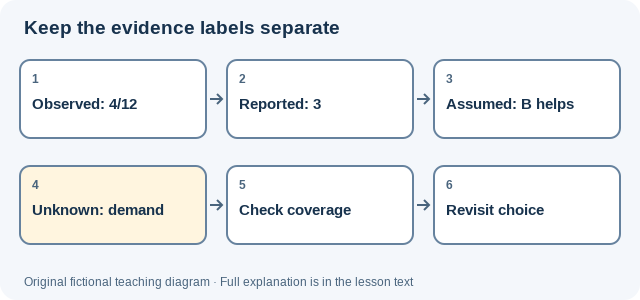
Separate the claims. Observation: four of 12 loans were late in this pilot. Reported experience: three borrowers described a scheduling conflict. Assumption: buying more drills will solve lateness. Unknown: whether the same difficulty affects other borrowers or people who never joined. Constraint: the fictional coordinator can rearrange two volunteer hours per week, but cannot add hours or approve purchases during the next trial.
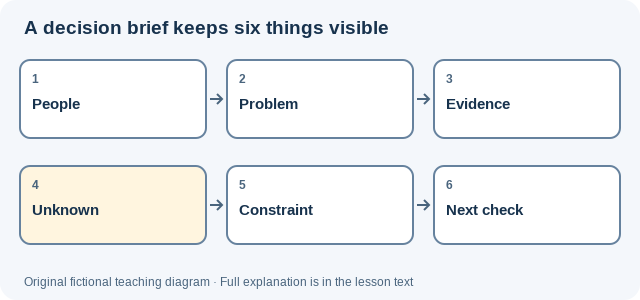
Six labelled boxes form a reading sequence: People, Problem, Evidence, Unknown, Constraint, Next check. The check returns to the brief because a finding may change the question or remove a proposed remedy.
This original diagram summarizes the existing six-line brief; it does not replace the five essential assessment criteria.

Another worked interpretation

A different fictional example is a shared reading table that becomes noisy. “Install a screen” is a proposed remedy, while “readers cannot hear a discussion at the agreed table” is a problem description. A six-line brief would separate an observed interruption from an assumed cause, name other room users and state what a check could change. The shape of the brief transfers; the tool-lending facts do not.

Sketch & check

Sketch the six boxes and place “Buy more drills” beside the box where it would be an unsupported leap.

Show diagram-practice feedback

It is a proposed option, not an observed problem or established evidence. Put the underlying difficulty in Problem, keep the remedy provisional, and use Next check to identify information that could support or reject it.

Optional video & watching prompt

University of Basel — Phase 1: problem framing ↗ (new tab)

Optional 5:30 video in a collaborative-research context. The public publisher page and linked English transcript were inspected; playback and caption synchronization were not tested. Rewrite the question from two affected people’s perspectives, then name the shared outcome. Nothing is embedded or played here; no account or response submission is required for this lesson.

Link checked 2026-10-30.

STEP 4 OF 6

Try it yourself

Choose the best next step for Maple Shelf and explain why. Then draft six short lines headed People, Problem, Evidence, Unknown, Constraint and Next check. Use only the fictional facts above; do not invent another survey. Include one affected group beyond current borrowers. Finally, classify “More drills will prevent late returns” as an observation or an assumption, and say what the existing log cannot tell you. Keep a first draft before reading the worked answer. For each of the five rubric criteria, quote a short phrase from your own brief and label it Supported or Not yet supported. Revise a missing or weak part and add a two-sentence revision note: what changed, and why that change better meets a named criterion. If every criterion was already supported, clarify one sentence without adding facts. Use the optional in-tab notes or paper; copy any notes you want to keep before leaving or reloading. Do not collect real people’s information for this exercise.

Fictional exercise · prewritten feedback, no live AI grading.

Navigation within this player keeps your notes. Use the optional notebook Save or Export controls to keep a snapshot before leaving. Nothing typed here is uploaded.

Practice options

Choose an option to see its reasoning. You can try again. No score is recorded.

STEP 5 OF 6

Worked answer & self-check

Sufficient evidence example for this introductory task — a worked brief: People: current borrowers, volunteers handling returns and potential borrowers who could not use the pilot; include people with different access needs rather than assuming one group speaks for everyone. Problem: some pilot borrowers are struggling to return tools at the agreed time; we need to understand the barrier before choosing a change. Evidence: the fictional two-week log contains four late returns among 12 loans. Three of those borrowers reported that the return window conflicted with their schedules. Requests that could not be filled were not recorded, so the log cannot establish unmet demand. This is a small local observation, not a prediction of all future borrowing. Unknown: which barriers affect other borrowers and nonparticipants, whether instructions were clear, and whether there is unmet demand for equipment. “More drills will prevent late returns” is an assumption: the log records timing, not the cause of lateness or how a purchase would affect it. Constraint: rearrange, but do not increase, the two volunteer hours per week. No purchasing authority is available for the next trial. Next check: review the existing notes and ask borrowers, volunteers and potential borrowers about the steps and times that caused difficulty. If those checks support it, the coordinator could approve a short trial that reallocates part of the existing return window. Record late and total returns, volunteer time and barriers people report. For example, if potential borrowers report that the proposed alternative window would exclude them, revise that window before a trial; if volunteers cannot cover it within the existing two hours, abandon that option and investigate another barrier. Agree beforehand what would justify continuing, changing or stopping. A small improvement would be a reason to investigate further, not proof of the cause. Other briefs can work. The test is whether the evidence supports the wording and the next check could change your mind. This is a self-check with a worked example, not live grading. Insufficient evidence example: “People want more drills. Four late returns prove a shortage. Buy eight drills, then ask whether people like them.” This does not identify another affected group, assumes a cause, exceeds purchasing authority and tests approval of a purchase rather than an unknown barrier. Merely selecting the strongest option would not repair this brief. Revision example (criterion 3, evidence accuracy): Before: “Four late returns prove a shortage.” After: “Four of 12 loans were late; three of those borrowers reported a scheduling conflict. The log does not record unmet requests or establish the cause.” Revision note: “I replaced a causal claim with the recorded counts and a reported experience. I stated the missing evidence so the next check can investigate rather than assume a cause.” This fixes criterion 3 only; the other four still need evidence. How to judge your work: use the five criteria below as essential checks, not an average score. For each, identify a sentence in your brief that meets its Supported descriptor. Mark a missing requirement Not yet supported, revise it and check again. The worked brief illustrates one defensible answer, not wording you must copy. Your revision note should identify the changed passage and the criterion it now supports. What the player checks: choosing an option displays prewritten reasoning; it does not assess your written brief or revision. Review marks and progress are your own reports, not an independently verified result. No teacher or automated grader evaluates your notes here.

Compare your answer

  • 1 · Affected people. Supported: names current borrowers and at least one other affected group (such as volunteers or nonparticipants), without claiming identical needs. Not yet supported: says only “everyone” or treats one group’s account as universal.
  • 2 · Open problem. Supported: describes difficulty meeting return times while leaving the remedy undecided. Not yet supported: defines the problem as a need to buy drills or move all returns to a particular day.
  • 3 · Evidence accuracy. Supported: uses four late returns among 12 loans and three reports from those late borrowers accurately; distinguishes reports from a proven cause and notes that unmet requests were not recorded. Not yet supported: invents findings or claims the counts prove a shortage or a universal scheduling barrier.
  • 4 · Feasible boundary. Supported: keeps any proposed trial within two volunteer hours per week, rearranged rather than increased, with no purchases. Not yet supported: omits the boundary or requires extra hours or purchasing authority.
  • 5 · Decision-changing check. Supported: links a next check to a named unknown, includes another affected group, and states how a possible finding could change the proposed action. For example, if an alternative window excludes nonparticipants or cannot fit volunteer hours, revise or abandon that option. Not yet supported: says only “do more research,” invents results, or asks people to approve a solution already chosen.

Give yourself one check for each point your work meets. Revise any missing piece. This is a self-check, not a score sent to a teacher.

STEP 6 OF 6

Recap & next step

  • Describe the difficulty before naming a solution.
  • An observation, a person’s explanation and a proven cause are different things.
  • A useful next check can change the decision; it should not merely confirm your favourite idea.

Return to your first draft and compare it with all five essential criteria. Keep your revised six-line brief, criterion-to-evidence notes and revision explanation in your own notes if useful. Your evidence is ready for your own review when every criterion has a supporting passage and your revision explains what improved; this is not certification or independent verification. Mark reviewed only as your personal progress signal. Continue to Goals, constraints and real options in this expanded course. Content version 1.1 was reviewed on 29 October 2026; source links and assessment wording should be rechecked when this module is revised. This historical version 1.1 review note applies only to the original frame module, not to the expansion. Show all reveals text; it does not complete the task.

A personal record of review; no grade or certificate.

Next lesson: Goals, constraints and real options →

LESSON 2 OF 8 · PLANNED 100 MINUTES

Goals, constraints and real options

STEP 1 OF 6

Your objective

Convert the Maple Shelf brief into a feasible option set: distinguish two objectives from hard constraints, retain a baseline and explain which apparent alternatives are genuinely different.

STEP 2 OF 6

The idea

An objective states what would be better for someone; an option describes an action that might make it better. “People can return a tool at a usable time” is an objective. “Open on Thursday evening” is an option. Starting with the outcome keeps other remedies available. Ask who benefits and who bears the inconvenience. Avoid claiming that one convenient time serves everyone: the supplied comments are a starting point, not a complete account of access.

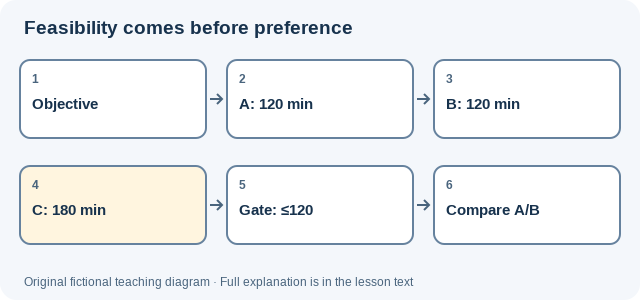
A constraint is a boundary an option must satisfy before preference scoring begins. In Maple Shelf the coordinator can rearrange 120 volunteer minutes each week, cannot add minutes and has no purchasing authority for this trial. A proposal using 180 minutes is not merely less attractive; it is outside the authorized set. Record whether a boundary is given, assumed or awaiting confirmation. You may question a boundary, but you may not silently remove it.

Preferences are negotiable aims, such as easier planning or a broader range of return times. A high preference score cannot compensate for breaking a hard boundary. Some access requirements may also be constraints rather than optional benefits; in a real project they require appropriate confirmation. Here all cases and requirements are supplied fiction. The exercise does not authorize collecting information from real borrowers or deciding what accommodation another person should accept.

A useful option set contains a baseline and several actions that change the mechanism, not just their labels. Keeping one two-hour window and splitting that window across two days are different. Renaming the same window is not. Combine actions only when the combination is feasible and you can explain what it changes. “Do nothing” is too vague: specify whether it means maintaining the current arrangement, pausing a decision or stopping a service.

Document exclusions so an attractive rejected idea does not return unnoticed later. A concise option record gives its action, expected mechanism, resources, assumptions and remaining unknowns. Feasible means it passes the supplied constraints, not that it will succeed. If every option fails, revise the question or seek an authorized change to the boundary; do not select the least impossible option and present it as a workable choice.

STEP 3 OF 6

Three schedules, one fixed resource budget

Starting point

A draft lists A: keep Tuesday 12–14, 120 volunteer minutes; B: Tuesday 12–13 plus Thursday 17–18, 120 minutes; C: Tuesday 12–13 plus Thursday 17–19, 180 minutes. It labels C “best access” and prepares to rank all three. No evidence establishes which schedule people can use.

A checkable approach

First apply the boundary: C exceeds 120 minutes by 60 and is excluded from this trial. A is the current-arrangement baseline. B reallocates the same two hours to a second day. Both remain candidates, conditional on actual availability and access being checked; neither is proven better.

Counterexample: “A with a friendlier name” is not a distinct schedule. A clear reminder could be a different intervention if its purpose and production time are specified, but its effect must remain an assumption. Do not add it as a free benefit to every option.

The objective leads to options A, B and C. A and B each require 120 minutes and pass the 120-minute gate. C requires 180 minutes and is excluded. Only A and B enter preference comparison.
A preference benefit cannot pass an option through a hard boundary; C remains recorded but excluded from this trial.

Another worked interpretation

Suppose another paper option provides a clearer reminder rather than a new time window. Its intended mechanism is reduced misunderstanding, so it is genuinely different from renaming the schedule. But producing and distributing it still takes time. If that time pushes the total past 120 minutes, it cannot be called a free improvement. Feasibility includes relevant work, not just the visible opening window.

Sketch & check

Draw the gate and add a reminder option with 15 preparation minutes plus 120 opening minutes.

Show diagram-practice feedback

Its total is 135 minutes, so it fails the stated boundary. A revision must fit all relevant work within 120 minutes or remain excluded; a favorable clarity score cannot authorize the extra time.

STEP 4 OF 6

Try it yourself

Use only the supplied fictional facts. Write two outcome statements beginning “People can…” or “The coordinator can…”, avoiding a schedule or purchase as the outcome. Make a constraint list and classify each item as a given boundary or an assumption to check. Produce one record each for A, B and C: action, volunteer minutes, proposed mechanism and unknown. Show the arithmetic that excludes C. Keep A as the baseline; propose one genuinely different non-purchase option, describing what would have to be checked before calling it feasible. Finally critique “B is fair because it has two days”: name an affected group that might still be excluded without inventing its preferences. Keep your first attempt, compare it to the worked answer and revise one confusion between an objective, a constraint and an option. Do not run a real scheduling exercise or ask real people for data.

Fictional exercise · prewritten feedback, no live AI grading.

Navigation within this player keeps your notes. Use the optional notebook Save or Export controls to keep a snapshot before leaving. Nothing typed here is uploaded.

Check 1: Which statement is an objective rather than an option?

Choose an option to see its reasoning. You can try again. No score is recorded.

Check 2: What should happen to option C at 180 minutes?

Choose an option to see its reasoning. You can try again. No score is recorded.

Check 3: Which is the most useful baseline?

Choose an option to see its reasoning. You can try again. No score is recorded.

STEP 5 OF 6

Worked answer & self-check

Worked response: objective 1 is that borrowers can meet an agreed return time without an avoidable scheduling barrier; objective 2 is that volunteers can deliver a predictable arrangement within the allowed time. These can conflict, so neither implies that more days are automatically better. Given constraints are a maximum of 120 volunteer minutes weekly and no purchasing authority. “A volunteer is available on Thursday” is an assumption, not a supplied fact. A uses 120 minutes and preserves the baseline; B uses 60 + 60 = 120 and changes the distribution; C uses 60 + 120 = 180, which exceeds the limit by 60. Exclude C pending a separately authorized change, rather than assigning a small resource penalty. A possible additional candidate is clearer return instructions within A, with preparation time and access to the instructions checked before inclusion. Its mechanism concerns misunderstanding rather than scheduling. It is not established to solve the reported conflict. “Two days is fair” overclaims: someone unable to attend either period could still be excluded, but the exercise does not tell us whether such a person exists or what they prefer. Revise the claim to “B creates two possible windows; who can use them remains to be checked.” Accept alternative records when the action, boundary and uncertainty are explicit; do not reward extra options that merely rename the same action. Check explanations: This is one possible action, not the outcome used to judge it. Correct. This describes the intended improvement without committing to one schedule. This is an action outside the trial authority; it also assumes the cause of the problem. A preference score does not authorize more volunteer time. Changing the recorded resource requirement hides the constraint violation. Correct. A hard boundary is checked before preference scoring; C exceeds it by 60 minutes. Correct. A specified baseline allows a meaningful comparison and retains the option of not changing yet. This could mean continue, pause or stop; the ambiguity prevents a clear comparison. A name change does not create a new mechanism or evidence of improvement.

Compare your answer

  • Supported: outcomes describe benefits or difficulties, not a chosen remedy. Not yet: a schedule is presented as the only possible goal.
  • Supported: the 120-minute and no-purchase boundaries control feasibility. Not yet: preference scores can erase a boundary.
  • Supported: A remains a clearly described baseline. Not yet: “do nothing” has no operational meaning.
  • Supported: each retained option changes a relevant mechanism and labels assumptions. Not yet: renamed duplicates inflate the list.
  • Supported: the revision identifies an unsupported access claim without inventing people’s preferences. Not yet: two days is automatically called fair.

Give yourself one check for each point your work meets. Revise any missing piece. This is a self-check, not a score sent to a teacher.

STEP 6 OF 6

Recap & next step

  • State the outcome before choosing the action.
  • Check hard constraints before comparing preferences.
  • Keep a baseline, distinct mechanisms and explicit unknowns.

Next, build an evidence-and-uncertainty ledger for the feasible options. Show all reveals the lesson; review marks remain personal and do not establish competence.

A personal record of review; no grade or certificate.
Next lesson: Evidence, uncertainty and a decision-changing check →

LESSON 3 OF 8 · PLANNED 100 MINUTES

Evidence, uncertainty and a decision-changing check

STEP 1 OF 6

Your objective

Construct a decision evidence ledger that separates observations, reported experiences, assumptions and unknowns, and select one proportionate fictional check that could reverse a recommendation.

STEP 2 OF 6

The idea

A decision ledger links each important claim to what supports it and what it cannot establish. The original Maple Shelf log says that four of 12 loans were late during two weeks. That is a description of those recorded loans. It does not show the number of people unable to borrow, the cause of lateness or the effect of a different schedule. A precise fraction can still answer the wrong question. Use the existing Evidence course for general source tracing; here the focus is how a gap could change a choice.

Reported experience is evidence of what someone reported, not automatically a population estimate or proof of a cause. Three late borrowers described a scheduling conflict. Keep their account visible without turning it into “all borrowers need Thursday.” Similarly, the absence of a recorded complaint does not establish the absence of a barrier. Nonparticipants may be missing from the available records. Do not fill that gap by inventing interviews or assigning them convenient preferences.

Separate uncertainty about facts from disagreement about values. We may not know whether Thursday coverage is available; that is a factual uncertainty. People may reasonably give different importance to predictable hours and a wider range of times; that is a value difference. More measurement may clarify the first but will not mechanically settle the second. A transparent decision record says which kind of uncertainty matters, who can decide and what remains unresolved.

Choose a check by asking what answer would change your action. “Would everyone like our plan?” is broad and leading. “Can the existing volunteer arrangement cover B without adding minutes?” has a direct consequence: if not, B leaves the feasible set. A useful check has an owner, a bounded source, an interpretation rule and a decision consequence. In this course you design the check on paper using synthetic records; planning a check is not evidence that it has happened.

Information gathering has limits. A small local check may reveal a serious obstacle but cannot establish universal satisfaction or a reliable causal effect. Stop when the next decision can be made honestly within the agreed boundary, not when every uncertainty disappears. If a high-impact unknown cannot be resolved, a cautious reversible option or a documented pause may be more defensible than pretending to know. No numeric confidence percentage is required when there is no basis for one.

STEP 3 OF 6

Four claims with very different support

Starting point

A proposal states: “One-third of everyone’s returns are late, all borrowers prefer Thursday, B will solve the problem, and volunteers can cover it.” It cites the original 12-loan log for all four claims.

A checkable approach

Repair the ledger: four of 12 recorded loans were late in the fictional pilot; three late borrowers reported a scheduling conflict; preference for Thursday is unknown; B’s effect is a forecast; Thursday coverage is unconfirmed. Check coverage before deciding whether B is feasible.

A second worked example: “We recorded no unfilled requests” is true about the recording method. “There was no unmet demand” is not supported because the method did not record it. Better arithmetic cannot repair missing coverage.

Four labelled evidence categories distinguish the observed four late loans out of 12, three reported scheduling conflicts, the assumption that B helps, and unknown unmet demand. A coverage check can change the feasible set.
An exact number still needs a denominator and a limit; no arrow turns a reported experience into a universal preference.

Another worked interpretation

A fictional reading-room note says that two visitors left early, but no reason was recorded. “Two visitors left early” is an observation. “The room was too noisy” is a possible explanation, not an established cause. “Nobody else had a problem” is unsupported if no other experiences were recorded. The next check should address a consequential uncertainty rather than merely collect approving comments.

Sketch & check

Label each of those three reading-room statements, then write one finding that would change the proposed response.

Show diagram-practice feedback

The first is observed, the second assumed and the third unsupported/unknown. A finding that the visitors had planned short visits could weaken the noise explanation; it would not prove that noise never matters to anyone.

STEP 4 OF 6

Try it yourself

Create five ledger rows: late returns, scheduling comments, Thursday preference, volunteer coverage and unmet demand. For each, give the exact claim, evidence type, source in this fictional case, one limit and what it means for A versus B. Calculate four divided by 12 as a fraction and an approximate percentage, then rewrite it so the denominator and time window stay visible. Choose one check that could remove B from the feasible set and one that could reveal a value disagreement rather than a factual error. State two possible findings and how your decision would differ. Do not claim a check was performed. Keep a first attempt; after the answer, revise any sentence that generalized beyond the record. Your response should be a decision ledger and a short check plan, not another generic essay about whether evidence is important.

Fictional exercise · prewritten feedback, no live AI grading.

Navigation within this player keeps your notes. Use the optional notebook Save or Export controls to keep a snapshot before leaving. Nothing typed here is uploaded.

Check 1: What does four of 12 establish?

Choose an option to see its reasoning. You can try again. No score is recorded.

Check 2: Which uncertainty concerns values rather than a missing fact?

Choose an option to see its reasoning. You can try again. No score is recorded.

Check 3: Which check most clearly changes a decision?

Choose an option to see its reasoning. You can try again. No score is recorded.

STEP 5 OF 6

Worked answer & self-check

Worked ledger: “Four of 12 recorded pilot loans were late” is a supplied observation, approximately 33.3% of recorded loans, not a percentage of all people or a future guarantee. “Three late borrowers described a scheduling conflict” is reported experience; it does not identify a preferred replacement day. “Borrowers prefer Thursday” is unknown; no supplied preference record supports it. “B fits volunteer availability” is an untested assumption despite its arithmetic total of 120 minutes. “There is no unmet demand” is unsupported because unfilled requests were not captured. Coverage check: the coordinator would inspect a fictional availability record for the two proposed windows. If coverage cannot be rearranged within 120 minutes, exclude B; if it can, B remains feasible but not proven effective. A separate comparison of how affected groups value predictability and timing choice could reveal different priorities even after factual errors are corrected. Do not convert that disagreement into an invented average preference. An acceptable alternative check targets another high-impact unknown and states a different action for different findings. An unacceptable plan says only “collect more data” or “ask whether B is good,” because neither states what would change. Correction example: replace “one-third of people always return late” with the limited observation about recorded loans and the two-week period. Check explanations: Correct. The denominator is loans and the claim stays within the supplied period. This changes loans into people and generalizes beyond the recorded pilot. The log contains no comparison of a purchase intervention or its effect. Availability is a factual question that an appropriate record might resolve. The supplied schedule allows that quantity to be calculated. Correct. This is a priority choice; factual evidence can inform it but cannot assign the values automatically. Selecting only supportive comments does not test a consequential uncertainty. Correct. The rule names a finding and its consequence without claiming that the check has already happened. An open-ended request lacks a defined question or stopping point.

Compare your answer

  • Supported: claims name the correct denominator and time window. Not yet: loans become people or future guarantees.
  • Supported: reports are distinguished from observations and forecasts. Not yet: a reported barrier becomes a universal preference.
  • Supported: missing information remains unknown. Not yet: absent records are treated as zero events.
  • Supported: each proposed check has at least two findings with different decision consequences. Not yet: data collection has no decision rule.
  • Supported: factual uncertainty and value disagreement are distinguished. Not yet: a measurement is said to settle whose priorities should count.

Give yourself one check for each point your work meets. Revise any missing piece. This is a self-check, not a score sent to a teacher.

STEP 6 OF 6

Recap & next step

  • Precision is not the same as relevance.
  • An unrecorded event is not necessarily an event that never happened.
  • A useful check can change your mind; a planned check is not an observation.

Next, compare feasible options using criteria whose meanings and limitations are visible. Show all reveals the lesson; review marks remain personal and do not establish competence.

A personal record of review; no grade or certificate.
Next lesson: Criteria, weights and trade-offs →

LESSON 4 OF 8 · PLANNED 120 MINUTES

Criteria, weights and trade-offs

STEP 1 OF 6

Your objective

Build and explain a three-criterion comparison, calculate both weighted totals, reject double-counting and distinguish a preference ranking from a feasibility decision.

STEP 2 OF 6

The idea

Criteria translate objectives into dimensions that can be compared. Before assigning numbers, define what a high or low score means and whether the criterion matters independently of the others. “Easy to plan” and “Predictable schedule” may describe almost the same benefit. Counting both can quietly give predictability extra influence. A small transparent set is better than a long list of overlapping labels. Keep hard constraints in a separate gate so a high total never authorizes an infeasible option.

The Maple Shelf example uses three preference criteria: access across possible windows, predictability, and coordination ease. The supplied scores run from 1, less favorable, to 5, more favorable. They are fictional judgments for arithmetic practice, not measured satisfaction. In this simplified exercise, the score steps are treated as comparable enough to add. In a real decision that assumption needs scrutiny: moving from 1 to 2 on one scale may not mean the same change as moving from 4 to 5 on another.

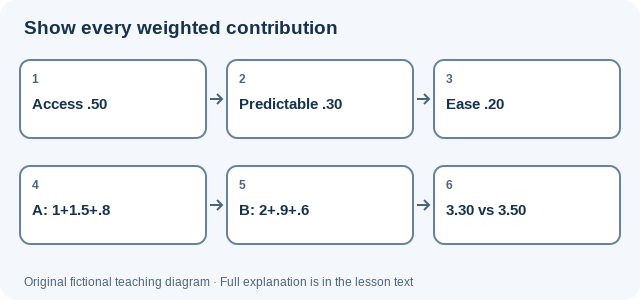
Weights express a chosen trade-off among criteria, not the probability that a criterion is true. We use 0.50 for access, 0.30 for predictability and 0.20 for coordination ease. They sum to 1.00. Multiplying a score by its weight and adding the products creates a summary under those judgments. It does not make the values objective or erase disagreement. Do not average incompatible scale definitions merely because a spreadsheet permits it.

Keep raw scores, weights, products and totals visible. A small lead can be sensitive to a disputed score or weight. A large lead can still be misleading if the criterion set omits an important consideration. Use a matrix to reveal the conversation, not close it prematurely. Someone may reject the assumed trade-offs or point to an omitted boundary. Record the disagreement and test its consequences instead of dismissing it as resistance to the numbers.

A defensible recommendation therefore has two parts: the calculation and the conditions under which it is informative. Say “B scores slightly higher under these illustrative weights; access evidence and coverage still need checking,” not “the matrix proves B is best.” If weights are equal, say that equal importance is an assumption. If a score is unknown, mark it unknown or test a plausible range; zero is outside the stated 1-to-5 scale and is not a neutral missing value.

STEP 3 OF 6

A small lead, not a mathematical command

Starting point

An attractive table shows A scores 2, 5, 4 and B scores 4, 3, 3 for access, predictability and ease. It includes infeasible C and labels B the scientifically proven choice. It does not show weights or explain where the scores came from.

A checkable approach

Exclude C. Under weights 0.50, 0.30, 0.20: A = 2×0.50 + 5×0.30 + 4×0.20 = 1.00 + 1.50 + 0.80 = 3.30. B = 4×0.50 + 3×0.30 + 3×0.20 = 2.00 + 0.90 + 0.60 = 3.50. B leads by 0.20 under the supplied fictional judgments.

Counterexample: adding “reliable timetable” as a fourth criterion alongside predictability, without an independent meaning, can count the same benefit twice. Another error is writing an unknown access score as 0: that turns missing information into an out-of-scale value rather than a neutral unknown.

Three criterion weights, access 0.50, predictability 0.30 and ease 0.20, feed two transparent sums: A has 1.00 plus 1.50 plus 0.80, totaling 3.30; B has 2.00 plus 0.90 plus 0.60, totaling 3.50.
The 0.20 lead describes this illustrative model; it is neither a probability nor a substitute for the feasibility gate.

Another worked interpretation

Consider a draft that adds “dependable timetable” with a large weight while leaving “predictability” unchanged. Unless the author explains a distinct benefit, the timetable advantage may be counted twice. A better revision removes the duplicate, rebalances weights openly and recalculates both totals. Keeping the same winner by secretly adjusting other weights would defeat the purpose of making trade-offs visible.

Sketch & check

Sketch the three contributions for each option and circle any score you would most want to verify.

Show diagram-practice feedback

Either option may have an uncertain score. State why the selected uncertainty could change the small 0.20 margin; do not assume an exact-looking total means every input was measured.

Optional video & watching prompt

OpenLearn — Decision matrix analysis ↗ (new tab)

Optional publisher-page video attributed to Mind Tools, with an inspected on-page transcript. Playback and caption synchronization were not tested. Its supplier example is only a method illustration, not Business course content. Change one disputed weight: does the ranking change? Treat scores as a discussion aid, not a command, and exclude infeasible options first. Nothing is embedded; OU response fields may request an account but are not needed.

Link checked 2026-10-30.

STEP 4 OF 6

Try it yourself

Reproduce the two weighted totals from the supplied A and B scores. Show each product, confirm the weights sum to 1, and report the difference. Before recommending anything, write the feasibility gate and identify which scores are judgments rather than measurements. Explain whether adding “regularity of opening times” beside predictability is independently useful or likely double-counting. Rewrite “B is objectively best” as a bounded recommendation that names the remaining coverage and access uncertainties. Then suppose B’s ease score was entered as 0 because nobody had checked it: explain why that is not a neutral default and propose a transparent alternative. Keep your first calculation, independently recompute it using a different order or calculator, and record any corrected arithmetic.

Fictional exercise · prewritten feedback, no live AI grading.

Navigation within this player keeps your notes. Use the optional notebook Save or Export controls to keep a snapshot before leaving. Nothing typed here is uploaded.

Check 1: What is A’s total under 0.50, 0.30, 0.20?

Choose an option to see its reasoning. You can try again. No score is recorded.

Check 2: Why keep hard constraints outside the weighted sum?

Choose an option to see its reasoning. You can try again. No score is recorded.

Check 3: What does an unknown score require?

Choose an option to see its reasoning. You can try again. No score is recorded.

STEP 5 OF 6

Worked answer & self-check

A’s products are 1.00, 1.50 and 0.80, totaling 3.30. B’s products are 2.00, 0.90 and 0.60, totaling 3.50. The weights total 1.00 and the difference is 0.20 in favor of B. These are totals on the defined illustrative preference scale, not percentages of people helped or probabilities of success. C is already excluded because it requires 180 minutes, regardless of any score. “Regularity of opening times” appears to duplicate predictability unless its distinct meaning can be demonstrated; omit it or redefine the criteria and weights openly. A bounded recommendation is: “B has a small lead under the stated scores and access-prioritizing weights, so keep it as a candidate while checking coverage and the relevant access assumptions.” An unknown ease score should stay unknown, be described qualitatively, or be tested across a justified range; it should not be entered as 0. If using a range, report how the recommendation changes across it rather than silently choosing the favorable end. Alternative matrix designs are acceptable when scales, constraints, sources and trade-offs are explained. The task is not passed merely because a calculator returns 3.50; the interpretation and exclusions are essential. Check explanations: This adds raw scores without applying the stated weights. That is B’s total, not A’s; retain the option labels beside each calculation. Correct. The three weighted products are 1.00, 1.50 and 0.80; their sum is 3.30. Correct. Feasibility is a gate; weights compare only the retained options. They matter enough to control inclusion rather than merely reduce a score. The supplied scores are illustrative judgments, not exact measurements. That turns uncertainty into a negative result and can change the ranking unjustifiably. Correct. Zero is outside the stated 1-to-5 scale and is not a neutral substitute for missing information. This chooses evidence to fit the conclusion instead of testing the choice.

Compare your answer

  • Supported: all six products and both totals can be reproduced. Not yet: only the winning total appears.
  • Supported: weights sum to 1 and are described as priorities. Not yet: they are called probabilities or facts.
  • Supported: infeasible C is excluded before ranking. Not yet: a high score overrides the time boundary.
  • Supported: overlapping criteria and unknown scores are identified. Not yet: double-counting or zero-filled unknowns distort the comparison.
  • Supported: the recommendation states assumptions and a relevant limit. Not yet: arithmetic is treated as objective proof of the best action.

Give yourself one check for each point your work meets. Revise any missing piece. This is a self-check, not a score sent to a teacher.

STEP 6 OF 6

Recap & next step

  • Weights make values visible; they do not remove them.
  • Check scale meanings, missing values and duplicate criteria.
  • A ranking remains conditional on feasibility and the judgments that produced it.

Next, deliberately challenge the ranking with different priorities and plausible conditions. Show all reveals the lesson; review marks remain personal and do not establish competence.

A personal record of review; no grade or certificate.
Next lesson: Scenarios, sensitivity and robust choices →

LESSON 5 OF 8 · PLANNED 120 MINUTES

Scenarios, sensitivity and robust choices

STEP 1 OF 6

Your objective

Calculate a ranking reversal, distinguish weight sensitivity from a scenario change, and explain why a worst-case comparison is a cautious choice rather than a probability forecast.

STEP 2 OF 6

The idea

Sensitivity analysis asks whether a recommendation changes when a consequential input or judgment changes. It is not a trick for finding a setting that preserves your favorite option. Start with an input that is uncertain or genuinely disputed, vary it transparently and keep other assumptions visible. A reversal is useful information: the decision depends on that judgment. No reversal across a narrow test does not prove that the recommendation is robust to every possible change.

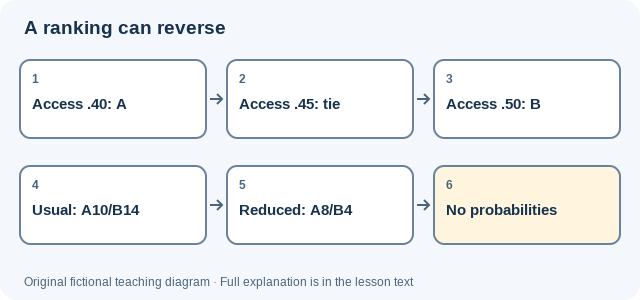
For Maple Shelf, changing weights from 0.50, 0.30, 0.20 to 0.30, 0.40, 0.30 gives predictability and ease more importance. The scores stay fixed. This is a change in priorities, not new evidence about access. A now scores 3.80 and B 3.30, reversing the original result. The right response is to discuss the trade-off, not to declare one set of values mathematically correct. State who is authorized to choose and which disagreement remains.

A threshold can show how narrow a lead is. Keep ease at 0.20 and let access have weight w, leaving predictability at 0.80 minus w. For these scores, B minus A equals 4w minus 1.80. The totals tie when w is 0.45. Below that threshold A leads; above it B leads, within the valid range from 0 to 0.80. This formula is a property of this small model, not a universal rule for access decisions.

A scenario changes the conditions in which an option operates. Suppose synthetic planning estimates say A handles 10 returns in a usual week and 8 when one volunteer is unavailable, while B handles 14 and 4. These are forecasts for two scenarios, not observations or probabilities. B performs better in the usual scenario; A has the better worst supplied result, 8 instead of 4. Choosing the higher minimum is one cautious decision rule, not the only reasonable rule.

Do not average scenarios unless there is a justified reason to assign their probabilities or treat them equally. A simple mean silently assumes a weighting and may hide an unacceptable downside. Also check whether the scenarios cover the important failures. An option that survives two invented scenarios may fail in a third. Robustness is always relative to the tested conditions, boundaries and definition of acceptable performance. Report that scope and the unanswered questions rather than using the word “robust” as a guarantee.

STEP 3 OF 6

Same scores, different priorities; then different conditions

Starting point

The initial matrix favors B, 3.50 to 3.30. A summary says B remains best under any reasonable view and predicts 14 returns every week. It confuses a preference score with a capacity forecast.

A checkable approach

Under weights 0.30, 0.40, 0.30, A = 0.60 + 2.00 + 1.20 = 3.80; B = 1.20 + 1.20 + 0.90 = 3.30. Separately, the scenario table is A: 10 usual, 8 reduced coverage; B: 14 usual, 4 reduced coverage. A’s minimum is 8 and B’s is 4.

These comparisons answer different questions. Weight changes expose value dependence. Scenario changes expose condition dependence. Neither establishes how frequently reduced coverage occurs. At access weight 0.45 and ease 0.20, both matrix totals are 3.45; this is a tie under the model, not a reason to invent extra decimal precision.

With ease fixed at 0.20, access weights 0.40, 0.45 and 0.50 produce A ahead, a tie and B ahead respectively. A separate scenario comparison shows usual returns A10/B14 and reduced coverage A8/B4, with no scenario probabilities supplied.
Top row varies priorities; bottom row varies operating conditions. Neither should be mistaken for observed future performance.

Another worked interpretation

A weather plan with indoor and outdoor options can be compared under dry and wet conditions without claiming the weather is equally likely. If the outdoor option performs very well when dry but fails a stated wet-weather boundary, its high dry score does not establish robustness. This example uses no actual forecast: it illustrates why a scenario table needs a decision rule and a clear statement of what remains unknown.

Sketch & check

Sketch the two rows separately. Explain why “two scenarios, therefore 50% each” is not justified.

Show diagram-practice feedback

The number of scenarios does not determine their likelihood. Equal probabilities would be an additional assumption requiring justification, not a fact supplied by the diagram.

Optional video & watching prompt

ClimateData.ca — Introduction to decision making using climate scenarios ↗ (new tab)

Optional two-minute climate-context video and inspected on-page transcript. Playback and caption synchronization were not tested. Transfer only the distinction between plausible conditions and a prediction; this is not climate-model selection guidance. Write three conditions for a fictional community plan and compare what survives each. Nothing is embedded and no external account is required for Brule practice.

Link checked 2026-10-30.

STEP 4 OF 6

Try it yourself

Recalculate A and B under the alternative weights, then explain the reversal without accusing either priority set of being an arithmetic mistake. With ease fixed at 0.20, test access weights 0.40, 0.45 and 0.50; compute or reason through B minus A and identify the threshold. Next reproduce the two-scenario table and identify each option’s minimum. Write one recommendation for a coordinator who prioritizes avoiding a weak reduced-coverage week, and another conditional recommendation for someone willing to accept that risk. Neither may invent a probability. Add one missing scenario or assumption worth checking and explain its decision consequence. Keep your first prediction before calculating, then revise it with the visible results.

Fictional exercise · prewritten feedback, no live AI grading.

Navigation within this player keeps your notes. Use the optional notebook Save or Export controls to keep a snapshot before leaving. Nothing typed here is uploaded.

Check 1: Which option leads under weights 0.30, 0.40, 0.30?

Choose an option to see its reasoning. You can try again. No score is recorded.

Check 2: At what access weight do the options tie when ease stays 0.20?

Choose an option to see its reasoning. You can try again. No score is recorded.

Check 3: What does A’s better scenario minimum mean?

Choose an option to see its reasoning. You can try again. No score is recorded.

STEP 5 OF 6

Worked answer & self-check

The alternative-weight totals are A 3.80 and B 3.30, a 0.50 lead for A. This is not a contradiction of the original 0.20 lead for B: the relative priorities changed. With ease at 0.20, B minus A is −0.20 at access 0.40, 0 at 0.45 and +0.20 at 0.50. At the tie, A = 0.90 + 1.75 + 0.80 = 3.45 and B = 1.80 + 1.05 + 0.60 = 3.45. The scenario minima are A 8 and B 4. A coordinator choosing the higher minimum among these supplied scenarios would favor A, while someone prioritizing the usual scenario might retain B if the downside is acceptable and coverage can be checked. Neither can call the usual scenario certain or calculate an expected number without a probability assumption. A useful missing condition is whether the split schedule can still operate when the only Thursday volunteer is unavailable; its result could remove B or require a different contingency. A weak answer averages 14 and 4, calls the result a prediction and declares uncertainty solved. A strong answer states the chosen decision rule and the scope of tested conditions. Different recommendations can be defensible if their values, boundaries and uncertainty are explicit. Check explanations: A prior ranking does not persist after its assumptions change. Correct. The same scores yield a different ranking because the priorities changed. The illustrative comparison can be calculated; its limits should be stated rather than hiding it. Correct. Solve 4w − 1.80 = 0; the resulting totals are both 3.45. This confuses the fixed ease weight with the access threshold. That is the upper valid access weight with ease fixed, not the equality point. A scenario minimum is not a prediction of every week. Listing two scenarios does not assign them equal probabilities. Correct. It supports a bounded cautious comparison, not a guarantee or a probability forecast.

Compare your answer

  • Supported: the alternative-weight totals and reversal are correct. Not yet: new weights are described as new observations.
  • Supported: the threshold is 0.45 with ease fixed at 0.20 and weights valid. Not yet: the threshold is generalized to other models.
  • Supported: scenario forecasts remain forecasts and no probabilities are invented. Not yet: a plausible week becomes an expected result.
  • Supported: the chosen cautious or opportunity-focused rule is named. Not yet: the minimum or maximum is called the only rational choice.
  • Supported: an untested condition and its consequence are identified. Not yet: two scenarios are claimed to prove universal robustness.

Give yourself one check for each point your work meets. Revise any missing piece. This is a self-check, not a score sent to a teacher.

STEP 6 OF 6

Recap & next step

  • A reversal reveals a dependency worth discussing.
  • Values, evidence and operating conditions are different inputs.
  • Robustness is bounded by what you actually tested.

Next, turn an uncertain choice into a reversible test with limits agreed before observing results. Show all reveals the lesson; review marks remain personal and do not establish competence.

A personal record of review; no grade or certificate.
Next lesson: A reversible test with an honest review rule →

LESSON 6 OF 8 · PLANNED 100 MINUTES

A reversible test with an honest review rule

STEP 1 OF 6

Your objective

Draft a bounded fictional trial with a decision question, resource boundary, observation plan, stop condition and review rule; interpret a supplied comparison without claiming causal proof.

STEP 2 OF 6

The idea

A reversible test is a temporary, bounded way to learn about an important uncertainty. It is not a promise that a small trial is harmless or that it proves a cause. Describe what changes, what remains unchanged, who can stop it and how the baseline can be restored. In this course the trial stays on paper and all results are supplied fiction. Do not recruit participants, collect personal details or alter a real community service to complete a lesson.

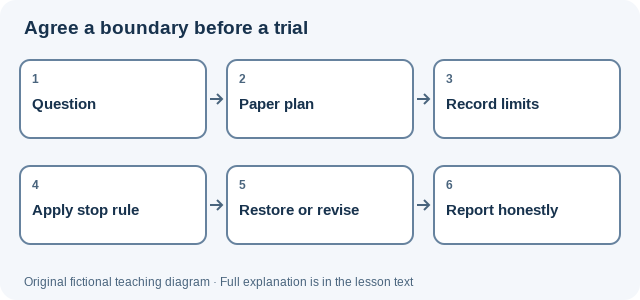
Start with the decision question: can B operate within 120 volunteer minutes while avoiding unacceptable new return barriers? Then specify an outcome measure and a balancing measure. Late returns divided by all recorded returns describes timing among those records. Volunteer minutes checks the resource boundary. A note that a window was inaccessible can expose a barrier even when the average rate improves. A single favorable metric should not conceal the reason an option was constrained.

Write the review rule before inspecting the fictional results. For example, any week above 120 volunteer minutes stops continuation of that configuration; the coordinator restores A and revises the plan. A better late-return rate does not cancel that rule. For an uncertain preference outcome, describe what would justify continuing to investigate rather than inventing an exact pass threshold unsupported by evidence. Separate a non-negotiable stop condition from a provisional signal worth examining.

A before-and-after comparison can be informative without proving causation. Different borrowers, weather, reminders or chance may affect two weeks. Record denominators and missing observations. If A has five late returns out of 18 and B four out of 20, the observed rates differ; that alone does not establish that B caused the difference. Small samples and changed conditions leave other explanations. The honest result may be “promising but infeasible” or “inconclusive,” not success or failure in every respect.

Close the loop with a decision record. Say whether the test happened or remains planned, what was observed, which rule applied and what changes next. Never retroactively soften a stop rule merely because the preferred option broke it. If a rule was badly designed, explain that and design a new authorized test; do not rewrite the old result. For detailed process maps and operational improvement methods, use the existing Process Mapping course rather than expanding this lesson into a duplicate workflow programme.

STEP 3 OF 6

An improved rate that does not authorize continuation

Starting point

Supplied fictional records: A week, 18 returns, five late, 120 volunteer minutes; B week, 20 returns, four late, 135 volunteer minutes. A report calls B a success because four is smaller than five and omits the extra 15 minutes.

A checkable approach

A’s late rate is 5/18, about 27.8%; B’s is 4/20, 20.0%. B’s recorded rate is lower by about 7.8 percentage points, but it used 15 minutes beyond the 120-minute boundary. Stop this configuration and restore the baseline while revising the plan.

Counterexample: “B improved by 7.8%” confuses percentage points with relative percentage change. Even the correctly computed difference is descriptive, not a causal effect. The supplied weeks do not isolate schedule changes from other influences.

The sequence runs from a decision question through a bounded paper plan and defined records to a pre-agreed stop rule, then restoration or revision and an honest report. A boundary breach returns the configuration to the baseline.
A lower late-return rate does not override 135 minutes exceeding a 120-minute boundary; the loop preserves reversibility.

Another worked interpretation

A fictional paper prototype for a room sign can be tested against supplied navigation tasks without installing it in a real building. If the sign sends someone to a route the case says is unavailable, the prototype fails that task even if most other tasks look better. The next step is a revised prototype and another bounded check, not a claim that a real public service is now accessible or validated.

Sketch & check

Add the supplied 135-minute observation at the appropriate stage and draw its consequence.

Show diagram-practice feedback

It belongs in the record, then triggers the boundary rule. Restore/revise rather than continuing the configuration; do not erase the value or invent authorization for more time.

Optional video & watching prompt

REL West / WestEd — Prototyping ideas for change, Module 6 ↗ (new tab)

Optional Module 6 video in a teacher-improvement collection. The publisher page and linked transcript were inspected; playback, YouTube streaming availability and caption synchronization were not tested. Name the smallest test artifact and evidence that would make you revise it. Add the boundaries and stop rules taught here; the clip is not a complete trial protocol. Nothing is embedded or submitted.

Link checked 2026-10-30.

STEP 4 OF 6

Try it yourself

Write a one-page paper trial plan for B. Include the decision question, maximum two-week window, authorized 120-minute weekly boundary, what changes, what stays fixed, a reversible return to A and who would apply the rule. Use only non-identifying synthetic fields: week label, option, total returns, late returns, volunteer minutes and a barrier note. State the boundary-triggered stop rule before reading the supplied results again. Calculate both late rates and their percentage-point difference, then apply the rule to 135 minutes. Write separate headings for “What these records show” and “What they do not establish.” Suggest one revision that could be checked within the existing authority without claiming it will work. Record the trial as designed on paper, not run by you.

Fictional exercise · prewritten feedback, no live AI grading.

Navigation within this player keeps your notes. Use the optional notebook Save or Export controls to keep a snapshot before leaving. Nothing typed here is uploaded.

Check 1: How should 5/18 and 4/20 be compared?

Choose an option to see its reasoning. You can try again. No score is recorded.

Check 2: What follows from 135 volunteer minutes under a 120-minute limit?

Choose an option to see its reasoning. You can try again. No score is recorded.

Check 3: Which status is honest for your course activity?

Choose an option to see its reasoning. You can try again. No score is recorded.

STEP 5 OF 6

Worked answer & self-check

A sufficient plan asks whether B can be delivered within the fixed boundary while improving usable return arrangements. It specifies two weeks at most, preserves the existing inventory and non-identifying recording method, and restores A if coverage cannot fit the boundary or a pre-agreed unacceptable barrier appears. The coordinator, not an automatic score, owns the stop decision. The supplied arithmetic is 5/18 ≈ 27.8%, 4/20 = 20.0%, a difference of roughly 7.8 percentage points. B’s 135 minutes exceed 120 by 15, so continuation of that configuration fails the boundary even though its rate is lower. “Records show a lower late-return proportion in the B week and an exceeded time limit” is justified; “B caused a reliable improvement” is not. A possible revision is to simplify a handoff or choose a different split within the same time limit, but feasibility and effects remain to be checked. Do not add unpaid preparation time invisibly: include all relevant volunteer time in the resource measure. An alternative plan can use a different meaningful review signal if it preserves the given boundaries and honestly distinguishes predicted results from supplied observations. Mark your work as a paper design; a diagram of a trial does not establish that any real service was tested. Check explanations: Raw counts ignore different totals, and neither count establishes a cause. This confuses percentage points with relative change and adds an unsupported causal claim. Correct. Use the denominators and label the difference correctly; this remains descriptive. Correct. The boundary is exceeded by 15 minutes; a favorable outcome measure does not waive it. That hides the balancing measure and violates the pre-agreed limit. Removing inconvenient observations destroys the integrity of the review. No actual implementation or independent validation occurred in this exercise. Correct. Designing a test and interpreting synthetic results do not mean you conducted a live trial. The supplied evidence cannot support a guarantee.

Compare your answer

  • Supported: the question, duration, baseline and decision owner are explicit. Not yet: “try B” has no bounded meaning.
  • Supported: outcome and balancing measures retain denominators and resource limits. Not yet: only a favorable count is reported.
  • Supported: a stop condition and restoration path exist before results. Not yet: rules change to protect the preferred option.
  • Supported: 135 minutes triggers the stated boundary response. Not yet: a lower late rate authorizes extra time.
  • Supported: descriptive differences are not called causal proof. Not yet: an unrun paper plan is described as a successful experiment.

Give yourself one check for each point your work meets. Revise any missing piece. This is a self-check, not a score sent to a teacher.

STEP 6 OF 6

Recap & next step

  • A balancing measure protects what a favorable average can hide.
  • Apply the rule you stated before observing the result.
  • A paper trial plan and an actual tested intervention are different achievements.

Next, communicate a recommendation that someone else can inspect and responsibly revise. Show all reveals the lesson; review marks remain personal and do not establish competence.

A personal record of review; no grade or certificate.
Next lesson: Explain, challenge and revise a recommendation →

LESSON 7 OF 8 · PLANNED 100 MINUTES

Explain, challenge and revise a recommendation

STEP 1 OF 6

Your objective

Write a concise decision record that states a conditional choice, evidence, trade-off, disagreement, responsibility and review trigger, then revise it after a specific challenge.

STEP 2 OF 6

The idea

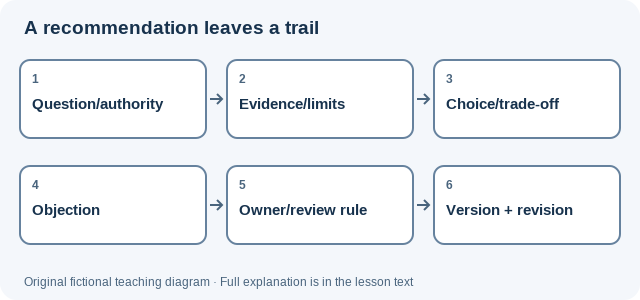
A decision record is an account of why an action is justified now and what could change it. It is not a persuasive document that hides weaknesses to secure agreement. Begin with the question and the authority: who can choose, what boundary controls the choice and whether the document recommends or authorizes action. The fictional coordinator may approve a schedule within existing hours; writing the recommendation does not give the learner that authority in a real service.

Keep facts, judgments and forecasts distinguishable. The record can cite the 12-loan baseline, report a conditional weighted comparison and describe a proposed trial, but it must not blend them into one story of proven improvement. Use plain labels such as supplied observation, illustrative score, assumption and pending check. A reader should be able to reconstruct the reasoning without trusting a confident tone or inspecting a hidden spreadsheet.

Acknowledge a real trade-off and the strongest relevant objection. If B offers more windows but less predictability, say so. A critique can reveal a missing constraint, a calculation error or a different value priority; those require different responses. Correct the arithmetic when it is wrong. Check a factual claim when evidence is missing. Record unresolved value differences instead of pretending the group reached consensus. Respectful disagreement is not a defect to be edited out.

A useful recommendation names a next action, a responsible role and a review trigger. “Review later” is too vague. “Before a trial, the coordinator checks coverage; any week above 120 minutes stops continuation” gives a sequence and a boundary. For a paper exercise, state that the responsibility is hypothetical and no one has actually agreed to take it. Do not fabricate sign-off, stakeholder consent or independent assessment to make the document appear ready.

Revision should leave a visible trail. Preserve the first version, name the challenge, show what changed and explain which criterion the change improves. If the choice remains the same, demonstrate that the challenge was considered rather than dismissed. If it changes, that can be evidence of good reasoning rather than failure. The existing Clear Writing course supports style and structure; this lesson specifically assesses the decision record’s traceability, uncertainty and revision logic.

STEP 3 OF 6

From a sales pitch to an inspectable recommendation

Starting point

“Everyone agrees B is best. Our matrix proves it, the trial succeeded, and we will launch permanently.” This asserts consensus, proof, a successful trial and authority that the supplied exercise does not establish.

A checkable approach

“Recommendation for the fictional coordinator: retain A while revising B’s configuration. B has an illustrative 0.20 matrix lead under one priority set, but another set favors A. The supplied B week exceeded the 120-minute boundary. Before considering another trial, confirm a feasible allocation and access assumptions; no real trial or agreement is claimed here.”

A challenge says that predictable hours matter more than the draft assumed. Do not call it a data error. Show the alternative-weight reversal, record the value disagreement and ask the authorized decision maker to resolve the trade-off or choose a bounded way to learn more.

A six-part decision record connects the question and authority to evidence and limits, a conditional choice and trade-off, an objection, the responsible role and review rule, and a preserved version with revisions.
Keep disagreement and uncertainty visible; the record is not a manufactured consensus or a substitute for authorization.

Another worked interpretation

A fictional community display proposal might state: “Use the smaller format provisionally because it fits the supplied space limit; the larger format may be easier to read but has not been tested in that space.” A later challenge about reading distance should trigger a check or revision, not deletion of the objection. Keeping both versions makes it possible to see whether evidence, priorities or authority changed.

Sketch & check

Write one sentence for the objection box and one consequence for the review-rule box.

Show diagram-practice feedback

The objection should concern a meaningful assumption or trade-off. The review rule should say what finding would cause a specified change, pause or stop; “we will think about it” is not a checkable consequence.

Optional video & watching prompt

OpenLearn — Not an easy outcome ↗ (new tab)

Optional workplace-discussion dramatization; use it to examine disagreement, not to replace the reserved Business pathway. Publisher text and full transcript were inspected; playback and caption synchronization were not tested. Draft a closing summary separating the choice, disagreement, next action and responsibility. Nothing is embedded; optional OU account-based responses are unnecessary.

Link checked 2026-10-30.

STEP 4 OF 6

Try it yourself

Write a 180–250-word recommendation for the fictional Maple Shelf coordinator, using the accumulated evidence and constraints. Include the decision question, current recommendation, strongest supporting evidence, one trade-off, one unresolved objection, a next action with an owner role and a review or stop trigger. You may favor A, a revised B or a justified pause, but cannot authorize extra hours or claim consensus. Label observations and illustrative judgments so a reader can tell them apart. Then respond to this challenge: “Your priorities underweight predictability, and the B week exceeded the time limit.” Preserve version 1, write version 2 and add a revision note naming what changed and which reason controlled it. If your recommendation does not change, explain why the challenge was already addressed. No message is to be sent to a real person.

Fictional exercise · prewritten feedback, no live AI grading.

Navigation within this player keeps your notes. Use the optional notebook Save or Export controls to keep a snapshot before leaving. Nothing typed here is uploaded.

Check 1: Which sentence accurately describes the matrix?

Choose an option to see its reasoning. You can try again. No score is recorded.

Check 2: What kind of challenge is “predictability should matter more”?

Choose an option to see its reasoning. You can try again. No score is recorded.

Check 3: What makes a revision note useful?

Choose an option to see its reasoning. You can try again. No score is recorded.

STEP 5 OF 6

Worked answer & self-check

One sufficient recommendation is: “For Maple Shelf’s fictional coordinator, I recommend retaining A while checking a feasible revision of B, rather than launching B permanently. The question is how to reduce return barriers within 120 volunteer minutes without assuming that more equipment solves lateness. The original log records four late returns among 12 loans and three reported scheduling conflicts; it does not establish Thursday preferences or unmet demand. B leads 3.50 to 3.30 under access-prioritizing illustrative weights, but A leads 3.80 to 3.30 under the alternative priorities. The supplied B comparison week used 135 minutes, beyond the boundary, so that configuration should not continue. The main trade-off is additional time-window choice versus predictability and coordination. The objection that predictability matters more remains a value issue, not a calculation error. Before a further paper trial is considered, the coordinator role would confirm coverage within 120 minutes and inspect the access assumptions. A boundary breach would stop continuation and restore A. This recommendation is a self-assessed fictional exercise; no real agreement, sign-off or successful live trial is claimed.” A revision could make the alternative priorities and boundary response explicit where version 1 omitted them. Different defensible recommendations are possible, but a claim that the matrix overrides the time limit is not. The revision note must identify a specific change, not merely say “made it clearer.” Check explanations: A calculation neither measures consensus nor establishes the right values. Correct. The wording makes the recommendation’s dependence on values visible. Preference scoring does not change the resource boundary. The statement concerns priorities, not whether a recorded event occurred. Hiding the objection prevents a transparent decision. Correct. It may justify a different weighting, but it is not by itself an arithmetic error. Correct. A reader can then inspect whether the revision actually addressed the challenge. That is too general to trace to a meaningful change. A revision does not create an approval that never occurred.

Compare your answer

  • Supported: the recommendation answers the question within authority. Not yet: the learner silently authorizes real action or extra resources.
  • Supported: observations, judgments and forecasts are distinguishable. Not yet: they are blended into a proof claim.
  • Supported: a serious trade-off and objection are addressed. Not yet: disagreement is erased as consensus.
  • Supported: owner role and review trigger specify a consequence. Not yet: “review later” has no condition.
  • Supported: both versions and the reason for revision are inspectable. Not yet: the first version disappears or the revision note is generic.

Give yourself one check for each point your work meets. Revise any missing piece. This is a self-check, not a score sent to a teacher.

STEP 6 OF 6

Recap & next step

  • Make the recommendation inspectable, not merely persuasive.
  • An objection can concern facts, arithmetic, values or authority.
  • A revised choice is not automatically a failure; an unexplained change is a missing record.

Finish with the independent Cedar Room project. Attempt it before opening the model answer. Show all reveals the lesson; review marks remain personal and do not establish competence.

A personal record of review; no grade or certificate.
Next lesson: Capstone: the Cedar Room decision dossier →

LESSON 8 OF 8 · PLANNED 180 MINUTES

Capstone: the Cedar Room decision dossier

STEP 1 OF 6

Your objective

Independently assemble, check and revise a complete decision dossier for a new fictional case, including feasible options, evidence limits, weighted and scenario comparisons, a bounded trial and a conditional recommendation.

STEP 2 OF 6

The idea

The Cedar Room project transfers the method to a new supplied case rather than asking you to repeat the Maple Shelf conclusion. A fictional community reading room is choosing a weekly opening pattern. Its coordinator can allocate at most 120 volunteer minutes and cannot add a collection of identifying visitor information. These are the case boundaries, not general rules for real organizations. All scores and scenario figures below are invented for learning; no real attendance or consent is implied.

Your task is to build an inspectable chain from question to recommendation. Keep the option records, feasibility gate, claim ledger, weighted products, sensitivity check, scenario comparison and trial rule together. Each part should change or constrain the final choice. A dossier that contains every heading but ignores its own findings is incomplete. You may use the downloadable local case file and a calculator; no account, spreadsheet upload or external AI submission is needed.

Use three options. A is one predictable 120-minute window, with preference scores 3, 5, 4. B splits 120 minutes across two windows, with scores 5, 3, 2. C uses 150 minutes, with scores 4, 4, 1, and must be excluded before ranking. Scores represent access, predictability and coordination ease on the same illustrative 1-to-5 scale used earlier. Initial weights are 0.40, 0.35, 0.25. Alternative weights are 0.60, 0.20, 0.20.

Supplied scenario forecasts are A: 9 visits in a usual week and 8 with reduced coverage; B: 13 and 5. They are not observed results or equally probable events. No actual trial has occurred. The coordinator has not resolved the priority disagreement. A group note says “more windows may improve access,” but there is no representative preference survey. Your recommendation must keep these limits visible while still proposing a useful bounded next step.

Attempt the dossier before reading the model. Then check the calculations independently, compare each criterion with evidence in your own document and revise at least one weak claim or missing link. A complete self-study submission includes both attempts and the reason for revision. If you cannot perform a proposed real-world check, leave it pending; this project requires a paper plan only. Passing your own checks is not independent assessment, accreditation or proof that the chosen service would work.

STEP 3 OF 6

A new case, not a copied answer

Starting point

A sample draft chooses B because 13 forecast visits is the largest number, includes C in the matrix despite 150 minutes, and says all visitors support two windows. It proposes collecting names “just in case.”

A checkable approach

Repair the structure before choosing: exclude C, keep forecasts separate from observations, compare A and B under both priority sets, inspect reduced coverage and design a paper trial using only non-identifying counts. Do not assume that Maple Shelf’s preferred option must be Cedar Room’s preferred option.

Worked boundary example: C exceeds 120 minutes by 30 and is excluded even if someone gives it higher scores. A non-identifying count can support a narrow timing question; it does not authorize collecting names or establish that every affected group can attend.

The Cedar Room workflow begins with the brief and feasibility gate, compares A and B, challenges the weights, tests supplied scenarios, designs a paper trial and ends with a dossier plus revision. C stays excluded at 150 minutes.
The project joins the methods into one decision record; completing the diagram alone does not satisfy the practical rubric.

Another worked interpretation

Two learners can reach different provisional recommendations without one inventing facts. One may retain A because of its initial score and higher reduced-coverage minimum. Another may prioritize access and propose a bounded B paper trial. Each must disclose the changed priorities, keep C excluded, preserve the resource limit and leave unperformed coverage checks pending. The difference is inspectable reasoning, not automatic approval of either outcome.

Sketch & check

Circle the point where your initial recommendation changed, or explain why it survived each challenge.

Show diagram-practice feedback

Show a specific calculation, scenario result or boundary that mattered. If the recommendation stayed the same, record the alternatives you tested and their limits rather than claiming it is immune to every possible change.

STEP 4 OF 6

Try it yourself

FIRST ATTEMPT: Produce a seven-part Cedar Room dossier in your own local notes: (1) six-line decision brief; (2) option and feasibility table; (3) evidence/assumption/unknown ledger; (4) both weighted comparisons with products and one explanation of the reversal; (5) scenario table and your chosen decision rule; (6) reversible two-week paper trial with a 120-minute stop condition, non-identifying fields and restoration path; (7) a 180–250-word conditional recommendation with an objection, responsible role and review trigger. Use the supplied case exactly; do not invent a survey, trial, approval or probability. Before reading the MODEL ANSWER, predict which option the initial weights favor and record why. After checking, label every rubric criterion Supported or Not yet supported and quote evidence from your dossier. Revise every unsupported essential criterion and add a revision log. If a real check is not performed, label it pending rather than claiming completion. The project is a self-assessment, not a submission to a teacher.

Fictional exercise · prewritten feedback, no live AI grading.

Navigation within this player keeps your notes. Use the optional notebook Save or Export controls to keep a snapshot before leaving. Nothing typed here is uploaded.

Check 1: Which option leads under Cedar Room’s initial weights?

Choose an option to see its reasoning. You can try again. No score is recorded.

Check 2: What happens under the alternative weights?

Choose an option to see its reasoning. You can try again. No score is recorded.

Check 3: What establishes completion of this self-study task?

Choose an option to see its reasoning. You can try again. No score is recorded.

STEP 5 OF 6

Worked answer & self-check

MODEL ANSWER — an original worked Cedar Room dossier. Read after your first attempt. All supplied case numbers are fictional. The proposed actions below have not occurred. 1. SIX-LINE BRIEF People: current and potential reading-room visitors, volunteers and the fictional coordinator; their different time and access needs are not established by the case. Problem: choose a usable weekly opening arrangement without exceeding the existing volunteer allocation or assuming that more windows automatically serve everyone better. Evidence: the supplied option descriptions require 120 minutes for A and B, and 150 for C. The preference scores and scenario counts are invented planning inputs, not observed visitor satisfaction or attendance. Unknown: actual coverage of each window, which visitors can use it, the priority to give access versus predictability, and whether the scenario forecasts are realistic. There is no representative preference survey. Constraint: no more than 120 volunteer minutes in any week and no new collection of identifying visitor information. Next check: the coordinator role would first confirm whether the proposed allocation fits available coverage. If B cannot be covered within 120 minutes, remove it; if it can, compare its access assumptions and downside before considering a bounded trial. These checks remain pending. 2. OPTIONS AND FEASIBILITY A — one predictable window; 120 minutes; scores access 3, predictability 5, ease 4. It passes the numerical time gate, subject to actual coverage confirmation. It is the specified baseline for a reversible test. B — two split windows; 120 minutes; scores 5, 3, 2. It also passes the numerical time gate but is not proven deliverable or better for visitors. C — a longer arrangement; 150 minutes; scores 4, 4, 1. Exclude it: 150 − 120 = 30 excess minutes. A preference score cannot compensate for that violation. Exclusion does not erase its record or silently authorize a changed boundary. 3. EVIDENCE LEDGER Claim: A and B each use 120 minutes. Type: supplied schedule specification. Support: the case option descriptions. Limit: arithmetic feasibility does not establish real volunteer coverage. Consequence: retain both provisionally and keep coverage confirmation pending. Claim: B improves access. Type: hypothesis represented by an illustrative access score of 5. Support: the supplied judgment and the group note that more windows may help. Limit: no representative preference survey or actual access test is supplied. Consequence: do not claim universal support; identify a consequential access check before implementation. Claim: A has a 3.95 initial total. Type: reproducible calculation from judgments. Support: the products below. Limit: the total depends on the scale, weights and omitted considerations; it is not a success probability. Consequence: compare another plausible priority set before recommending. Claim: A receives nine visits in a usual week. Type: scenario forecast. Support: the supplied planning table. Limit: no actual attendance or scenario probability is supplied. Consequence: use it for a bounded comparison, not a reported outcome. Claim: all visitors prefer B. Type: unsupported claim. Support: none in the case. Limit: preferences remain unknown. Consequence: remove the sentence and retain the uncertainty rather than manufacturing consensus. 4. WEIGHTED COMPARISONS Initial weights: access 0.40, predictability 0.35, ease 0.25; sum 1.00. A: 3×0.40 + 5×0.35 + 4×0.25 = 1.20 + 1.75 + 1.00 = 3.95. B: 5×0.40 + 3×0.35 + 2×0.25 = 2.00 + 1.05 + 0.50 = 3.55. A leads by 0.40 under the initial judgments. Alternative weights: 0.60, 0.20, 0.20; sum 1.00. A: 1.80 + 1.00 + 0.80 = 3.60. B: 3.00 + 0.60 + 0.40 = 4.00. B leads by 0.40 under the access-prioritizing weights. The reversal reveals a value dependence; it does not mean that new visitor behavior was observed. No probabilities or false decimal precision are added. 5. SCENARIOS AND DECISION RULE Usual coverage forecast: A 9 visits; B 13. Reduced coverage forecast: A 8; B 5. A's minimum among these two scenarios is 8; B's is 5. A cautious higher-minimum rule therefore favors A. This dossier provisionally uses that rule because it prioritizes avoiding a weak reduced-coverage result, not because it has proved that reduced coverage is likely. Listing two scenarios does not make them equally probable. Someone accepting B's downside and placing more weight on access could justify a different conditional proposal. Untested conditions and actual coverage remain unknown. 6. BOUNDED PAPER TRIAL Decision question: could B operate within 120 weekly volunteer minutes without an unacceptable new access barrier? Status: paper design only; no real trial or participant contact has occurred. Proposed owner: the fictional coordinator role, which would need to authorize any real implementation; no sign-off is asserted. Duration and change: at most two weeks with B's split windows. Hold the 120-minute maximum, existing service scope and no-identifying-data boundary fixed. A remains the restoration baseline. Confirm feasible coverage before starting; otherwise do not start. Record plan: use synthetic week label, option, total visits, volunteer minutes and a non-identifying barrier note. Count visits, not unique people, unless a separately justified method exists. A visit count cannot establish satisfaction or reveal all excluded visitors. Include relevant preparation and handoff work in volunteer minutes. Stop and restore: if total volunteer time would exceed or is observed above 120 minutes in any week, the coordinator stops continuation of B and restores A at the next safe operating point. If a required access route cannot be used, pause that configuration rather than hiding the barrier in an average. If restoration cannot be arranged safely, pause service decisions and seek appropriate authorization; do not improvise extra hours. Review: at the two-week limit, compare the recorded boundary and barrier evidence with the plan. Continue investigating only if the constraints held and coverage/access questions are adequately addressed; otherwise revise or retain A. No observed improvement threshold is invented from the scenario forecasts. A lower or higher count alone does not prove causation. All real coverage and access checks remain pending in this self-study dossier. 7. CONDITIONAL RECOMMENDATION For Cedar Room's fictional coordinator, I recommend retaining A provisionally while checking coverage and the access assumptions before any real trial. The decision is how to provide usable weekly opening time within 120 volunteer minutes, not simply how to maximize a forecast. C is excluded because its 150 minutes exceed that boundary. A scores 3.95 against B's 3.55 under the initial illustrative priorities, but access-prioritizing weights reverse the result to B 4.00 against A 3.60. The arithmetic therefore does not settle the value disagreement. A also has the better minimum among the two supplied coverage scenarios, eight forecast visits versus five. Those figures are not observed attendance or probabilities. The strongest objection is that B's two windows might serve people who cannot use A; the case does not establish those preferences or actual access. The coordinator role would first confirm that B can be covered within the existing allocation, then decide whether the access question justifies a bounded paper-to-practice proposal. Any authorized trial would stop continuation if a week exceeded 120 minutes, restore A and retain non-identifying records only. Until coverage, access and the priority trade-off are addressed, I would not launch B permanently. This is a self-assessed fictional recommendation, not approval or evidence of a successful trial. CRITERION-TO-EVIDENCE EXAMPLE Criterion 1: Supported by the six-line brief's people, problem and fixed authority boundary. Criterion 2: Supported by C's exclusion and all twelve displayed weighted products. Criterion 3: Supported by the five-row claim ledger separating specifications, judgments, forecasts and unknowns. Criterion 4: Supported by the reversal and scenario comparison, both cited in the recommendation. Criterion 5: Supported by the two-week paper plan, coordinator role, 120-minute stop rule, restoration and non-identifying fields. Criterion 6: Supported by the recommendation's objection, next action and review trigger. Criterion 7 cannot be marked Supported merely by copying this model: the learner must retain their own first attempt, criterion evidence and revisions, leaving unperformed checks pending. REVISION EXAMPLE First draft: “Everyone wants B, and 13 forecast visits prove it works.” Criterion 3 is Not yet supported because a preference and an observed outcome were invented. Revised sentence: “B is hypothesized to improve access, but preferences are not established; 13 is a supplied usual-coverage forecast, not an observed result.” Revision reason: the new wording labels both uncertainty and forecast status, so the recommendation now calls for a consequential coverage/access check rather than announcing success. The learner's own dossier still needs its own evidence and revisions. Self-study completion requires support for every essential criterion; an average cannot conceal a boundary failure. No institution-awarded grade or independent assessment is claimed. Check explanations: Correct. Use Cedar Room’s scores and weights rather than copying Maple Shelf’s totals. A scenario forecast and a weighted preference total answer different questions. C is infeasible at 150 minutes and cannot enter the authorized comparison. A preference ranking can change when values change even with the same scores. Correct. The reversal reveals dependence on the chosen priorities; it does not create new observations. Weighted preference totals are not probabilities of success. The marks record personal review and do not assess the practical dossier. Invented implementation evidence invalidates the reasoning rather than completing it. Correct. This is an honest self-assessment record, not independent grading or a claim of real implementation.

Compare your answer

  • Essential — Supported: the question, people, authority and constraints are explicit. Not yet: the preferred option is treated as the problem or authority is invented.
  • Essential — Supported: C is excluded and A/B calculations are correct under both weight sets. Not yet: arithmetic or feasibility errors control the choice.
  • Essential — Supported: every substantive claim is labelled as supplied fact, judgment, forecast or unknown. Not yet: preferences, observations or approvals are fabricated.
  • Essential — Supported: reversal and reduced-coverage consequences inform the recommendation. Not yet: only the favorable comparison is reported.
  • Essential — Supported: the paper trial has a boundary, stop rule, restoration path and non-identifying measures. Not yet: it implies an actual test or unnecessary data collection.
  • Essential — Supported: the recommendation states a trade-off, objection, owner role and review trigger. Not yet: it claims universal superiority or consensus.
  • Essential — Supported: first attempt, criterion evidence and revisions are retained; unperformed checks are pending. Not yet: review marks are presented as independent competence.

Give yourself one check for each point your work meets. Revise any missing piece. This is a self-check, not a score sent to a teacher.

STEP 6 OF 6

Recap & next step

  • A defensible dossier connects its evidence and calculations to an actual choice.
  • Alternative recommendations can be sound when their assumptions and boundaries are explicit.
  • Keep real implementation, human assessment and authority claims separate from a completed self-study project.

Keep your dossier and revision log locally. Revisit an earlier lesson if an essential criterion still lacks support; then choose another Brule course. Show all reveals the lesson; review marks remain personal and do not establish competence.

A personal record of review; no grade or certificate.
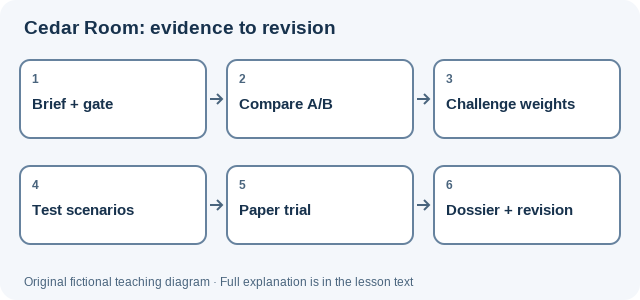
Revisit the course → · Choose another course →

Sources & learning limits

Examples, exercises and worked answers are original fictional teaching material. Source checks inform the factual explanations; these organisations do not endorse this course.

This independent course is general education, not accreditation, a degree, professional advice or a promise of competence. No institutional affiliation or endorsement is implied. The illustrated setting is fictional.