Knowledge Management: Capture, Find & Share Know-how — full text

8 original lessons · 16 planned hours · unpiloted · self-paced

Course details & full text

Build a practical knowledge-handoff kit that preserves context, connects people and stays useful as work changes

Basic reading and writing. Paper or an existing local text editor is enough. No software purchase, registration, prior management qualification or real-team recruitment is needed.

Eight original lessons, eight worked examples, 16 solved practices, 24 individually explained checks and a practical knowledge-handoff kit. Proposed workload: 16 active hours including the capstone and revision; an unpiloted estimate, not a required elapsed duration. Non-credit general education. No expert review or independent learner validation has been performed. Review marks record review only, not demonstrated competence, a qualification or successful knowledge transfer. All case material is fictional; no personal or workplace records, interviews, uploads or paid accounts are required.

  • Distinguish explicit records from tacit judgement and preserve the context needed for reuse.
  • Map knowledge holders, recipients, resources and missing feedback paths for a bounded task.
  • Design a capture interview and observation note that separates evidence, interpretation and unknowns.
  • Create a small task index, metadata record and vocabulary, then test retrieval.
  • Plan sharing, continuity and curation with clear roles, review triggers and unresolved risks.
  • Build and self-test a fictional knowledge-handoff kit, interpreting outcomes without overclaiming.
Practice files & complete project

Download once; all fixtures are fictional. Keep your first attempt before reading the model. No upload is used.

LESSON 1 OF 8 · PLANNED 90 MINUTES

Knowledge is more than a stored file

STEP 1 OF 6

Your objective

Distinguish explicit records, tacit judgement and the context needed for useful reuse.

STEP 2 OF 6

The idea

Knowledge management helps a group retain and use what it needs to do its work. A file collection is one possible support, not the goal. Begin with a person, a task and a moment of need: a new display editor needs to decide whether a replacement caption is ready before a fictional preview. The useful question is not “How many documents do we have?” but “Can this editor find, interpret and apply the relevant know-how, or obtain help when it does not cover the case?”

Explicit knowledge can be articulated in a form such as a rule, diagram, example or explanation. Tacit knowledge includes judgement or skill that people may use without fully explaining it. These are working distinctions, not two airtight boxes. A designer might write “leave enough white space” while still relying on experience to recognise a crowded card. Writing that sentence makes part of the idea explicit; it does not automatically transfer the judgement needed to apply it.

A record becomes more reusable when its context travels with it. State the task, audience, conditions, date, source of authority, known exceptions and where to ask when uncertain. In the fictional Paperbridge display team, “60 words maximum” is incomplete unless the reader knows which card format it concerns and whether it is current. A beautiful old example may illustrate layout without establishing the current rule. An experienced colleague may also remember an obsolete rule sincerely.

Choose a capture method to fit what is missing. A stable limit may need a checked reference card. Judging a borderline layout may need contrasting examples, an explanation of cues and a practice attempt with feedback. A specialist contact may still be necessary when the circumstances change. Do not promise that every kind of expertise can be extracted into text or that collecting everything is worth the maintenance burden.

This course concentrates on knowledge moving between people, tasks and maintained resources. Clear Writing supports readable explanations; Technical Instructions develops executable procedures; Learning & Memory concerns individual study practice. Those are useful neighbours, not substitutes for an organisational knowledge system. Work only with fictional inputs here. No employee interview, personal record, account or disclosure is needed, and the models do not establish real-world competence.

STEP 3 OF 6

Original worked example

Starting point

The team has a folder labelled “Useful stuff”, a checked card stating a 60-word caption limit, and an experienced editor who can spot cramped layouts. A newcomer cannot tell which example applies. What should be preserved?

A checkable approach

Preserve the checked 60-word rule with its format, owner and review date as explicit knowledge. Capture the editor’s layout cues through two contrasting fictional examples and a commentary on the differences, then let a newcomer explain a new case. Keep a route to the editor role for unresolved judgement. Rename or index the folder by actual tasks. File count alone would not show that the newcomer can use any of this.

All people, roles, records and results in this case are fictional. First try an answer privately; then compare the reasoning, not just the wording.

STEP 4 OF 6

Try it yourself

Use only these fictional inputs. Practice 1: Classify a saved caption template, an editor’s unspoken sense of visual crowding, and a dated note explaining when the template must not be used. Propose a useful next step for each. Practice 2: A manager says that scanning 300 pages has transferred all the team’s expertise. Rewrite the claim and name one test. Complete the three explained checks. Keep your first attempt on paper or in an existing local file before revealing the model.

Fictional exercise · prewritten feedback, no live AI grading.

Write your answer on paper or in your own notes, then compare the options and worked answer.

Check 1: Which item most directly represents tacit judgement?

A. A dated list of approved card sizes

Not correct. This list states information explicitly; it may still require context and verification.

B. Recognising a cramped layout without yet explaining its cues

Correct. The judgement is being used before its relevant cues have been fully articulated.

C. A folder containing the same template twice

Not correct. Duplicate files are explicit artefacts, not evidence of an unspoken judgement skill.

D. A written 60-word limit

Not correct. A written limit is explicit, although its scope and authority still matter.

Check 2: What is missing from “use the blue template”?

A. A larger number of duplicate copies

Not correct. Extra copies do not resolve which task, version or conditions the instruction concerns.

B. A guarantee that every editor agrees

Not correct. Universal agreement is not a practical substitute for a checked scope and owner.

C. Its task, applicable version and conditions for use

Correct. This context helps a new reader determine whether the template fits the present task.

D. A promise of permanent correctness

Not correct. A template can become outdated, so permanent correctness should not be promised.

Check 3: What is the best evidence of useful transfer in this limited case?

A. A successor locates the current rule and applies it to a new caption

Correct. The observed task checks both access and application, while supporting only a limited conclusion.

B. The folder contains 300 files

Not correct. Document volume does not show that a successor can find or use relevant knowledge.

C. The expert says the folder is complete

Not correct. An expert opinion is useful input but does not replace a successor’s application test.

D. Every page has the same font

Not correct. Consistent appearance can aid reading but cannot establish currency or practical understanding.

STEP 5 OF 6

Worked answer & self-check

Practice 1: The template is an explicit artefact: identify its current version and purpose. The sense of crowding is largely tacit judgement: use contrasting examples and ask what cues matter. The dated exception note is explicit context: connect it to the template and verify whether the exception still applies. Classification alone is not enough; each item needs a reuse path. Partial-credit self-review: 4 points: 1 for the template and verification; 1 for tacit judgement and examples; 1 for explicit exception context; 1 for linking the exception to the template. Award 0 for an unsupported “all files are current” claim. Practice 2: Scanning has created digital copies of 300 pages; coverage, currency and usable expertise are not established. Ask a fictional successor to locate the current caption rule and explain what to do with a borderline layout using the copies. Record the answer, missing context and any help required. A successful test supports that task only. Partial-credit self-review: 4 points: 1 distinguishes copies from transfer; 1 checks currency or context; 1 specifies an observable task; 1 limits the conclusion to the task. Which item most directly represents tacit judgement? A. A dated list of approved card sizes — Not correct. This list states information explicitly; it may still require context and verification. B. Recognising a cramped layout without yet explaining its cues — Correct. The judgement is being used before its relevant cues have been fully articulated. C. A folder containing the same template twice — Not correct. Duplicate files are explicit artefacts, not evidence of an unspoken judgement skill. D. A written 60-word limit — Not correct. A written limit is explicit, although its scope and authority still matter. What is missing from “use the blue template”? A. A larger number of duplicate copies — Not correct. Extra copies do not resolve which task, version or conditions the instruction concerns. B. A guarantee that every editor agrees — Not correct. Universal agreement is not a practical substitute for a checked scope and owner. C. Its task, applicable version and conditions for use — Correct. This context helps a new reader determine whether the template fits the present task. D. A promise of permanent correctness — Not correct. A template can become outdated, so permanent correctness should not be promised. What is the best evidence of useful transfer in this limited case? A. A successor locates the current rule and applies it to a new caption — Correct. The observed task checks both access and application, while supporting only a limited conclusion. B. The folder contains 300 files — Not correct. Document volume does not show that a successor can find or use relevant knowledge. C. The expert says the folder is complete — Not correct. An expert opinion is useful input but does not replace a successor’s application test. D. Every page has the same font — Not correct. Consistent appearance can aid reading but cannot establish currency or practical understanding. Keep your first attempt, explain one correction and try the changed case again. These are prewritten models, not automated or instructor grading. A defensible alternative may earn the stated criteria without matching this wording.

Compare your answer

  • 4 points: 1 for the template and verification; 1 for tacit judgement and examples; 1 for explicit exception context; 1 for linking the exception to the template. Award 0 for an unsupported “all files are current” claim.
  • 4 points: 1 distinguishes copies from transfer; 1 checks currency or context; 1 specifies an observable task; 1 limits the conclusion to the task.
  • Distinguishes supplied facts from assumptions, missing knowledge and proposed tests.
  • Makes a specific revision; does not treat a model or a review mark as observed performance.

Give yourself one check for each point your work meets. Revise any missing piece. This is a self-check, not a score sent to a teacher.

STEP 6 OF 6

Recap & next step

  • Start with a person and task, not a repository.
  • Preserve context along with explicit records.
  • Use examples and practice for judgement that text alone may not transfer.

Save useful notes privately if wanted. Review marks record review only; Show all reveals text, not completed exercises or a tested handoff. Use the project pack to carry this lesson into your knowledge-handoff kit.
Next lesson: Map where know-how moves and gets stuck →

LESSON 2 OF 8 · PLANNED 105 MINUTES

Map where know-how moves and gets stuck

STEP 1 OF 6

Your objective

Map knowledge holders, recipients, resources and missing feedback around one task.

STEP 2 OF 6

The idea

A knowledge-flow map shows who needs to know what, where that knowledge comes from and how it reaches the point of use. It is not simply an organisation chart or a sequence of operational steps. A process map can show that a caption is submitted, edited and printed. A knowledge map asks how an incoming editor learns which wording rules apply, who knows the exception and how discoveries return to the maintained reference.

Choose a narrow boundary before drawing. For this lesson, use one fictional monthly display cycle from caption revision to print approval. Draw role labels rather than personal names: editor, layout reviewer and coordinator. Add resources such as the current rule card and an older example folder. Label arrows with the knowledge being exchanged and the channel. “Editor → reviewer” is vague; “borderline layout and reason for uncertainty, in review queue” tells you what actually needs to flow.

Investigate gaps in both directions. Knowledge may exist but be inaccessible at the moment of need; it may reach the editor with no explanation; or a correction may remain in a private conversation instead of improving the rule card. A single person can become a bottleneck, but that does not make the person the problem. The system may not provide time, ownership or a route for maintaining the answer. Treat an absent arrow as a question to investigate, not proof that no communication occurs.

Prioritise knowledge at risk using a small, explicit qualitative judgement. Consider consequence if unavailable, how often it is needed, how difficult it is to reconstruct and whether more than one role can supply it. These factors are not a scientific risk score. A rarely used exception can deserve attention if its loss repeatedly forces expensive rework. A common trivial fact may be low priority because the current source is easy to locate.

Close the map with a feedback path and a named role responsible for the resource. If the layout reviewer corrects a rule, how does the current card change, who checks it and how do people learn about the change? Propose the smallest intervention that repairs the observed gap. Do not install a new platform merely because arrows cross a departmental boundary. The exercise here uses supplied fictional evidence; unknown flows must remain labelled unknown until a test or observation supplies evidence.

STEP 3 OF 6

Original worked example

Starting point

A fictional editor asks the coordinator about caption exceptions every cycle. The coordinator forwards the question to the layout reviewer, who replies privately. The public rule card never changes. Where is the knowledge-flow problem?

A checkable approach

The reviewer holds relevant exception knowledge; the editor needs it at revision time. The coordinator relays the request but adds a waiting dependency. The response reaches one editor, while the rule card receives no correction. Add a reviewed exception example linked from the card, assign the editor role to maintain it with reviewer approval, and provide a direct unresolved-question route. Then test whether a new editor can answer the next comparable case without repeating the relay.

All people, roles, records and results in this case are fictional. First try an answer privately; then compare the reasoning, not just the wording.

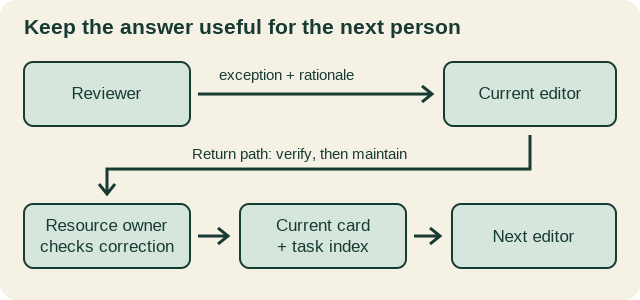
Knowledge-flow map: reviewer explains an exception to the editor; the missing return path to the checked card is repaired by an owner and verification step.
Original schematic. A useful answer must reach the next person through a checked resource, not only a private conversation.

Read the return path

The correction travels from the editor to the resource owner for verification, then to the current card and the next editor. The arrow means a responsibility to perform that check, not evidence that it already happened.

Sketch & check

Sketch a route that is missing from a fictional team map. Label what knowledge travels, who checks it and where a future editor finds it.

Show diagram-practice feedback

A defensible sketch connects the discovered exception to a responsible checking role, then a maintained resource and its user. An unlabeled arrow or an automatic “approved” status does not complete the return path.

STEP 4 OF 6

Try it yourself

Use only these fictional inputs. Practice 1: Draw a text map for this case: a new editor uses an old template, the reviewer explains the current limit in a chat, and the next editor still opens the old template. Label one missing return path. Practice 2: Choose a capture priority: the only layout reviewer leaves next week and knows recurring exceptions; the lunch-room poster font is undocumented but easily recreated. Explain without inventing a numerical risk score. Complete the three explained checks. Keep your first attempt on paper or in an existing local file before revealing the model.

Fictional exercise · prewritten feedback, no live AI grading.

Write your answer on paper or in your own notes, then compare the options and worked answer.

Check 1: Which arrow is most useful on a knowledge-flow map?

A. Department A → Department B

Not correct. Department names alone do not identify the knowledge needed or its point of use.

B. Folder → folder

Not correct. Moving files between folders does not explain who needs the knowledge or why.

C. Everything → everyone

Not correct. This erases audience and access boundaries and gives no testable transfer route.

D. Reviewer → editor: exception rationale through a checked example

Correct. The arrow identifies the roles, the knowledge carried and a concrete transfer mechanism.

Check 2: A correction stays in one private conversation. What is missing?

A. A verified return path into the maintained resource

Correct. A checked update can make the correction available to later users rather than only one conversation.

B. A longer organisation chart

Not correct. Additional reporting lines do not by themselves preserve the useful correction.

C. A rule that all conversations be public

Not correct. Broad disclosure is unnecessary; preserve only appropriate checked knowledge through an authorised route.

D. More copies of the old template

Not correct. Copying the stale template spreads the original problem rather than its correction.

Check 3: How should an unobserved communication route appear?

A. As a confirmed failure

Not correct. Lack of observation is not proof that a communication route never operates.

B. As a guaranteed working connection

Not correct. A guessed connection should not be presented as verified evidence of transfer.

C. As unknown, with a proposed way to check it

Correct. Labelling the uncertainty keeps the map honest and gives the next investigation a purpose.

D. Removed so the map looks simpler

Not correct. Hiding a relevant unknown can conceal the very knowledge gap the map should expose.

STEP 5 OF 6

Worked answer & self-check

Practice 1: Old template → new editor carries an outdated limit. Reviewer → current editor carries a correction through chat. The missing path is correction → maintained template/index → future editors. Propose that the template owner verifies the correction, marks the old version superseded and updates the discoverable current reference. Do not assume the chat is an approved source. Partial-credit self-review: 4 points: 1 maps the old resource; 1 labels the correction flow; 1 identifies the missing return path; 1 adds verification and ownership. Practice 2: Prioritise recurring layout exceptions because the only identified holder is leaving soon, the knowledge is repeatedly needed and reconstruction may cause rework. Record the departure assumption as supplied fictional evidence and identify a backup role. The poster font is lower priority here because it is easily recreated and has limited task consequence. Revisit the choice if new facts change those conditions. Partial-credit self-review: 4 points: 1 uses departure and single-holder evidence; 1 considers consequence or frequency; 1 compares reconstruction difficulty; 1 states the provisional nature of the choice. Which arrow is most useful on a knowledge-flow map? A. Department A → Department B — Not correct. Department names alone do not identify the knowledge needed or its point of use. B. Folder → folder — Not correct. Moving files between folders does not explain who needs the knowledge or why. C. Everything → everyone — Not correct. This erases audience and access boundaries and gives no testable transfer route. D. Reviewer → editor: exception rationale through a checked example — Correct. The arrow identifies the roles, the knowledge carried and a concrete transfer mechanism. A correction stays in one private conversation. What is missing? A. A verified return path into the maintained resource — Correct. A checked update can make the correction available to later users rather than only one conversation. B. A longer organisation chart — Not correct. Additional reporting lines do not by themselves preserve the useful correction. C. A rule that all conversations be public — Not correct. Broad disclosure is unnecessary; preserve only appropriate checked knowledge through an authorised route. D. More copies of the old template — Not correct. Copying the stale template spreads the original problem rather than its correction. How should an unobserved communication route appear? A. As a confirmed failure — Not correct. Lack of observation is not proof that a communication route never operates. B. As a guaranteed working connection — Not correct. A guessed connection should not be presented as verified evidence of transfer. C. As unknown, with a proposed way to check it — Correct. Labelling the uncertainty keeps the map honest and gives the next investigation a purpose. D. Removed so the map looks simpler — Not correct. Hiding a relevant unknown can conceal the very knowledge gap the map should expose. Keep your first attempt, explain one correction and try the changed case again. These are prewritten models, not automated or instructor grading. A defensible alternative may earn the stated criteria without matching this wording.

Compare your answer

  • 4 points: 1 maps the old resource; 1 labels the correction flow; 1 identifies the missing return path; 1 adds verification and ownership.
  • 4 points: 1 uses departure and single-holder evidence; 1 considers consequence or frequency; 1 compares reconstruction difficulty; 1 states the provisional nature of the choice.
  • Distinguishes supplied facts from assumptions, missing knowledge and proposed tests.
  • Makes a specific revision; does not treat a model or a review mark as observed performance.

Give yourself one check for each point your work meets. Revise any missing piece. This is a self-check, not a score sent to a teacher.

STEP 6 OF 6

Recap & next step

  • Label knowledge, not just arrows.
  • Look for feedback paths as well as delivery paths.
  • Use evidence and consequences to prioritise capture.

Save useful notes privately if wanted. Review marks record review only; Show all reveals text, not completed exercises or a tested handoff. Use the project pack to carry this lesson into your knowledge-handoff kit.

Next lesson: Capture decisions, cues and exceptions →

LESSON 3 OF 8 · PLANNED 105 MINUTES

Capture decisions, cues and exceptions

STEP 1 OF 6

Your objective

Use a bounded interview and observation plan to preserve reasoning without inventing evidence.

STEP 2 OF 6

The idea

Capture is a translation task: make useful know-how available in a form another person can inspect and try. Begin with an intended use rather than “tell me everything you know”. For the fictional display team, the need might be handling a late replacement caption, not documenting an editor’s entire working life. Define the audience, output, time available and how the captured account will be checked. Actual interviews require permission and an appropriate handling plan; this course uses only invented case material.

Ask about a specific episode. What was the situation? What cues did the person notice? What options were considered? Why was one option chosen? What exception would change the decision? What would a newcomer likely miss? Ask for a contrasting case and for uncertainty. These questions can reveal more than a generic list of tips, but memory is selective. Treat a remembered account as an account to verify, not a complete or infallible reconstruction.

Observation can show routine actions that an expert forgets to mention. Separate what was observed from your interpretation: “the reviewer compared the caption with a printed card” is an observation; “the reviewer distrusts screens” is an inference. Ask what the comparison was checking rather than guessing. Thinking aloud may alter the work, and observing one successful case does not establish all exceptions. Preserve the scope and the unobserved conditions.

Structure a small capture note with situation, cues, action, rationale, exception, supporting artefact, confidence and follow-up. Keep raw notes distinct from the checked reusable summary. Invite correction by the appropriate role, record what was confirmed and flag disagreements. A record should never gain an “approved” label simply because someone tidied its prose. Verification is a separate act from editing.

Capture should lead to a usable resource and a test. An explanation of layout judgement might become two annotated examples plus an unresolved-case route. A stable deadline might become a checked reference card. Do not convert every account into a compulsory procedure; some decisions genuinely need judgement or escalation. For detailed instruction-writing use the existing Technical Instructions course. For permission and data-handling principles use Data Ethics. Here your job is to preserve the reasoning and uncertainty that make a handoff usable.

STEP 3 OF 6

Original worked example

Starting point

In a fictional observation, a reviewer holds a sample caption beside a blank card and says “this will not fit”. The note-taker writes “any caption longer than four lines is forbidden”. Is that a justified capture?

A checkable approach

No. The observation establishes that this reviewer compared this sample with a card and judged a problem; it does not establish a universal four-line rule. Ask which cue mattered, whether the card format changes the judgement and for an acceptable contrasting example. Record the initial statement as an unverified interpretation. A checked capture could contain two annotated samples and a scope note, while an unresolved case still goes to the reviewer role.

All people, roles, records and results in this case are fictional. First try an answer privately; then compare the reasoning, not just the wording.

STEP 4 OF 6

Try it yourself

Use only these fictional inputs. Practice 1: Draft four questions to capture how the fictional reviewer handles a replacement caption that arrives after the usual check. Include an exception and a verification question. Practice 2: Separate observation from inference: “The editor opened an older example before choosing a layout, so the older example is the current policy.” Write a corrected capture note. Complete the three explained checks. Keep your first attempt on paper or in an existing local file before revealing the model.

Fictional exercise · prewritten feedback, no live AI grading.

Write your answer on paper or in your own notes, then compare the options and worked answer.

Check 1: Which interview prompt is least leading and most useful?

A. You always use the latest template, correct?

Not correct. This suggests the desired answer and may conceal exceptions or a different actual practice.

B. Why did you make such an obvious mistake?

Not correct. The accusation assumes fault and is unlikely to reveal the cues and constraints involved.

C. Walk through one recent case and the cues you used

Correct. A bounded episode invites concrete reasoning without prescribing the answer the person should give.

D. List every fact you have ever learned

Not correct. This is unbounded and does not connect capture to a specific user need.

Check 2: What does a single observation justify?

A. A complete policy for every future case

Not correct. One observed case cannot establish every boundary, exception or authorised requirement.

B. A scoped account of what happened in that observed case

Correct. The account should distinguish observed actions from interpretations and untested generalisations about other cases.

C. A claim that interviews are unnecessary

Not correct. Observation may expose actions while leaving the reasoning behind them unexplained.

D. A guarantee that the action was correct

Not correct. An action can be observed accurately while still conflicting with the current approved approach.

Check 3: What changes an edited capture note into a checked resource?

A. A professional-looking heading

Not correct. Presentation does not demonstrate that the facts, boundaries or authority have been checked.

B. A high document download count

Not correct. Popularity does not validate the captured reasoning or its scope of application.

C. Removing all signs of uncertainty

Not correct. Concealing uncertainty makes the resource appear more reliable than the evidence supports.

D. A recorded verification by the appropriate role, with unresolved points retained

Correct. The record distinguishes confirmed content from open questions without pretending that editing itself supplied approval.

STEP 5 OF 6

Worked answer & self-check

Practice 1: Ask: “Describe one replacement case and what made it different.” “Which cues told you another layout review was needed?” “When would your usual response be wrong or require another role?” “Which current record or role can confirm the deadline and exception?” These questions elicit an episode, cues, boundaries and a check rather than demanding a polished universal rule. Partial-credit self-review: 4 points: 1 for a concrete episode; 1 for cues or rationale; 1 for an exception; 1 for verification. Alternative neutral wording earns the same credit. Practice 2: Observed: the editor opened an older example before choosing a layout in one fictional case. Inference, not confirmed: the example may have influenced the choice. Unknown: whether the example reflects current policy. Follow-up: ask what the editor was checking and compare the applicable rule with the maintained current reference before publishing a reusable summary. Partial-credit self-review: 4 points: 1 records the observed action; 1 labels the inference; 1 identifies unknown authority; 1 proposes an appropriate check. Which interview prompt is least leading and most useful? A. You always use the latest template, correct? — Not correct. This suggests the desired answer and may conceal exceptions or a different actual practice. B. Why did you make such an obvious mistake? — Not correct. The accusation assumes fault and is unlikely to reveal the cues and constraints involved. C. Walk through one recent case and the cues you used — Correct. A bounded episode invites concrete reasoning without prescribing the answer the person should give. D. List every fact you have ever learned — Not correct. This is unbounded and does not connect capture to a specific user need. What does a single observation justify? A. A complete policy for every future case — Not correct. One observed case cannot establish every boundary, exception or authorised requirement. B. A scoped account of what happened in that observed case — Correct. The account should distinguish observed actions from interpretations and untested generalisations about other cases. C. A claim that interviews are unnecessary — Not correct. Observation may expose actions while leaving the reasoning behind them unexplained. D. A guarantee that the action was correct — Not correct. An action can be observed accurately while still conflicting with the current approved approach. What changes an edited capture note into a checked resource? A. A professional-looking heading — Not correct. Presentation does not demonstrate that the facts, boundaries or authority have been checked. B. A high document download count — Not correct. Popularity does not validate the captured reasoning or its scope of application. C. Removing all signs of uncertainty — Not correct. Concealing uncertainty makes the resource appear more reliable than the evidence supports. D. A recorded verification by the appropriate role, with unresolved points retained — Correct. The record distinguishes confirmed content from open questions without pretending that editing itself supplied approval. Keep your first attempt, explain one correction and try the changed case again. These are prewritten models, not automated or instructor grading. A defensible alternative may earn the stated criteria without matching this wording.

Compare your answer

  • 4 points: 1 for a concrete episode; 1 for cues or rationale; 1 for an exception; 1 for verification. Alternative neutral wording earns the same credit.
  • 4 points: 1 records the observed action; 1 labels the inference; 1 identifies unknown authority; 1 proposes an appropriate check.
  • Distinguishes supplied facts from assumptions, missing knowledge and proposed tests.
  • Makes a specific revision; does not treat a model or a review mark as observed performance.

Give yourself one check for each point your work meets. Revise any missing piece. This is a self-check, not a score sent to a teacher.

STEP 6 OF 6

Recap & next step

  • Capture an episode, cues, rationale and exceptions.
  • Keep observations, interpretations and unknowns separate.
  • Verify before promoting a note into reusable authority.

Save useful notes privately if wanted. Review marks record review only; Show all reveals text, not completed exercises or a tested handoff. Use the project pack to carry this lesson into your knowledge-handoff kit.

Next lesson: Make knowledge findable and interpretable →

LESSON 4 OF 8 · PLANNED 120 MINUTES

Make knowledge findable and interpretable

STEP 1 OF 6

Your objective

Design a small task-based index, metadata record and synonym map, then test retrieval.

STEP 2 OF 6

The idea

Findability means a person can locate an appropriate resource using terms and routes available to them. A filename is only one clue. A newcomer may search “reprint” while the team calls the task “replacement caption”. If those phrases describe the same concept in this context, the index should connect them. If they describe different tasks, a scope note should explain the distinction. Do not assume that an expert’s preferred label is the only phrase a learner will use.

Metadata is information describing a resource. For a small knowledge card, useful fields can include identifier, task-focused title, summary, owner role, status, version, checked date, next review trigger, audience, format and location. Dublin Core provides established descriptive terms such as title, subject, creator and modified; this course’s simple record is an original teaching design, not a claim to implement that standard. A modified date records change, whereas a checked date should mean someone actually reviewed the relevant content.

A taxonomy organises concepts into useful categories or relationships. Use a small structure tied to the work, not a miniature copy of the organisation chart. For example: Caption work → Drafting / Replacement / Review. A controlled vocabulary chooses a preferred label and records alternatives, so “reprint” can lead to “replacement caption”. W3C’s SKOS Primer describes preferred and alternative labels and broader, narrower and related concepts. You do not need to write code or RDF to practise the underlying distinctions here.

Keep location and identity separate. An identifier such as KB-02 remains meaningful when the file moves. A current index can point to the maintained location and retain a clear superseded notice for old versions. Do not distribute multiple unlabelled copies that appear equally authoritative. An access restriction can be necessary, but the permitted audience still needs a clear route to request appropriate help; “search harder” is not an access strategy.

Test with realistic queries and success criteria before declaring the structure usable. Ask which current rule applies to a replacement caption, not merely whether the title can be found. Record the query, route, correct or incorrect resource selected, time if measured, and any assistance. A learner can run a scripted self-test with the fictional inputs, but must label it as self-testing rather than independent user validation. A visually tidy taxonomy can still fail these tasks, and a small purposeful index can succeed without a new platform.

STEP 3 OF 6

Original worked example

Starting point

The current card is named “final-v7-new.doc”, has no owner and is filed under “Admin”. New editors search “reprint deadline” and open an obsolete example. Design a more useful catalogue record.

A checkable approach

Use ID KB-02, title “Replacement caption: print cut-off”, preferred topic “replacement caption” and alternative search label “reprint”. Record the coordinator role as owner, the checked status and date, the precise scope, the current location and the next review trigger. Put it under Caption work → Replacement. Label the old example superseded and point to KB-02. Test whether a new query reaches the current deadline and its exception, not just any matching document.

All people, roles, records and results in this case are fictional. First try an answer privately; then compare the reasoning, not just the wording.

STEP 4 OF 6

Try it yourself

Use only these fictional inputs. Practice 1: Create a metadata record for a fictional checked 60-word rule for small display cards. Include title, ID, scope, owner, status and review trigger. Practice 2: “Reprint” and “replacement caption” refer to the same task in the fictional case. “Proofreading” is related but different. Build a three-entry vocabulary note and one retrieval test. Complete the three explained checks. Keep your first attempt on paper or in an existing local file before revealing the model.

Fictional exercise · prewritten feedback, no live AI grading.

Write your answer on paper or in your own notes, then compare the options and worked answer.

Check 1: Which metadata field best identifies who must maintain a card?

A. Owner role

Correct. An assigned role identifies maintenance responsibility, while a filename or timestamp alone does not.

B. File size

Not correct. File size describes storage volume and says nothing about responsibility for keeping the content useful.

C. Number of capital letters in its title

Not correct. Typography cannot establish who verifies changes or answers a question about the resource.

D. The first person who downloaded it

Not correct. Downloading a resource does not automatically confer authority or a maintenance responsibility.

Check 2: Which relationship is appropriate for two names of the same task?

A. A parent category and an unrelated child

Not correct. A hierarchy changes the conceptual relationship rather than recording two labels for the same task.

B. Two unlinked duplicate policies

Not correct. Unlinked copies create ambiguity about which policy is current and should be used.

C. A compulsory access restriction

Not correct. Access control addresses permission, not the vocabulary connection between two task labels.

D. Preferred label and alternative label

Correct. Both labels can lead to the same concept while one provides the consistent display name.

Check 3: Which result demonstrates the stronger retrieval test?

A. A search returns 40 documents containing the word caption

Not correct. Many matching documents do not show that the person selected an applicable current answer.

B. The person finds the current cut-off and explains its scope without help

Correct. The result checks selection and interpretation, though it establishes success only for that test task.

C. Every folder has a colour

Not correct. Folder colours may aid orientation but do not demonstrate accurate retrieval or interpretation.

D. The file has a recent modified date

Not correct. A recent edit does not necessarily mean the relevant rule was checked or understood.

STEP 5 OF 6

Worked answer & self-check

Practice 1: ID: KB-01. Title: Small display-card caption limit. Scope: the fictional small-card format only; 60 words maximum. Owner: editor role. Status: checked for the supplied case, not independently reviewed. Trigger: review whenever the card format or approved wording limit changes. Add a checked date only when a check actually occurs; do not substitute a file-modified timestamp. Partial-credit self-review: 4 points: 1 for title and stable ID; 1 for format and limit scope; 1 for owner and honest status; 1 for a meaningful review trigger. Practice 2: Preferred label: replacement caption. Alternative label: reprint, which points to the same task. Related topic: proofreading, which has its own scope and is not a synonym. Test: starting with the query “reprint deadline”, locate the current replacement cut-off and explain when proofreading is still needed. Record what was found, whether it was current and any assistance. Partial-credit self-review: 4 points: 1 for preferred label; 1 for same-concept alternative; 1 keeps proofreading distinct; 1 tests current applicable retrieval. Which metadata field best identifies who must maintain a card? A. Owner role — Correct. An assigned role identifies maintenance responsibility, while a filename or timestamp alone does not. B. File size — Not correct. File size describes storage volume and says nothing about responsibility for keeping the content useful. C. Number of capital letters in its title — Not correct. Typography cannot establish who verifies changes or answers a question about the resource. D. The first person who downloaded it — Not correct. Downloading a resource does not automatically confer authority or a maintenance responsibility. Which relationship is appropriate for two names of the same task? A. A parent category and an unrelated child — Not correct. A hierarchy changes the conceptual relationship rather than recording two labels for the same task. B. Two unlinked duplicate policies — Not correct. Unlinked copies create ambiguity about which policy is current and should be used. C. A compulsory access restriction — Not correct. Access control addresses permission, not the vocabulary connection between two task labels. D. Preferred label and alternative label — Correct. Both labels can lead to the same concept while one provides the consistent display name. Which result demonstrates the stronger retrieval test? A. A search returns 40 documents containing the word caption — Not correct. Many matching documents do not show that the person selected an applicable current answer. B. The person finds the current cut-off and explains its scope without help — Correct. The result checks selection and interpretation, though it establishes success only for that test task. C. Every folder has a colour — Not correct. Folder colours may aid orientation but do not demonstrate accurate retrieval or interpretation. D. The file has a recent modified date — Not correct. A recent edit does not necessarily mean the relevant rule was checked or understood. Keep your first attempt, explain one correction and try the changed case again. These are prewritten models, not automated or instructor grading. A defensible alternative may earn the stated criteria without matching this wording.

Compare your answer

  • 4 points: 1 for title and stable ID; 1 for format and limit scope; 1 for owner and honest status; 1 for a meaningful review trigger.
  • 4 points: 1 for preferred label; 1 for same-concept alternative; 1 keeps proofreading distinct; 1 tests current applicable retrieval.
  • Distinguishes supplied facts from assumptions, missing knowledge and proposed tests.
  • Makes a specific revision; does not treat a model or a review mark as observed performance.

Give yourself one check for each point your work meets. Revise any missing piece. This is a self-check, not a score sent to a teacher.

STEP 6 OF 6

Recap & next step

  • Use task language and meaningful synonyms.
  • Distinguish identity, location, modification and review.
  • Test whether people find an applicable answer, not just a file.

Save useful notes privately if wanted. Review marks record review only; Show all reveals text, not completed exercises or a tested handoff. Use the project pack to carry this lesson into your knowledge-handoff kit.

Next lesson: Build sharing into the work →

LESSON 5 OF 8 · PLANNED 105 MINUTES

Build sharing into the work

STEP 1 OF 6

Your objective

Design a bounded exchange that turns a useful conversation into shared, checked knowledge.

STEP 2 OF 6

The idea

Knowledge sharing is not the same as broadcasting a document to everyone. People need a reason to attend, a relevant question, a way to contribute and a connection to actual work. A long announcement may increase exposure while leaving the practical problem unresolved. Begin with a recurring need: fictional display editors keep encountering borderline replacement captions. A short case discussion may be more useful than a generic monthly presentation about teamwork.

A community of practice is a group organised around a shared area of work or learning, with people developing and exchanging practical know-how. Its value depends on participation and use, not the label. Distinguish a question-and-answer channel, a time-limited project group and an ongoing practice community; they may overlap but need not be identical. Do not mandate a new community merely because a folder has few visits.

Design a small exchange with a purpose, host role, participants, cadence and a concrete output. For example, a 20-minute fictional caption clinic can examine one anonymised invented example, compare reasoning, agree a provisional summary and assign an owner to verify it. Separate what the group agrees from what an authorised role has checked. Encourage questions, uncertainty and dissent about the task without turning the session into a ranking of people.

Combine pull and push thoughtfully. Pull means finding knowledge when needed, such as searching a maintained index. Push means bringing a relevant change to the people who need it, such as a brief notice that the caption rule changed. A notice should point to the current resource rather than create another competing copy. Too many alerts can become noise; too little notice may leave people using a changed resource without understanding why.

Close the loop after the exchange. Record the question, useful explanation, owner, verification action, open disagreement and intended point of reuse. At the next session ask whether the example helped a real task, not just whether the meeting was enjoyable. Participation counts can describe reach but cannot prove learning or practical benefit. In this course, draft the exchange and simulate a fictional case privately: there is no requirement to recruit people, send messages, disclose workplace experiences or create a new account.

STEP 3 OF 6

Original worked example

Starting point

A fictional team runs a weekly 45-minute meeting with 12 slide updates. The same caption question returns each week. Attendance is high, but there is no maintained answer. Redesign one part of the exchange.

A checkable approach

Use a 20-minute case clinic: define the recurring question, compare one ordinary and one exception example, and record the reasoning plus unresolved disagreement. Assign the editor role to draft a linked knowledge card and the layout reviewer role to check its scope. Send only a short change notice to relevant roles after verification. At the next clinic, test whether the maintained answer resolves a new comparable case; attendance alone cannot show that it did.

All people, roles, records and results in this case are fictional. First try an answer privately; then compare the reasoning, not just the wording.

STEP 4 OF 6

Try it yourself

Use only these fictional inputs. Practice 1: Write a five-line plan for a fictional community-of-practice session on replacement captions: purpose, participants, activity, output and follow-up. Practice 2: An announcement copies an entire changing rule into six chat channels. Propose a safer push-and-pull arrangement, and say what attendance cannot prove. Complete the three explained checks. Keep your first attempt on paper or in an existing local file before revealing the model.

Fictional exercise · prewritten feedback, no live AI grading.

Write your answer on paper or in your own notes, then compare the options and worked answer.

Check 1: Which is the strongest output from a case clinic?

A. A meeting with no questions permitted

Not correct. Preventing questions can hide the uncertainty that the exchange is meant to resolve.

B. A list ranking participants by how often they speak

Not correct. Speaking frequency does not establish useful knowledge and can discourage careful questioning.

C. A scoped draft example, owner, verification step and open question

Correct. These elements make the conversation reusable while preserving responsibility and unresolved uncertainty.

D. An unqualified statement that everyone now knows the answer

Not correct. Attendance and agreement do not demonstrate that everyone can apply the answer.

Check 2: What is a sensible push message after a rule changes?

A. A brief change notice linking to the maintained current rule

Correct. A relevant notice can direct attention without creating another apparently authoritative full copy.

B. An unlabelled full copy in every unrelated channel

Not correct. Broad duplication creates noise and makes later updates harder to keep consistent.

C. A message saying no future review is needed

Not correct. A current change cannot establish that the rule will remain correct indefinitely.

D. No indication that anything changed

Not correct. People who rely on the rule may need to know its scope or application has changed.

Check 3: What does high meeting attendance establish by itself?

A. Every participant can use the knowledge correctly

Not correct. Correct application needs a task or other evidence beyond merely being present.

B. The organisation has no remaining knowledge gaps

Not correct. Attendance says nothing about unexamined tasks or missing expertise elsewhere.

C. The resource is up to date

Not correct. Resource currency depends on appropriate checking and maintenance, not meeting headcount.

D. Many people attended, not necessarily that their work improved

Correct. Attendance measures reach; claims about learning or task benefit require additional relevant evidence.

STEP 5 OF 6

Worked answer & self-check

Practice 1: Purpose: reduce recurring uncertainty about replacement captions. Participants: editor, layout reviewer and incoming editor roles. Activity: compare one normal case and one exception, with time for questions. Output: a draft example card and a clearly labelled unresolved question. Follow-up: the reviewer checks the draft, the editor updates the index, and the next session examines a fresh case using it. Partial-credit self-review: 4 points: 1 for a task-focused purpose and roles; 1 for an active comparison; 1 for a reusable output with uncertainty; 1 for verification and reuse follow-up. Practice 2: Maintain one current rule with an owner and stable index entry. Send a brief relevant change notice with the effective scope and a link to that resource; keep a route for questions. Readers can pull the current detail at the moment of use. Attendance or message views describe exposure, not accurate application or improved task outcomes. Partial-credit self-review: 4 points: 1 for a current maintained resource; 1 for a relevant linked notice; 1 for a question or retrieval route; 1 limits interpretation of attendance. Which is the strongest output from a case clinic? A. A meeting with no questions permitted — Not correct. Preventing questions can hide the uncertainty that the exchange is meant to resolve. B. A list ranking participants by how often they speak — Not correct. Speaking frequency does not establish useful knowledge and can discourage careful questioning. C. A scoped draft example, owner, verification step and open question — Correct. These elements make the conversation reusable while preserving responsibility and unresolved uncertainty. D. An unqualified statement that everyone now knows the answer — Not correct. Attendance and agreement do not demonstrate that everyone can apply the answer. What is a sensible push message after a rule changes? A. A brief change notice linking to the maintained current rule — Correct. A relevant notice can direct attention without creating another apparently authoritative full copy. B. An unlabelled full copy in every unrelated channel — Not correct. Broad duplication creates noise and makes later updates harder to keep consistent. C. A message saying no future review is needed — Not correct. A current change cannot establish that the rule will remain correct indefinitely. D. No indication that anything changed — Not correct. People who rely on the rule may need to know its scope or application has changed. What does high meeting attendance establish by itself? A. Every participant can use the knowledge correctly — Not correct. Correct application needs a task or other evidence beyond merely being present. B. The organisation has no remaining knowledge gaps — Not correct. Attendance says nothing about unexamined tasks or missing expertise elsewhere. C. The resource is up to date — Not correct. Resource currency depends on appropriate checking and maintenance, not meeting headcount. D. Many people attended, not necessarily that their work improved — Correct. Attendance measures reach; claims about learning or task benefit require additional relevant evidence. Keep your first attempt, explain one correction and try the changed case again. These are prewritten models, not automated or instructor grading. A defensible alternative may earn the stated criteria without matching this wording.

Compare your answer

  • 4 points: 1 for a task-focused purpose and roles; 1 for an active comparison; 1 for a reusable output with uncertainty; 1 for verification and reuse follow-up.
  • 4 points: 1 for a current maintained resource; 1 for a relevant linked notice; 1 for a question or retrieval route; 1 limits interpretation of attendance.
  • Distinguishes supplied facts from assumptions, missing knowledge and proposed tests.
  • Makes a specific revision; does not treat a model or a review mark as observed performance.

Give yourself one check for each point your work meets. Revise any missing piece. This is a self-check, not a score sent to a teacher.

STEP 6 OF 6

Recap & next step

  • Give sharing a task, output and follow-up.
  • Use relevant notices to point at maintained knowledge.
  • Treat participation as reach, not proof of benefit.

Save useful notes privately if wanted. Review marks record review only; Show all reveals text, not completed exercises or a tested handoff. Use the project pack to carry this lesson into your knowledge-handoff kit.

Next lesson: Plan continuity before someone leaves →

LESSON 6 OF 8 · PLANNED 120 MINUTES

Plan continuity before someone leaves

STEP 1 OF 6

Your objective

Build a risk-based handoff with a successor test, clear ownership and honest unresolved gaps.

STEP 2 OF 6

The idea

Knowledge continuity means keeping important know-how available through a change in people, roles, tools or circumstances. Departure is one trigger, but leave, rotation and a changed process can create similar gaps. Starting only on the last day compresses capture, checking and practice into the least forgiving moment. A useful handoff is therefore a small continuity process, not a farewell email containing every file someone once touched.

Start with critical tasks and dependencies. For each task, identify the knowledge needed, present holder or resource, receiving role, current gap and consequence if the knowledge is unavailable. Prioritise what is difficult to reconstruct and matters to upcoming work. The list should not become a biography of the departing person. Use role-based routes and authorised resources, not personal passwords or private correspondence. This course needs none of those real records.

A handoff kit connects several pieces: a task and knowledge map, a checked resource index, important exceptions, unresolved decisions, owner and backup roles, review triggers and a route for seeking help. A directory of contacts without an explanation of when to ask may not be enough. Likewise, a checked document without a receiving role can remain unused. If a successor or backup has not been assigned, label that as an open continuity risk rather than filling the box with an invented name.

Use a demonstration, a successor attempt and a teach-back where feasible. The receiving person should locate the resource, explain the rationale and apply it to an altered case. Record help given and gaps discovered. A signed receipt confirms receipt, not necessarily successful transfer. If no real successor is available, a scripted self-test can reveal defects in the kit, but it is weaker evidence and must not be described as independent acceptance.

Plan for incomplete capture. Mark the unresolved question, safe temporary boundary, accountable role and next check. Some work may need to pause or be escalated rather than performed from uncertain instructions. Do not imply that a knowledge note overrides an organisation’s actual controls. The original project pack provides a fictional scenario and blank acceptance record so you can practise these distinctions without interviewing anyone. NASA’s public knowledge-continuity resources are optional background; the kit here is original and not a NASA-approved process.

STEP 3 OF 6

Original worked example

Starting point

The sole fictional layout reviewer leaves in three days. A coordinator proposes handing a successor a 90-file archive and marking transfer complete when they acknowledge the email. What should change?

A checkable approach

Identify the upcoming caption-review tasks first. Select the checked rules and two exception examples, build a short index and flag unverified archive items. Assign the receiving editor role and a backup reviewer route; leave any unfilled assignment visibly open. Ask the successor to find the current limit and handle a changed case, recording assistance and unresolved gaps. Acknowledging the archive establishes receipt only, so completion of transfer cannot be claimed until the stated acceptance task is actually attempted and assessed.

All people, roles, records and results in this case are fictional. First try an answer privately; then compare the reasoning, not just the wording.

STEP 4 OF 6

Try it yourself

Use only these fictional inputs. Practice 1: Design an acceptance task for a fictional incoming editor. It must test retrieval, application, an exception and the help route without requiring real outreach. Practice 2: The receiving role is known, but no backup reviewer is assigned. Write a continuity-risk entry and a temporary boundary. Complete the three explained checks. Keep your first attempt on paper or in an existing local file before revealing the model.

Fictional exercise · prewritten feedback, no live AI grading.

Write your answer on paper or in your own notes, then compare the options and worked answer.

Check 1: Which result establishes more than receipt of a handoff?

A. The successor clicks an acknowledgement button

Not correct. An acknowledgement can confirm receipt without showing the ability to find or apply the knowledge.

B. The successor completes a specified task and explains the exception

Correct. Observed retrieval, application and explanation supply task-specific evidence of transfer beyond simple receipt.

C. The archive contains more files than last month

Not correct. Increasing file volume does not establish that the relevant know-how reached its receiving role.

D. The departing person sends a farewell message

Not correct. A farewell message does not test continuity of the critical task.

Check 2: What should a kit say when a backup role is not yet assigned?

A. Backup confirmed, to make the kit look complete

Not correct. Inventing a confirmed backup hides an unresolved dependency and misleads the receiving team.

B. No risk remains because the primary role is named

Not correct. A named primary role does not remove the risk created by its absence.

C. Delete the backup field entirely

Not correct. Removing the field can make a material continuity gap invisible to the coordinator.

D. Unassigned, with an accountable role, temporary boundary and next check

Correct. This makes the gap actionable without pretending that an unavailable person or role has been secured.

Check 3: How should a solo learner label their rehearsal?

A. Scripted self-test, not independent successor acceptance

Correct. This describes the evidence actually collected without inventing an external participant or validation result.

B. Expert-certified knowledge transfer

Not correct. A solo rehearsal does not supply expert certification or independent verification of the handoff.

C. A real employee interview

Not correct. Working through supplied fictional inputs is not evidence that an actual interview occurred.

D. A guarantee that nobody will need help

Not correct. A rehearsal cannot eliminate all future uncertainty or the need for appropriate help.

STEP 5 OF 6

Worked answer & self-check

Practice 1: Provide the fictional kit and ask the incoming-editor role to locate the current small-card word limit, decide what to do with a 72-word replacement, explain why the older large-card example does not authorise a small-card exception, and identify the role that handles an unresolved layout exception. In solo study, perform and label a scripted self-test; record actual results and assistance, not an imagined successor’s success. Partial-credit self-review: 4 points: 1 retrieval; 1 application; 1 exception or obsolete-resource reasoning; 1 help route plus honest solo-test label. Practice 2: Risk: unresolved layout exceptions depend on an unassigned backup reviewer. Owner: coordinator role must identify an appropriate reviewer. Temporary boundary: do not label disputed layouts checked; keep them pending and use only cases covered by verified guidance. Next check: before the fictional preview preparation begins. Record the backup as unassigned until the role is actually confirmed. Partial-credit self-review: 4 points: 1 states the unassigned dependency; 1 assigns responsibility for resolving it; 1 gives a usable temporary boundary; 1 records a trigger without inventing a successor. Which result establishes more than receipt of a handoff? A. The successor clicks an acknowledgement button — Not correct. An acknowledgement can confirm receipt without showing the ability to find or apply the knowledge. B. The successor completes a specified task and explains the exception — Correct. Observed retrieval, application and explanation supply task-specific evidence of transfer beyond simple receipt. C. The archive contains more files than last month — Not correct. Increasing file volume does not establish that the relevant know-how reached its receiving role. D. The departing person sends a farewell message — Not correct. A farewell message does not test continuity of the critical task. What should a kit say when a backup role is not yet assigned? A. Backup confirmed, to make the kit look complete — Not correct. Inventing a confirmed backup hides an unresolved dependency and misleads the receiving team. B. No risk remains because the primary role is named — Not correct. A named primary role does not remove the risk created by its absence. C. Delete the backup field entirely — Not correct. Removing the field can make a material continuity gap invisible to the coordinator. D. Unassigned, with an accountable role, temporary boundary and next check — Correct. This makes the gap actionable without pretending that an unavailable person or role has been secured. How should a solo learner label their rehearsal? A. Scripted self-test, not independent successor acceptance — Correct. This describes the evidence actually collected without inventing an external participant or validation result. B. Expert-certified knowledge transfer — Not correct. A solo rehearsal does not supply expert certification or independent verification of the handoff. C. A real employee interview — Not correct. Working through supplied fictional inputs is not evidence that an actual interview occurred. D. A guarantee that nobody will need help — Not correct. A rehearsal cannot eliminate all future uncertainty or the need for appropriate help. Keep your first attempt, explain one correction and try the changed case again. These are prewritten models, not automated or instructor grading. A defensible alternative may earn the stated criteria without matching this wording.

Compare your answer

  • 4 points: 1 retrieval; 1 application; 1 exception or obsolete-resource reasoning; 1 help route plus honest solo-test label.
  • 4 points: 1 states the unassigned dependency; 1 assigns responsibility for resolving it; 1 gives a usable temporary boundary; 1 records a trigger without inventing a successor.
  • Distinguishes supplied facts from assumptions, missing knowledge and proposed tests.
  • Makes a specific revision; does not treat a model or a review mark as observed performance.

Give yourself one check for each point your work meets. Revise any missing piece. This is a self-check, not a score sent to a teacher.

STEP 6 OF 6

Recap & next step

  • Prioritise critical tasks before archiving everything.
  • Test the receiving role’s use, not just receipt.
  • Keep unassigned responsibilities and unresolved cases visible.

Save useful notes privately if wanted. Review marks record review only; Show all reveals text, not completed exercises or a tested handoff. Use the project pack to carry this lesson into your knowledge-handoff kit.

Next lesson: Keep the knowledge base trustworthy →

LESSON 7 OF 8 · PLANNED 105 MINUTES

Keep the knowledge base trustworthy

STEP 1 OF 6

Your objective

Assign ownership and lifecycle rules that handle stale, conflicting and superseded resources.

STEP 2 OF 6

The idea

A knowledge resource changes after publication: rules evolve, people move, links break and exceptions accumulate. Curation is the continuing work of deciding what belongs, checking its usefulness and making status visible. The resource’s owner is accountable for organising that maintenance; the reviewer checks relevant substance; contributors may propose changes. One role can sometimes perform more than one function, but the responsibilities should still be explicit.

Use a small lifecycle with clear meanings. In this course, draft means not yet checked, checked means verified for a stated scope, review due means a trigger requires reassessment, and superseded means another identified resource replaces it. These are original teaching labels, not a universal mandated scheme. A checked date should never be advanced automatically just because the file was opened, moved or restyled. A status without the scope of the check can mislead readers.

Set review triggers based on the task. A scheduled interval may help, but changes in a card format, deadline, role or underlying rule can require earlier review. Record who receives a reported problem, how a disputed item is labelled meanwhile and where the current answer will be placed. Higher-consequence material may need stricter controls than the fictional caption examples. Avoid asserting that one review interval fits every organisation.

Conflicts deserve visible handling. Suppose a checked rule says 60 words while an old example says 80. First compare scope, date and authority: these might apply to different formats, or one might be obsolete. Do not simply choose the newer-looking filename. If the conflict is unresolved, mark the affected guidance under review, identify the checking role and give an appropriate temporary boundary. Preserve a record of the resolution so the same disagreement does not return silently.

Retirement is not indiscriminate deletion. A superseded copy can retain an unmistakable notice and a pointer to the current version when appropriate; archival or deletion decisions depend on applicable retention and access requirements. Do not make those legal or organisational decisions from this educational example. For data-handling principles, use the Data Ethics course. The task here is to design a small, maintainable ownership and status system in which a newcomer can tell what is current, what is disputed and where to ask.

STEP 3 OF 6

Original worked example

Starting point

Two fictional cards both say “final”. One says 60 words; another says 80. The 80-word file has the newest modified timestamp because its logo changed yesterday. Which is authoritative?

A checkable approach

The modified timestamp alone cannot decide. Check each card’s format scope, substantive review record and authorising role. In the supplied scenario the checked small-card rule is 60 words and the 80-word example is an older large-card illustration, so label the scopes distinctly and stop presenting them as interchangeable. If that explanation has not actually been verified, keep the conflict open and ask the responsible editor role to check it; a cosmetic edit is not a substantive review.

All people, roles, records and results in this case are fictional. First try an answer privately; then compare the reasoning, not just the wording.

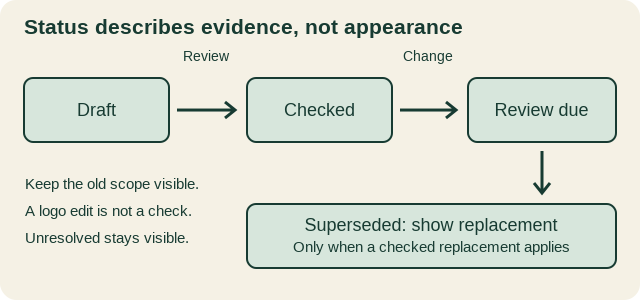
Knowledge-card lifecycle: draft moves through substantive check to checked; a changed condition makes review due; a replacement creates a clearly linked superseded copy.
Original teaching lifecycle, not a universal standard. A cosmetic edit never substitutes for a substantive review.

Read the status, not the filename

The older card can remain available with a superseded notice and replacement link. If the new format has not been checked, the card is review due rather than silently current.

Sketch & check

Draw the status change when a card-format update invalidates the last review. Label the owner and what the reader sees meanwhile.

Show diagram-practice feedback

Checked becomes review due for the changed format. The owner arranges a substantive check, the old scope remains visible and a new checked date is recorded only after the check occurs.

STEP 4 OF 6

Try it yourself

Use only these fictional inputs. Practice 1: Write a lifecycle entry for a checked small-card rule after the card format changes. Include status, owner, review trigger and what the reader should see. Practice 2: An old example remains widely linked after a replacement is checked. Propose a retirement approach that does not destroy unique history or imply a legal retention rule. Complete the three explained checks. Keep your first attempt on paper or in an existing local file before revealing the model.

Fictional exercise · prewritten feedback, no live AI grading.

Write your answer on paper or in your own notes, then compare the options and worked answer.

Check 1: What should advance a substantive checked date?

A. Moving a file into a new folder

Not correct. Moving a resource changes its location but does not verify whether its content is correct.

B. Changing the logo colour

Not correct. A cosmetic edit is not evidence that the underlying rule or its scope was reviewed.

C. A search engine finding the file

Not correct. Discovery by a search engine supplies no substantive confirmation from an appropriate reviewer.

D. An actual recorded review of the relevant content and scope

Correct. The date should represent the check performed, with any limits or unresolved issues retained.

Check 2: Which is the best first response to apparently conflicting limits?

A. Use whichever file has the longest title

Not correct. Title length provides no evidence about scope, currency or the authority of a rule.

B. Delete both files immediately

Not correct. Immediate deletion can lose useful evidence and does not resolve the underlying question.

C. Compare scope, substantive review evidence and the responsible authority

Correct. The limits may concern different cases or versions; those distinctions must be checked before selecting guidance.

D. Average the two numbers

Not correct. Averaging incompatible rules invents a new rule that neither source authorises.

Check 3: What does a superseded notice need to help a future reader?

A. Only the word final in capital letters

Not correct. This wording does not identify a replacement and can increase confusion about the resource’s status.

B. A clear replacement route and explanation of the relevant scope change

Correct. The notice helps a reader reach current guidance while understanding why the older resource should not govern this case.

C. A guarantee that no historical copy is ever needed

Not correct. Historical copies may have legitimate uses or retention requirements that this exercise cannot decide.

D. The private passwords of the former owner

Not correct. A knowledge record must not expose credentials; use an appropriate role-based help route instead.

STEP 5 OF 6

Worked answer & self-check

Practice 1: Status: review due for the changed format. Owner: editor role, with layout reviewer checking the relevant scope. Trigger: card-format change. Reader notice: the previous check covers the old format only; do not treat it as approval for the new format. Link the last checked resource with its limited scope and record a new checked date only after the substantive review occurs. Partial-credit self-review: 4 points: 1 updates status; 1 assigns ownership and review; 1 uses the actual trigger; 1 displays the scope boundary without fabricating a new check. Practice 2: Mark the old example superseded and link to the replacement’s stable index entry. Explain which scope changed and retain its identifier so old links are interpretable. Ask the responsible owner to apply the organisation’s actual retention and access requirements before archiving or deleting anything. Verify important incoming links and update the index rather than silently removing unique material. Partial-credit self-review: 4 points: 1 clear superseded label; 1 current replacement link; 1 preserves identity and checks links; 1 defers retention/deletion to applicable authorised rules. What should advance a substantive checked date? A. Moving a file into a new folder — Not correct. Moving a resource changes its location but does not verify whether its content is correct. B. Changing the logo colour — Not correct. A cosmetic edit is not evidence that the underlying rule or its scope was reviewed. C. A search engine finding the file — Not correct. Discovery by a search engine supplies no substantive confirmation from an appropriate reviewer. D. An actual recorded review of the relevant content and scope — Correct. The date should represent the check performed, with any limits or unresolved issues retained. Which is the best first response to apparently conflicting limits? A. Use whichever file has the longest title — Not correct. Title length provides no evidence about scope, currency or the authority of a rule. B. Delete both files immediately — Not correct. Immediate deletion can lose useful evidence and does not resolve the underlying question. C. Compare scope, substantive review evidence and the responsible authority — Correct. The limits may concern different cases or versions; those distinctions must be checked before selecting guidance. D. Average the two numbers — Not correct. Averaging incompatible rules invents a new rule that neither source authorises. What does a superseded notice need to help a future reader? A. Only the word final in capital letters — Not correct. This wording does not identify a replacement and can increase confusion about the resource’s status. B. A clear replacement route and explanation of the relevant scope change — Correct. The notice helps a reader reach current guidance while understanding why the older resource should not govern this case. C. A guarantee that no historical copy is ever needed — Not correct. Historical copies may have legitimate uses or retention requirements that this exercise cannot decide. D. The private passwords of the former owner — Not correct. A knowledge record must not expose credentials; use an appropriate role-based help route instead. Keep your first attempt, explain one correction and try the changed case again. These are prewritten models, not automated or instructor grading. A defensible alternative may earn the stated criteria without matching this wording.

Compare your answer

  • 4 points: 1 updates status; 1 assigns ownership and review; 1 uses the actual trigger; 1 displays the scope boundary without fabricating a new check.
  • 4 points: 1 clear superseded label; 1 current replacement link; 1 preserves identity and checks links; 1 defers retention/deletion to applicable authorised rules.
  • Distinguishes supplied facts from assumptions, missing knowledge and proposed tests.
  • Makes a specific revision; does not treat a model or a review mark as observed performance.

Give yourself one check for each point your work meets. Revise any missing piece. This is a self-check, not a score sent to a teacher.

STEP 6 OF 6

Recap & next step

  • Separate contribution, ownership and substantive review.
  • Use both scheduled and event-based review triggers.
  • Resolve conflicts visibly; retire resources without careless deletion.

Save useful notes privately if wanted. Review marks record review only; Show all reveals text, not completed exercises or a tested handoff. Use the project pack to carry this lesson into your knowledge-handoff kit.

Next lesson: Test use and finish the handoff kit →

LESSON 8 OF 8 · PLANNED 210 MINUTES

Test use and finish the handoff kit

STEP 1 OF 6

Your objective

Combine the course into a knowledge-handoff kit and interpret limited test evidence honestly.

STEP 2 OF 6

The idea

A knowledge system should be judged by the work it supports, not only by how much material it contains. Counts of files, visits or meeting attendees can describe activity and reach. They do not establish that people found the correct answer, applied it appropriately or avoided a recurring problem. Choose a small set of measures tied to the original task and define what each measure can and cannot tell you.

For a fictional caption handoff, measure retrieval success as the number of defined tasks in which the correct current resource and scope were identified, divided by the number attempted. Record the numerator and denominator, assistance and task version. A time measure needs a start, an end and a rule for unsuccessful attempts; otherwise fast wrong answers can look like improvement. Note an unresolved attempt explicitly rather than discarding it from the denominator.

Compare like with like and avoid causal overclaims. If six of eight retrieval tasks succeeded before an index revision and seven of eight after, the observed result is 75% and 87.5%, a 12.5 percentage-point increase. Different task difficulty, prior exposure or help could explain the change. It is not evidence of a guaranteed 12.5% productivity gain. A tiny scripted self-test is especially limited and should be described as such.

The capstone assembles a practical knowledge-handoff kit using only the original fictional case inputs in the downloadable pack. Create a flow and risk map, two checked-scope knowledge cards, a task index with synonyms, a capture note, a sharing plan, an ownership and lifecycle table, and an acceptance record. Include an open issue and a clear temporary boundary rather than pretending everything is known. The worked model illustrates one defensible kit; it is not a real team’s completed handoff.

Perform the scripted self-test before comparing your kit with the model, revise the defects and rerun the affected task. Record actual outcomes in the blank log; printed model outcomes are illustrations, not your results. Use the 100-point rubric for partial-credit self-review, not a course-wide pass mark or qualification. Proposed lesson time includes project construction and revision and is unpiloted. No expert review or independent learner validation has been performed. If a real project later requires interviews or sharing, obtain the appropriate permission and handling arrangements first; this course requires neither.

STEP 3 OF 6

Original worked example

Starting point

A fictional team reports 120 downloads and says its new knowledge base “eliminated confusion”. In a small scripted test, six of eight tasks initially found the right current answer; after revising labels, seven of eight did. How should the report change?

A checkable approach

Report downloads as reach, not proof of understanding. The scripted retrieval test changed from 6/8 (75%) to 7/8 (87.5%), an increase of 12.5 percentage points. Preserve the failed task and record any help, changed task wording or prior exposure. Say the revised labels were associated with a better result in this small exercise, not that confusion was eliminated or that the labels alone caused the difference. Next investigate the remaining failed task and test its revision.

All people, roles, records and results in this case are fictional. First try an answer privately; then compare the reasoning, not just the wording.

STEP 4 OF 6

Try it yourself

Use only these fictional inputs. Practice 1: Calculate and interpret a fictional test changing from 3 correct tasks out of 5 attempted to 4 out of 5. Include one limitation and one next action. Practice 2: Complete the knowledge-handoff kit using the linked project pack. Before opening WORKED MODEL, produce your first attempt and run the four SCRIPTED SELF-TEST tasks. Describe what an honest unfinished record looks like. Complete the three explained checks. Keep your first attempt on paper or in an existing local file before revealing the model.

Fictional exercise · prewritten feedback, no live AI grading.

Write your answer on paper or in your own notes, then compare the options and worked answer.

Check 1: What is the strongest interpretation of 120 downloads?

A. The resource was downloaded 120 times; correct use remains untested

Correct. Downloads measure an activity, not whether readers selected, understood or applied the relevant knowledge correctly.

B. Exactly 120 people mastered the content

Not correct. Downloads may repeat and do not supply evidence of individual mastery or task success.

C. Every future knowledge gap is solved

Not correct. An activity count cannot rule out unresolved or newly emerging knowledge needs.

D. The resource needs no further maintenance

Not correct. Resource currency and ownership remain necessary regardless of how often it is downloaded.

Check 2: A test rises from 6/8 to 7/8. What is the absolute rate change?

A. A guaranteed 12.5% productivity increase

Not correct. The observation concerns task success, not productivity, and does not establish a guaranteed causal effect.

B. 12.5 percentage points in this task-success rate

Correct. The success rates are 75% and 87.5%; their absolute difference is 12.5 percentage points.

C. One hundred percentage points

Not correct. Only one additional task out of eight succeeded, not the entire set changing from none to all.

D. No change because the sample is small

Not correct. A small sample limits interpretation but does not erase the observed numerical difference.

Check 3: What should an unperformed acceptance task show?

A. Pass, because the worked model passed it

Not correct. A model result is illustrative and cannot stand in for an attempt that was never performed.

B. A plausible invented duration

Not correct. A made-up duration misrepresents the evidence and prevents honest interpretation of the test.

C. NOT RUN, with the pending task and reason or next action

Correct. The record remains useful without fabricating a result or claiming acceptance that has not occurred.

D. No entry so the remaining results look complete

Not correct. Omitting unperformed tasks hides missing evidence and can falsely inflate apparent coverage.

STEP 5 OF 6

Worked answer & self-check

Practice 1: The rates are 3/5 = 60% and 4/5 = 80%, a 20 percentage-point increase. That is one additional successful task in a five-task set, not a guaranteed productivity increase. The same person’s prior exposure or a change in assistance may affect the comparison. Keep the failed task, inspect its query and resource selection, revise the identified defect and rerun it with the actual result recorded. Partial-credit self-review: 4 points: 1 for both correct rates; 1 for 20 percentage points rather than an unsupported productivity claim; 1 plausible limitation; 1 failure-focused next action. Practice 2: An honest kit contains all seven requested artefact groups, identifies the unresolved layout judgement and unassigned backup role, and leaves unperformed test results as NOT RUN. Record actual self-test outcomes, assistance and revisions without copying illustrative model results. Use the seven-category 100-point rubric to award only criteria your own kit meets. The supplied model is one worked solution, not evidence that a real successor accepted your handoff. Partial-credit self-review: 4 points for this lesson checkpoint: 1 first-attempt artefacts; 1 visible open risks and boundaries; 1 honest actual or NOT RUN record; 1 criterion-based partial-credit review. The full project uses its separate 100-point rubric. What is the strongest interpretation of 120 downloads? A. The resource was downloaded 120 times; correct use remains untested — Correct. Downloads measure an activity, not whether readers selected, understood or applied the relevant knowledge correctly. B. Exactly 120 people mastered the content — Not correct. Downloads may repeat and do not supply evidence of individual mastery or task success. C. Every future knowledge gap is solved — Not correct. An activity count cannot rule out unresolved or newly emerging knowledge needs. D. The resource needs no further maintenance — Not correct. Resource currency and ownership remain necessary regardless of how often it is downloaded. A test rises from 6/8 to 7/8. What is the absolute rate change? A. A guaranteed 12.5% productivity increase — Not correct. The observation concerns task success, not productivity, and does not establish a guaranteed causal effect. B. 12.5 percentage points in this task-success rate — Correct. The success rates are 75% and 87.5%; their absolute difference is 12.5 percentage points. C. One hundred percentage points — Not correct. Only one additional task out of eight succeeded, not the entire set changing from none to all. D. No change because the sample is small — Not correct. A small sample limits interpretation but does not erase the observed numerical difference. What should an unperformed acceptance task show? A. Pass, because the worked model passed it — Not correct. A model result is illustrative and cannot stand in for an attempt that was never performed. B. A plausible invented duration — Not correct. A made-up duration misrepresents the evidence and prevents honest interpretation of the test. C. NOT RUN, with the pending task and reason or next action — Correct. The record remains useful without fabricating a result or claiming acceptance that has not occurred. D. No entry so the remaining results look complete — Not correct. Omitting unperformed tasks hides missing evidence and can falsely inflate apparent coverage. Keep your first attempt, explain one correction and try the changed case again. These are prewritten models, not automated or instructor grading. A defensible alternative may earn the stated criteria without matching this wording.

Compare your answer

  • 4 points: 1 for both correct rates; 1 for 20 percentage points rather than an unsupported productivity claim; 1 plausible limitation; 1 failure-focused next action.
  • 4 points for this lesson checkpoint: 1 first-attempt artefacts; 1 visible open risks and boundaries; 1 honest actual or NOT RUN record; 1 criterion-based partial-credit review. The full project uses its separate 100-point rubric.
  • Distinguishes supplied facts from assumptions, missing knowledge and proposed tests.
  • Makes a specific revision; does not treat a model or a review mark as observed performance.

Give yourself one check for each point your work meets. Revise any missing piece. This is a self-check, not a score sent to a teacher.

STEP 6 OF 6

Recap & next step

  • Measure task success with denominators and conditions.
  • Keep failures and incomplete tests visible.
  • Finish a usable, revisable kit—not a promise of universal competence.

Save useful notes privately if wanted. Review marks record review only; Show all reveals text, not completed exercises or a tested handoff. Use the project pack to carry this lesson into your knowledge-handoff kit.

Revisit the course → · Choose another course →

Sources & learning limits

Examples, exercises and worked answers are original fictional teaching material. Source checks inform the factual explanations; these organisations do not endorse this course.

This independent course is general education, not accreditation, a degree, professional advice or a promise of competence. No institutional affiliation or endorsement is implied. The illustrated setting is fictional.