LESSON 1 OF 24 · PLANNED 150 MINUTES
Customers, problems and payers
STEP 1 OF 6
Your objective
Build a customer–problem–payer map that separates use, choice, payment and affected interests, then explain what must be true for an offer to help someone and sustain an organization.
STEP 2 OF 6
The idea
A business offers something people or organizations find useful and arranges resources to keep delivering it. This includes a service, a product maker and many social enterprises; it does not mean every useful activity must become a business. A business model explains value creation, delivery and continuing resources. Start with people and their difficulty. A clever product description can hide the absence of a pressing reason to use or fund it.
A customer is not always one person playing every role. The user experiences the offer; the chooser selects it; the payer provides money. One adult buying a notebook may fill all three roles. In a fictional workplace meal service, employees eat, a coordinator chooses the supplier and the employer pays. Preferences, ordering effort and spending limits all matter. Satisfying only one role can fail even when the food is excellent.
A problem is a difficulty accomplishing something in a particular situation. “People need our app” names a solution. “Volunteer coordinators lose track of last-minute shift changes” identifies an activity and difficulty, but still needs boundaries: which coordinators, how often, and with what consequences? These distinguish an irritation from a problem someone will act to solve. Consequences can include lost time, uncertainty and exclusion as well as money.
Need does not establish willingness or ability to pay. Someone may urgently need a service and lack money, authority or access to purchase it. An organization may pay to remove administrative work users barely notice. A nonprofit can connect beneficiaries with a separate funder; a cooperative can combine member use, control and funding. Each arrangement still needs an explanation of why its resource providers will support continuing delivery.
Build a map with each important role, its desired result, current difficulty and unresolved assumptions. Include affected nonpayers: a repair collection service may help commuters while adding work for reception staff. A matching platform may help buyers and sellers while increasing moderation work. Calling the payer the “real customer” erases these dependencies. Payment gives one role influence, but other people can determine whether delivery works.
Scope makes the map useful. “All bicycle owners” includes different skills, schedules and alternatives; “commuters at one office with difficult workshop access” is an investigable starting group. Label observations, interpretations and unknowns; /school/evidence-sources-syllabus.html refreshes that shared skill. The distinctive task here is mapping business roles. “The user benefits, but no continuing payer is identified” is a useful finding, not something a slogan can repair. Use only the supplied fictional material.
STEP 3 OF 6
Fictional case: Cedar Repair pickup service
Starting point
Cedar proposes office-lobby collection and next-afternoon bicycle return. Its founder writes: “Anyone who likes convenience is our customer; the employer will pay.” No employer agreement or employee purchasing record is supplied.
A checkable approach
Map commuters as users and possible individual payers; the office coordinator as an access decision-maker; and the employer as a possible, unconfirmed payer. Reception staff bear possible handover work. The problem hypothesis concerns workshop hours conflicting with commuters’ schedules.
This exposes three unknowns: whether the difficulty matters enough, who pays and whether lobby collection is workable. Employer payment remains a hypothesis.
Read the diagram
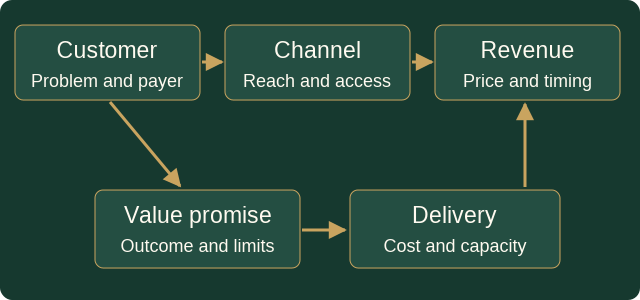
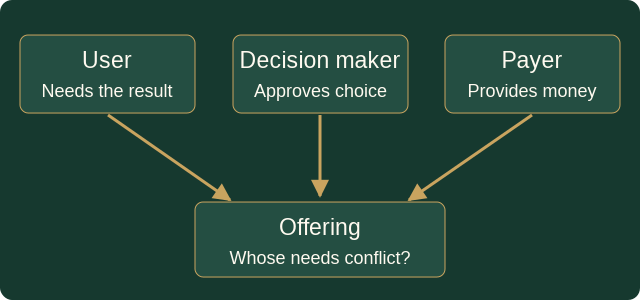
Different people may use, choose and pay for one offering. Trace each relationship and explain one assumption that could make the conclusion fail.
Sketch & check
Describe this diagram in words without relying on colour. Name one input, one relationship and one limitation.
Show diagram-practice feedback
A fictional repair offer separates user, decision maker and payer; each connects to the offering and can impose a different constraint. A sound response distinguishes the given relationship from evidence that a real business can deliver it.
STEP 4 OF 6
Try it yourself
Spend 25 minutes mapping commuter, employer, office coordinator, reception staff and repair worker: role, desired result, possible burden and unknown. Then write two arrangements: employees pay individually, or the employer buys a defined benefit. Explain which roles change. Select a response below, then review your own map against every rubric criterion. Revise two claims that exceed the supplied facts and retain the revision. Use paper or local notes; no external contact is required.
Fictional exercise · prewritten feedback, no live AI grading.
Write your answer on paper or in your own notes, then compare the options and worked answer.
Guided practice
Fictional case: a center lends reading lamps to residents; a foundation funds the first batch, volunteers manage loans and the center selects the design. Identify roles and two continuation questions.
Optional hint 1
Separate the first purchase from the resources needed for future lending.
Optional hint 2
A volunteer role can affect continuation without becoming a paying-customer role.
Compare the explained guided answer
Residents use, the center chooses and the foundation initially funds the lamps. Volunteers deliver the process. Who funds replacements, and is continuing volunteer time available? Initial funding does not establish a continuing payer. Other questions work when connected to sustaining delivery.
Independent transfer
Fictional case: a tutoring marketplace offers free learner search and paid tutor listings. Explain why “only tutors matter because they pay” is incomplete.
Keep your attempt before opening the explanation. Reading an answer is different from producing your own response.
Compare the explained transfer answer
Tutors might want suitable inquiries with manageable administration; learners might want available teaching that fits their needs. These are hypotheses. Tutor payment may depend on learner participation, while learners need useful listings. The marketplace also needs to manage inaccurate listings. Naming two groups is incomplete without explaining that dependence.
Check 1: Who pays in the supplied Cedar proposal?
A. The employer has committed
No commitment is supplied.
B. The payer is unresolved
Correct. Individual and employer payment remain possibilities.
C. Reception staff must pay
Being affected does not establish payment responsibility.
Check 2: Which statement describes a problem?
A. Buy our collection service
This names a solution.
B. Workshop hours conflict with some commuters’ schedules
This identifies a difficulty in a situation.
C. Everyone values innovation
This is broad and unsupported.
Check 3: Why include affected nonpayers?
A. They can influence delivery and bear burdens
Correct. Payment is only one relevant role.
B. They automatically become purchasers
Being affected does not establish demand.
C. Their interests always match the payer’s
Different roles can have conflicting needs.
STEP 5 OF 6
Worked answer & self-check
A defensible map gives commuters the user role and a possible benefit of avoiding a workshop trip. Its importance remains unconfirmed. The employer is a possible payer, not a committed one. The coordinator may control access; reception staff may bear handover work; repair workers need bicycles, instructions and resources arranged for reliable delivery. With individual payment, commuters choose and pay while the office permits access. With employer funding, the employer could choose and pay for a defined scope while employees decide whether to participate. Neither arrangement automatically supplies reception support. Explain these responsibilities rather than merely replacing one payer’s name. Other maps work when hypothetical roles remain labelled. “Everyone benefits, so everyone is a customer” is insufficient: identify each benefit, burden and unknown. Revise unsupported commitments into assumptions. Choosing an option does not grade your map; the worked answer supports your own review.
Compare your answer
- Role accuracy: separates user, chooser, payer and affected participant; overlapping roles are explained rather than assumed.
- Problem specificity: describes an activity and difficulty for a bounded group without defining the problem as buying Cedar’s service.
- Assumption control: labels employer payment, access and the importance of convenience as unconfirmed; does not invent support.
- Connected reasoning: explains how two payment arrangements alter responsibilities and incentives while retaining delivery burdens.
- Revision evidence: identifies two changed claims and explains how each revision makes the map more faithful to the supplied case.
Give yourself one check for each point your work meets. Revise any missing piece. This is a self-check, not a score sent to a teacher.
STEP 6 OF 6
Recap & next step
Retrieve, then revisit
Without looking back, distinguish user, chooser and payer. Give one fictional case where the roles differ, then name an affected nonpayer.
Revisit in course week(s) 2, 5, 9; later dates are review visits, not extra required course slots.
Check the retrieval explanation
A user experiences the offer, a chooser selects it and a payer supplies money. In an employer-funded meal service, employees use, a coordinator chooses and the employer pays. Cleaning staff may be affected by delivery and packaging. Equivalent examples work when each role is explicit.
- Use, choice and payment can belong to different people.
- A meaningful need does not establish a paying customer.
- People outside the sale can still determine whether delivery works.
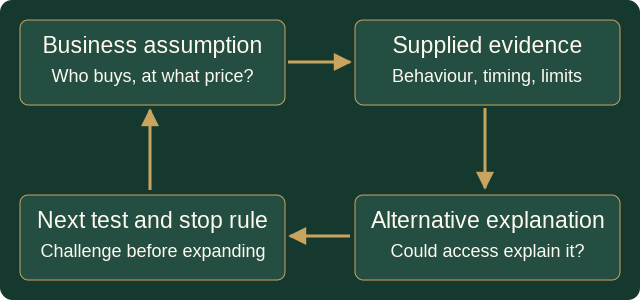
Keep the revised map. In the next lesson, use it to judge whether a fictional observation provides evidence of demand or only evidence that someone noticed an offer.
Next lesson: Evidence of demand: interest, action and commitment →